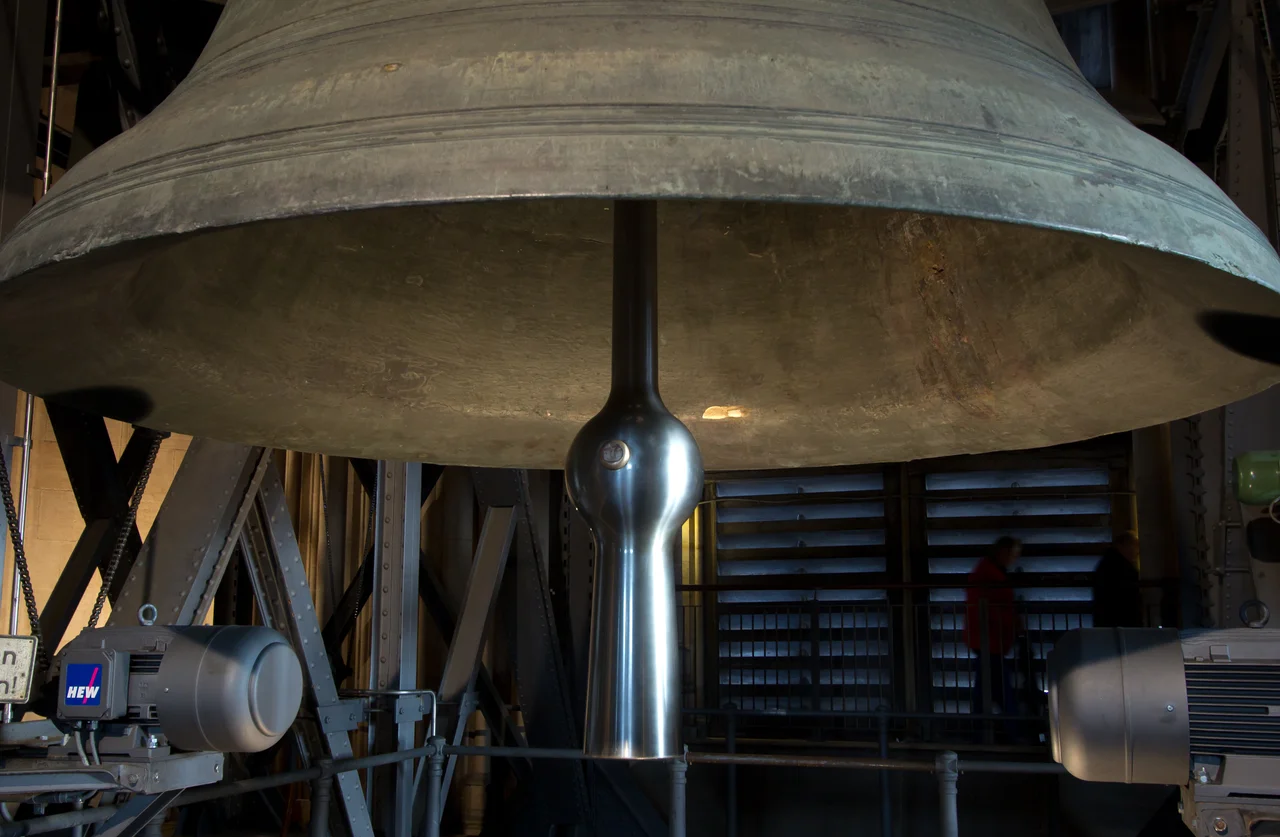

Petersglocke
On the night of 6 January 2011, the clapper of the Petersglocke broke loose at the top of Cologne Cathedral's south tower and fell. The four earthquake sensors built into the cathedral structure all registered the impact. The clapper weighed about 700 kilograms; the bell it had been striking weighs around 24 tons and measures 3.22 metres across — the second largest free-swinging bell in the world, surpassed only by the bell hung in Bucharest's People's Salvation Cathedral. Cologners call her the Dicker Pitter, "Fat Peter," with the kind of affectionate roughness reserved for things you have known your whole life. For most of 2011, Fat Peter was silent. Then in December a new clapper was installed, and on 7 December she rang again.
Cast in a Country That Could Not Pay
The Petersglocke was cast on 5 May 1923 in the small Thuringian town of Apolda, in the foundry of Heinrich Ulrich. Weimar Germany was in the middle of its hyperinflation, and the bell-founder refused to accept payment in German marks — by the time he could deposit them they would be worth nothing. So the Cologne Cathedral chapter paid him in U.S. dollars, $5,000 in all. The new bell was replacing the Kaiserglocke, a 27-ton imperial bell from 1873 that had been melted down in 1918 to make weapons for the First World War, and had been disliked anyway: its sound had never come out right despite repeated attempts to fix it, earning it the nickname Große Schweigerin, "the great silent one." The new bell was funded by the German Reich, the Prussian state, and a public petition signed by 68 prominent Cologne citizens — a quiet act of civic stubbornness in a country falling apart financially.
Voices She Has Marked
The Petersglocke does not ring often. She is reserved for solemnities, for the death of an Archbishop of Cologne or of a Pope, and for the moments in German history that the cathedral chooses to recognise. She rang on 1 February 1926, at midnight, when the Allied occupation of the Cologne zone ended. She rang above the ruins of the city in 1945 to announce the end of the Second World War. She rang in 1990 for the reunification of Germany. There is a darker entry too: all of the cathedral's bells were rung on the eve of 28 March 1936, for a Friedensappell, a "peace appeal," that Adolf Hitler made in Cologne ahead of the Reichstag elections. Bells do not choose what they are rung for. The Petersglocke has rung for liberations and dictatorships, deaths and weddings, the inauguration of new archbishops, and her own birthdays.
Cracks, Clappers, and Repairs
In 1951 a crack 110 centimetres long appeared in the bell. The Lachenmeyer bell workshop from Nördlingen welded it in 1956 and fitted a lighter clapper of roughly 600 kilograms. They rotated the bell about 20 degrees so the new clapper would never strike the welded scar. That repair held for half a century before the more spectacular failure of 6 January 2011, when the clapper broke off entirely. Investigators eventually traced the accident back to the 1950s installation — the clapper had been mounted slightly wrong, and the asymmetric wear had eaten through the metal across decades. A new 600-kilogram clapper, 3.20 metres long, was cast and installed on 2 December 2011. Two new electric ringing motors were fitted at the same time, slowed from 750 to 500 rpm to match the new clapper. The bell first rang again on 7 December. Five days later she rang for the Feast of the Immaculate Conception.
The Symphony of the Cathedral Bells
On 5 May 2023 the Petersglocke turned 100 years old, and Cologne staged a bell concert in her honour — what the cathedral's musicians called the "Symphony of the Cologne Cathedral Bells," a six-movement programme that worked through the cathedral's history before bringing all twelve of its bells into the final movement together. By rule, when the Petersglocke does ring, she rings alone for ten minutes before the others join in. The system is hierarchical: not every cathedral bell rings every time. For Christmas Eve Vigil, bells 1 through 3 sound. For the Feast of the Immaculate Conception, bells 1 through 6. For the very largest occasions, all twelve, with Fat Peter holding the bottom note — a low C that drifts out over the Rhine and is, for many Cologners, the sound of the city telling itself that something has happened.
From the Air
The Petersglocke hangs in the south tower of Cologne Cathedral, at roughly 50.941°N, 6.957°E, at the cathedral's southwest corner. The cathedral's twin spires are the dominant landmark of central Cologne from any altitude, immediately west of the main railway station and the Rhine. Nearest airport is Cologne Bonn (EDDK / CGN), 14 km southeast across the river.
Nearby Stories
- Diamond Interchange: How a Simple Idea Reshapes Towns Like Julich 2.8 km away
- Dusseldorf-Unterbach 6.1 km away
- Baumwollspinnerei Ermen & Engels 11 km away
- RAF Bruggen 15 km away
- Hagen Open-air Museum 21 km away
- Belgium 130 km away
- Marcinelle Mining Disaster 173 km away
- Zwingenberg Castle 178 km away