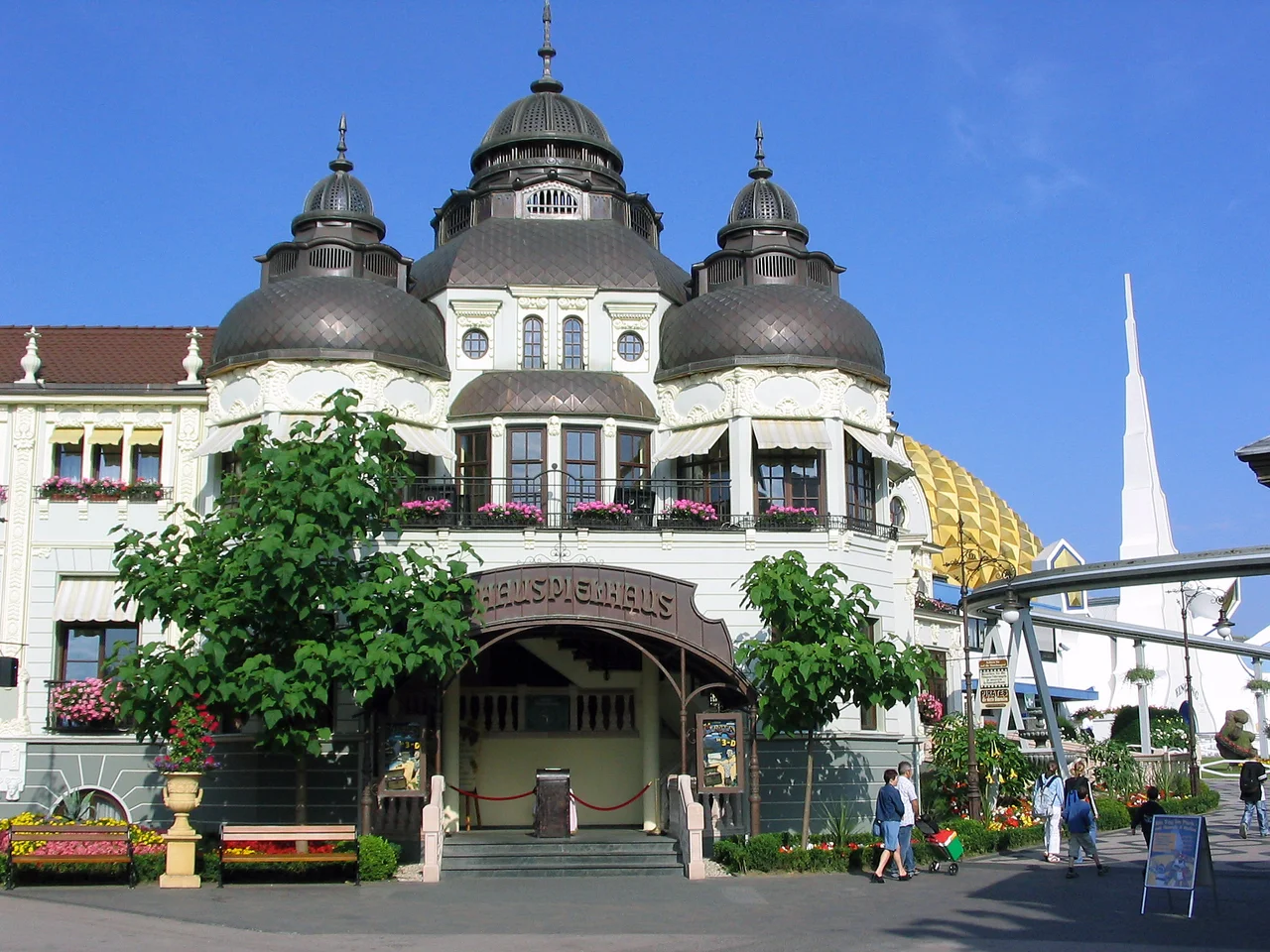

Phantasialand
Most theme parks have one problem: they can always build more. Phantasialand has the opposite problem. Wedged into a parcel of land in Brühl, just outside Cologne, the park has nowhere to expand. So instead of growing outward, it eats itself - demolishing perfectly good rides every few years to make room for whatever it has decided to obsess over next. The result, opened in 1967 by Gottlieb Löffelhardt and Richard Schmidt, is a German theme park that European coaster enthusiasts speak about the way wine people speak about Burgundy.
Themed to Within an Inch of Its Life
Walk into the Klugheim section and you do not see a roller coaster with rocks around it. You see a basalt valley with a roller coaster threading through it - a Norse-flavored canyon of weathered stone columns that took years to build. The same obsessive logic governs Deep in Africa, where the Black Mamba inverted coaster snakes through a faux-savannah village, and Mexico, where Chiapas pours through a mountainscape of dripping vines and stone temples. Phantasialand does not separate the ride from the world around it. The two are constructed together, and the boundary between queue and attraction often disappears entirely.
The Fire That Reshaped Everything
On May 1, 2001, a cable fire in the Grand-Canyon-Bahn destroyed two roller coasters, a theatre, and parts of the Westernstadt. Fifty-four people were injured. Damage came to about 38 million Deutsche Mark, around 17 million US dollars. The park reopened in two weeks, but the burned land became the seed of a different Phantasialand. River Quest, a rapids ride engineered around the lost footprint, used two lifts instead of a hill because there simply was not enough space for the traditional design. After the fire, every building got sprinkler systems. The park invested about two million euros in fire safety - a quiet, expensive vow to a kind of disaster that visitors would never see and rarely think about.
Michael Jackson Cut the Ribbon
Colorado Adventure, a Vekoma mine train coaster that opened in 1996 in the park's Wild West section, had an unusually famous opening guest: Michael Jackson, who was friends with the park's owners and a known theme-park enthusiast. He arrived with an entourage, posed for photographs, rode the coaster. Decades later, the section's western themeing has changed twice - Silver City and the Silbermine dark ride were both demolished in 2014 to make room for Klugheim - but Colorado Adventure still runs, weaving between the mountains it was built into. The mine train remains a Phantasialand artifact, surviving while everything around it gets reinvented.
Hotels You Walk Through to Reach the Coaster
Hotel Ling Bao opened in 2004 with roof tiles imported from China and hand-engraved doors on every room. Matamba arrived in 2008, three stars, themed to Deep in Africa. In 2020 came the Hotel Charles Lindbergh in the new Rookburgh district - the only park hotel in the world where a roller coaster, F.L.Y., dives around your bedroom window. The hotels are not amenities. They are part of the theming. Guests who stay overnight enter the park through the hotel's own gates, in some cases without ever passing through the main entrance, immersed before they even buy a ticket.
The Constraint Made the Park
Two million visitors a year file into a footprint that would barely qualify as a medium-sized municipal park elsewhere. The cramped geography forces Phantasialand to do what other parks do not have to: tear down to build up. Crazy Bats from 1988, Talocan from 2007, Verrücktes Hotel Tartüff from 2012, Taron and Raik in 2016, F.L.Y. in 2020 - each new world arrived because something else was demolished or absorbed to make room. The result is a park where almost nothing has been standing for more than a generation, but where the level of craft on what does exist is higher than nearly anywhere else in Europe. Constraint, here, has been the great creative discipline.
From the Air
50.80N 6.88E. The park is in Brühl, North Rhine-Westphalia, about 12 km southwest of Cologne. Nearest airport: Cologne/Bonn (EDDK), 12 km. From cruising altitude visible as a tight cluster of themed structures and water features among suburban fields, with the Lindbergh hotel tower in the new Rookburgh quarter as a recognizable landmark.
Nearby Stories
- Baumwollspinnerei Ermen & Engels 2 km away
- Battle of Kircheib 3.3 km away
- Federal Office for the Protection of the Constitution 5.4 km away
- Erkelenz 12 km away
- Eilendorf (Aachen) 14 km away
- Marcinelle Mining Disaster 134 km away
- Basilica of Saint-Pierre-aux-Nonnains 156 km away
- Zwingenberg Castle 164 km away