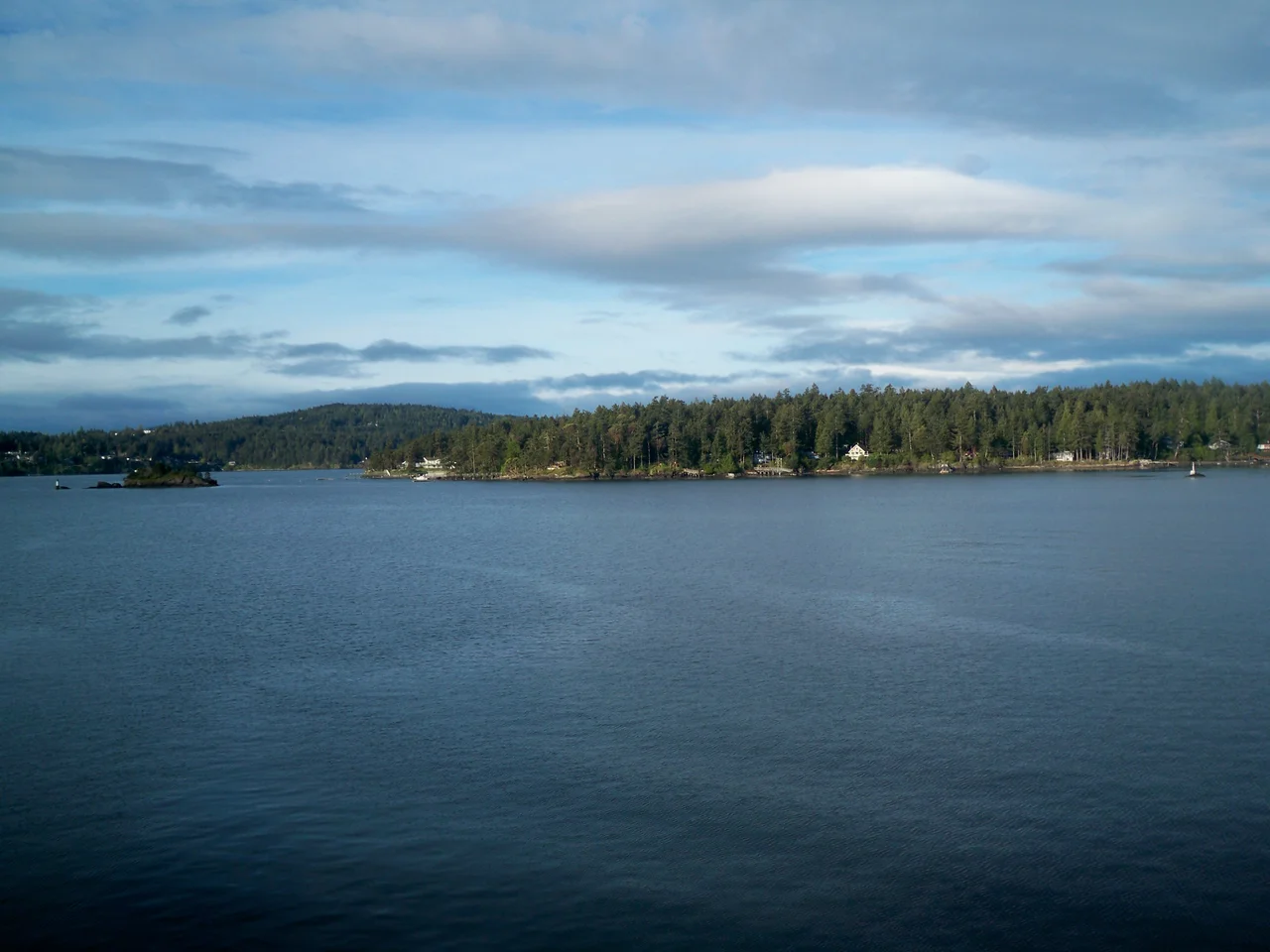

Piers Island
Piers Island covers less than a square mile. There are no public roads on it, no cars to speak of, and the way across is a small boat. For three years in the 1930s, this small piece of ground held a federal penitentiary containing more than six hundred people - men and women whose criminal offence had been to take off their clothes in public as an act of religious protest. Nothing on the island today announces that. It is one of the strangest and least-visited chapters in British Columbia's history, and it happened within sight of the Swartz Bay ferry terminal.
A Surgeon's Name on the Chart
The island sits in Satellite Channel, the passage that links Saanich Inlet in the west to Colburne Passage and Haro Strait in the east. Haro Strait carries the Canada-United States border here, separating British Columbia's Gulf Islands - of which Piers is one - from Washington's San Juan Islands, and forming part of the Inside Passage, the sheltered marine route running north toward Alaska. Shute Passage divides Piers from somewhat larger Portland Island to the northeast. The name comes from Henry Piers, a Royal Navy surgeon who served at the Pacific Station at Esquimalt and later rose to Deputy Inspector of Hospitals and Fleets before his death in 1902 - a naval medical officer memorialized, as so much of this coast is, by a nineteenth-century Admiralty chart.
A Protest Without Clothes
The Doukhobors were Russian pacifist Christians who came to Canada at the end of the nineteenth century to escape persecution, many of them settling eventually in the Kootenays as the communal Christian Community of Universal Brotherhood. Within that population, a smaller faction called the Sons of Freedom rejected compromise with the state altogether - refusing land registration, compulsory schooling, and the census - and pressed their case against both government authority and their own community's leadership through nude demonstrations and, at times, arson. Whatever one makes of their methods, the convictions that followed were for indecency. Some 546 Sons of Freedom men and women were found guilty of nude parading and sentenced to three years. Canada then had to find somewhere to put them.
Party by Party
The answer was to build a penitentiary from scratch, in the summer of 1932, on an island nobody else was using. Prisoners arrived from the Kootenays across the second half of that year in a series of escorted parties: a first group of twenty men on August 11, further contingents of about thirty as new barracks were finished, then women beginning November 7 in groups of twenty-seven to forty-eight, the last arriving December 27. By the time the transfers were complete, 579 people had been brought to Piers Island. The facility ran until 1935, and in the end none of the prisoners served the full three years. What remains of the operation is mostly documentary - photographs, prison records, the accounts of descendants who have since come back to walk the ground where their grandparents were held.
The Children Left Behind
The heaviest cost was not paid on the island. With both parents imprisoned in many households, more than 350 Doukhobor children were separated from them - 119 placed in foster homes by the Children's Aid Society of Vancouver, others sent to orphanages and industrial schools. Ottawa deliberately kept them off the formal ward rolls, reasoning that parents should be able to reclaim custody without a court fight once released, but the practical effect was the same: children pulled from their families, their language, and their faith community for the length of their parents' sentences, and some carried the consequences of that separation for the rest of their lives. It is worth stating plainly: a religious minority was imprisoned for a public protest, and their children were taken from them by the state. Whatever the courts of 1932 believed they were doing, the arithmetic is difficult to read any other way.
Golf Carts and Quiet
The prison came down and the island went on to a very different life. Today Piers Island holds about 131 private properties strung along a dirt loop road and a web of walking trails, with no bridge, no causeway, and no public road access at all. Residents get across on a foot ferry to the Swartz Bay government dock or Canoe Cove Marina, or in their own boats. Once ashore, people move around on foot, by bicycle, or in electric golf carts, which have turned out to suit the place better than anything with a combustion engine. The fire hall's training room doubles as the community meeting space and the reading library. It is, by almost any measure, one of the most peaceable small places on this coast - which is exactly what makes the 1930s so hard to picture standing there.
From the Air
Piers Island sits at 48.7000°N, 123.4167°W, immediately north of the Saanich Peninsula at the top of Vancouver Island's southeastern corner. From the air it is easy to pick out: a small, densely wooded island in Satellite Channel just west of the Swartz Bay BC Ferries terminal, with larger Portland Island across Shute Passage to the northeast and the broad opening of Saanich Inlet to the southwest. Ferry wakes converging on Swartz Bay make a reliable pointer. Recommended viewing altitude is 2,000-4,000 ft MSL for island detail, or 8,000 ft to take in the Gulf Islands, Haro Strait, the international boundary, and the San Juan Islands beyond. Victoria International (CYYJ) is roughly 6 nm south, and Victoria Harbour Water Aerodrome (CYWH) about 15 nm southwest; Vancouver International (CYVR) lies approximately 30 nm northeast. This area carries heavy floatplane traffic between Vancouver and the Gulf Islands, and the boundary with United States airspace runs close by to the east. Summer visibility is generally excellent; winter brings low cloud and fog through the channels.
Nearby Stories
- Mesachie Lake 3.6 km away
- Island Rail Corridor 3.9 km away
- Canadian Forces Station Ladner 4.5 km away
- Patos Island Light 5.6 km away
- San Juan Island National Historical Park 6 km away
- Valdes Island 6.4 km away
- Juan de Fuca Marine Trail 11 km away
- Mount Arrowsmith Biosphere Region 19 km away