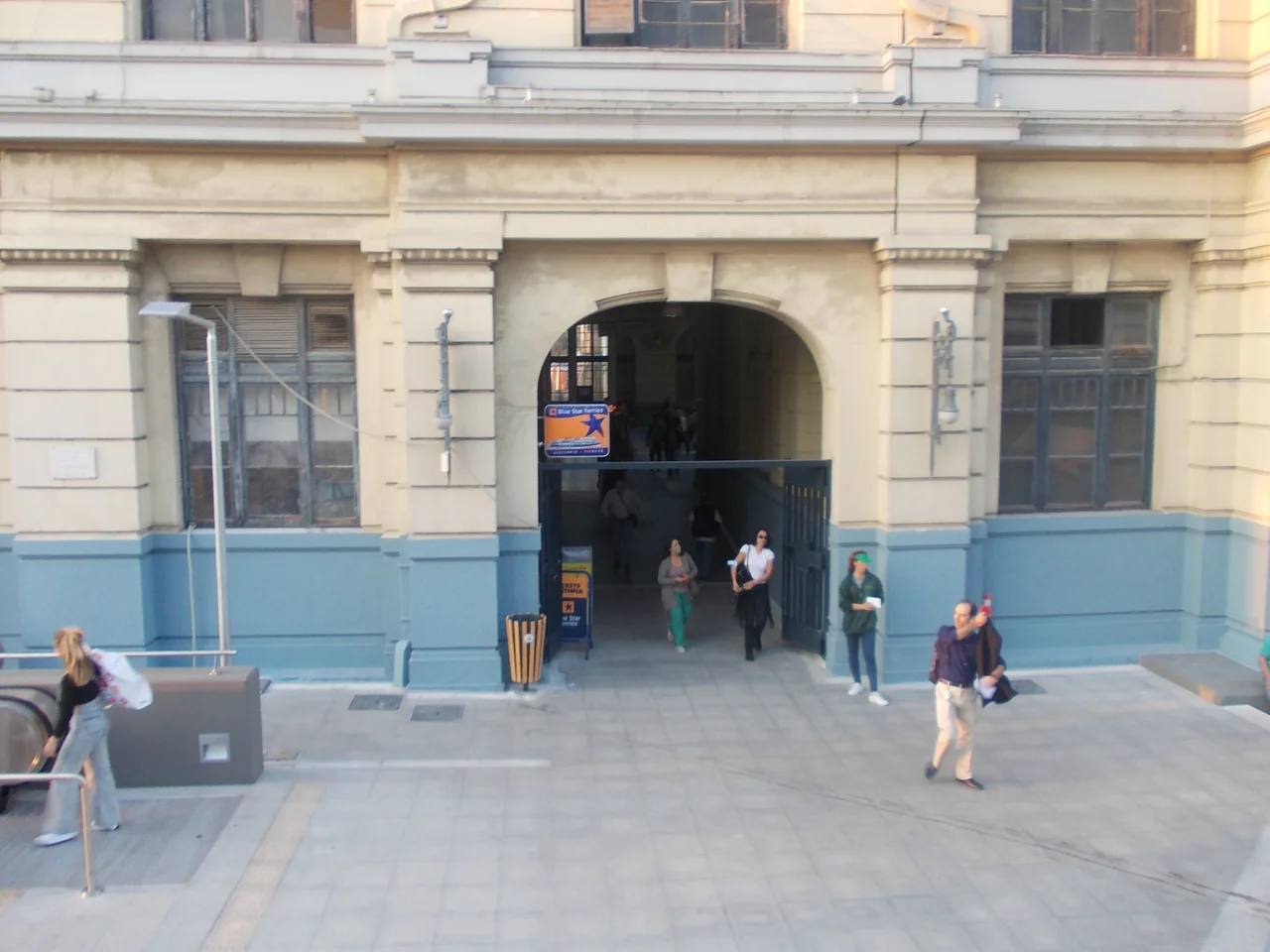

Piraeus Station
Greece's first railway line was not a grand mountain crossing or a connection between major cities. It was a route between Athens and its port, Piraeus — nine kilometres of track laid in 1869 by a company called SAP, linking the capital to the sea. The station that anchors the Piraeus end of that line has stood near the waterfront ever since, in various forms: steam, electric, metro, suburban rail. Two separate station buildings now occupy the site, approximately 9 km southwest of central Athens. Together they handle Metro Line 1 and Line 3, plus suburban rail connections extending east toward the airport and west toward Corinth. Tucked inside the metro station, in the space that once housed the Post Office, is the Electric Railways Museum of Piraeus — a quiet collection documenting the 150-year history of the line whose terminus you are standing in.
Greece's First Railway
When the Athens-Piraeus line opened in 1869, Piraeus was not yet considered part of Athens in any administrative sense; the railway was an intercity connection between two separate settlements. The line ran as a conventional steam, single-track mixed cargo and passenger service, the first in Greece. It was electrified in 1904. The current metro station building for Line 1 — the surface-level station, a tile-clad structure at the waterfront — dates to 30 June 1928, constructed by the EIS company that had by then taken over operations. For a century and a half, commuters have arrived at this building and stepped into the noise and salt-air of the port. The station's position next to the ferry terminal means that millions of travellers pass through it: islanders heading home to Crete, Mykonos, and Rhodes; tourists arriving with rolling luggage; workers commuting from the suburbs at dawn.
Occupation, Damage, Recovery
The railway through Piraeus did not escape the Second World War intact. During the Axis occupation of Greece from 1941 to 1944, German military forces controlled Athens, and the rail network was used for the transport of troops and supplies. During the German withdrawal in 1944, the network was severely damaged — by both the retreating German army and by Greek resistance groups targeting infrastructure. The track and rolling stock replacement was slow; the Greek Civil War, which immediately followed the occupation, added further disruption. Normal service was not resumed until around 1948. A separate station — the Piraeus railway station on what was then Ploutonos Street, now the Kallimassioti coast — served mainline trains from 1884 onward as part of the Piraeus, Athens and Peloponnese line, colloquially known as the Peloponnese Station. That line was nationalised repeatedly, merged, and eventually transferred to the Hellenic Railways Organisation. It closed for reconstruction in 2005 and reopened in 2007 as a suburban rail terminus.
The Lines That Converge Here
Piraeus station today is an interchange point of some complexity. The surface-level building serves Athens Metro Line 1 — the original electric railway, now fully underground within central Athens but running on the surface at the Piraeus end. Below ground, Line 3 arrived in October 2022, extending the blue metro line all the way to the port for the first time, cutting journey times to the airport dramatically. Suburban rail services on Lines A1 and A4 also call at the adjacent railway station, running toward the airport and northward via the city. The result is a node where you can step off a ferry from Heraklion and, within minutes, be on a train to Athens International Airport without crossing a street. For a port city, this kind of integration — between sea and rail and metro — took a very long time to achieve.
The Museum in the Station
The Electric Railways Museum of Piraeus occupies the former Post Office space inside the metro station building. Its exhibits document the history of the Athens-Piraeus Electric Railways — rolling stock, photographs, tickets, signage — from the steam era through electrification to the modern metro. It is a small museum in a working station, easily missed. But it holds something rare: a record of continuous transit history on a single urban corridor stretching back to 1869. Old photographs show the steam engines that puffed between Athens and the port in the years when Piraeus was transforming from a fishing village of 300 people into one of the great Mediterranean harbours. The museum does not announce itself loudly. It rewards the curious traveller who pauses between trains.
A Terminus at the Edge of the Sea
What is distinctive about Piraeus station is its position. Unlike most railway termini, which are set back from the water by the width of a city, this one ends at the port. Walk out of the metro exit at Akti Kallimasioti and the Saronic Gulf is in front of you; the ferry gangways and the great white hulls of the island boats are fifty metres away. The railway arrived here in 1869 because the sea was here — because Piraeus was the port and the port was why a railway was needed. That logic still holds. Whether you arrive on Line 1 from Kifissia in the northern suburbs, or on Line 3 from the airport, the station delivers you to the same threshold: the edge of Greece, with the Aegean beginning across the quay.
From the Air
Piraeus station sits at 37.95°N, 23.64°E at the waterfront of the port of Piraeus, approximately 9 km southwest of central Athens. From the air, the harbour is immediately identifiable: look for the large ferry terminals and the dense commercial port infrastructure. The station itself sits close to the Akti Kallimasioti quay. Nearest major airport: Athens International Eleftherios Venizelos (LGAV), approximately 30 km to the east. The suburban rail line directly connects the two, running via central Athens.
Nearby Stories
- Parnitha 3.4 km away
- Kea (island) 7.3 km away
- Sanctuary of Apollo Maleatas 11 km away
- Sousaki Volcano 12 km away
- Battle of Leuctra 14 km away
- Great Sand Beach 18 km away
- Agios Georgios (island) 23 km away
- Skyros 84 km away