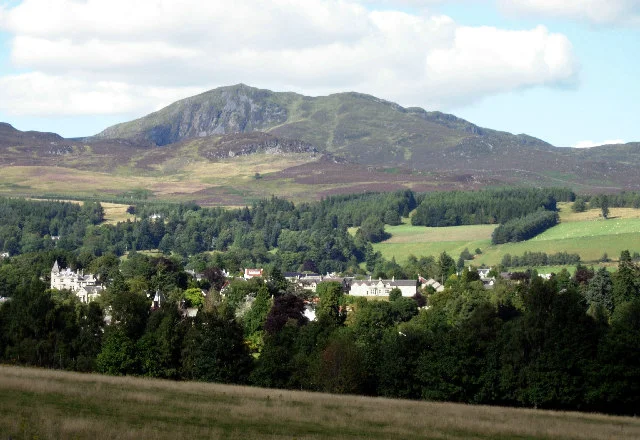

Pitlochry
Walk down Atholl Road on a summer afternoon and the canopy gives it away. There is no other high street in Scotland with quite this iron filigree shading one side of the pavement, a Victorian flourish that has somehow survived a century and a half of weather, war, and bypass schemes. Pitlochry was built to be visited. The railway arrived in 1863, the tourists followed, and the town has been quietly excellent at the business of welcoming travellers ever since. When the A9 was finally diverted around the town in 1981, the result was not decline but reprieve: the through traffic vanished, and the Victorian centre was left to itself.
Getting Here is Half the Pleasure
Pitlochry sits on the main Highland line from Edinburgh and Glasgow to Inverness, with trains every hour or two. From London Kings Cross, one direct daytime service takes 6 hours 30 minutes via York, Newcastle, and Edinburgh. The truly romantic option is the Caledonian Sleeper from London Euston, which pulls in to Pitlochry around 6 AM after a night through the dark of England and the Borders. The station has a ticket office, a waiting room, and a small bookshop on Platform 1 that has been there since 2005. Citylink coaches stop here too, on the M90 service between Edinburgh and Inverness, though the A9 itself bypasses the town and you may need to change at Broxden Park-and-Ride near Perth.
What to See, What to Climb
Ben Vrackie at 841 metres is the signature hike, a Corbett that starts behind the Moulin Brewery and takes about four hours return through woodland and open heath. The last section is a scramble, easy in summer and treacherous in winter ice. For something gentler, walk south of town to the Pictish cross-slab now in its glass protective case, or up to Sunnybrae Cottage on the main road - an eighteenth-century Highland blackhouse with its original layout where family lived on the west side and cattle on the east. The Pass of Killiecrankie just north of town is a scenic drive or cycle, especially in autumn. The Edradour Distillery, a mile east, offers tours of Scotland's smallest traditional distillery.
Festivals and Forests
Pitlochry's calendar is built around its festivals. Pitlochry Festival Theatre runs its repertory season through summer, with a different play every night. The Enchanted Forest sound and light show takes over Faskally Forest each October, drawing tens of thousands of visitors to walk through illuminated woodland set to original music. March into Pitlochry, a live music charity festival, happens in May. The Highland Games on the Recreation Park on Ferry Road run on the second Saturday of September - the last event in the Scottish Games calendar and a closing act for the summer. Every Monday in summer, the Vale of Atholl Pipe Band leads a procession through town.
Eating, Sleeping, Going Next
The town centre clusters around the foot of West Moulin Road. Co-op Food handles daily groceries from six in the morning to ten at night. Prince of India on Station Road serves curry daily through the afternoon and into the night. The Old Mill Inn has live music on Friday and Saturday evenings. Stay anywhere central and you can walk to the train, the theatre, and the riverside paths in under ten minutes. When you leave, Blair Atholl lies fifteen minutes north for its castle and the Falls of Bruar, then the road climbs over bleak Drumochter Pass to Aviemore. Branch west up the Tummel valley toward lonely Rannoch Moor, or head south through Dunkeld and Birnam for the autumn woodlands that drew Queen Victoria here in the first place.
From the Air
Pitlochry lies at 56.703 north, 3.733 west, in the valley of the River Tummel about 27 miles north of Perth. From the air the Victorian town is visible as a compact settlement on the river plain, with Loch Faskally stretching to the north behind the hydroelectric dam, and Ben Vrackie rising to 841 metres immediately to the north. Best appreciated from 3,000 to 6,000 feet. Dundee Riverside (EGPN) lies roughly 36 nm east-southeast. Edinburgh (EGPH) is about 55 nm south, Inverness (EGPE) 75 nm north. Highland weather can deteriorate quickly; the surrounding Grampians frequently carry low cloud.
Nearby Stories
- Airlie Castle 3.8 km away
- Inner Tay Estuary 4 km away
- Inchaffray Abbey 4.7 km away
- Lochearnhead 6.2 km away
- Battle of Tullich 14 km away
- Meggernie Castle 14 km away
- Glendoe Hydro Scheme 26 km away