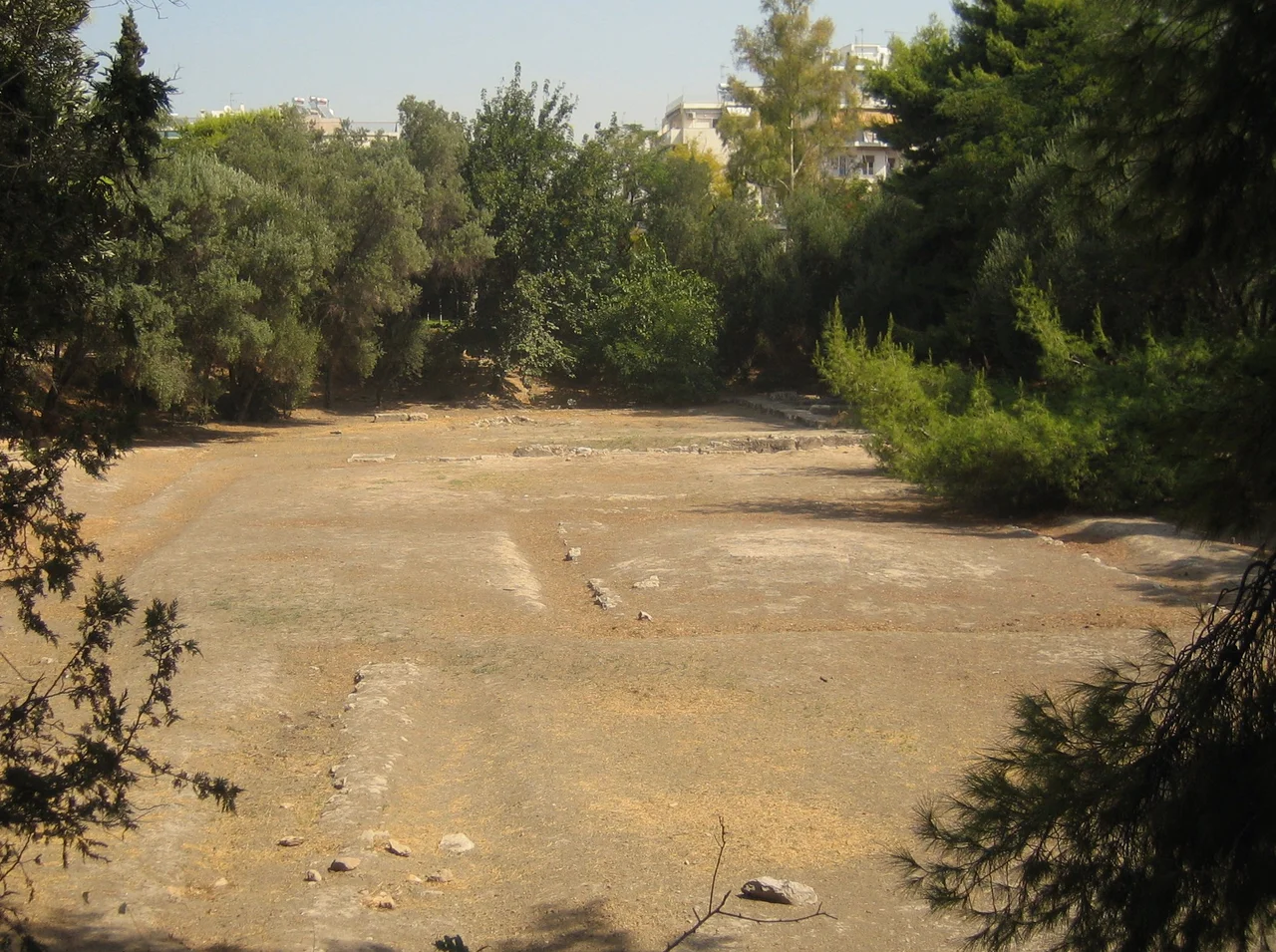

Platonic Academy
Every time someone speaks of an academy, an academic journal, or an academic year, they are unknowingly invoking a legendary Athenian hero named Akademos and the grove of olive trees that bore his name. Around 387 BC, returning from his travels in Italy and Sicily, the philosopher Plato bought property beside that sacred grove just north of the Athenian city walls and began gathering students to think out loud. There was no campus, no tuition, no curriculum in any modern sense. There was a man, a garden, and an unprecedented conviction that careful reasoning, pursued in good company, could lead toward truth. From that garden grew the idea of the school itself.
The Sacred Grove
Long before philosophy arrived, the site was holy ground. It held a grove of olive trees dedicated to Athena, goddess of wisdom, and a cult that reached back to the Bronze Age. Its archaic name was Hekademia, later softened to Akademia and linked by tradition to the hero Akademos, who was said to have revealed to Castor and Polydeuces where Theseus had hidden Helen. Out of respect for that legend, even the invading Spartans spared these "groves of Academe." The Roman general Sulla showed no such reverence: in 86 BC, besieging Athens, he cut down Athena's ancient olive trees to build siege engines. The Athenian statesman Cimon had earlier enclosed the precinct with a wall and laid out shaded walkways, turning a wild grove into a place fit for gathering.
A School Without a Syllabus
Plato's Academy looked nothing like a lecture hall. It was an exclusive club that charged no fees, with senior and junior members rather than teachers and pupils in any rigid sense. Rather than handing down doctrine, Plato posed problems for the group to wrestle with, favoring the back-and-forth of dialectic over the monologue of the lecture, though he is recorded to have delivered at least one famous talk, "On the Good." The subjects ranged remarkably wide for the age: mathematics, astronomy, and the great questions of ethics and politics that fill the Platonic dialogues. Two women are known to have studied here, Axiothea of Phlius and Lasthenia of Mantinea, at a time when Athenian public life largely excluded women. A later story, written centuries afterward, claims the words "Let None But Geometers Enter Here" were inscribed above the door.
Aristotle and the Long Inheritance
The Academy's most famous student arrived as a teenager and stayed for twenty years. Aristotle studied under Plato from 367 to 347 BC before founding his own rival school, the Lyceum, and going on to tutor Alexander the Great. After Plato's death, a succession of leaders called scholarchs guided the institution: Speusippus, then Xenocrates, then Polemo. Under Arcesilaus in the third century BC the Academy took a sharp turn toward skepticism, doubting whether certain knowledge was possible at all, a stance the school largely held until the time of Philo of Larissa, often called its last undisputed head. The original Academy did not survive Sulla's siege, and Philo's flight to Rome effectively closed the book on the school's continuous life.
Echoes and Endings
The name proved more durable than the place. Around AD 410, Neoplatonist philosophers revived an "Academy" in Athens, presenting themselves as Plato's heirs across an eight-hundred-year gap, though no real institutional thread connected them to the original. This later school flourished under the brilliant Proclus, who died in 485, before Emperor Justinian placed it under state control in AD 529, an act usually remembered as the closing of the Academy and a symbolic end to classical pagan learning. The physical site, near ancient Colonus about 1.5 km north of the Dipylon gates, was lost for centuries and rediscovered only in the twentieth, in the modern Akadimia Platonos neighborhood. Excavated and free to visit, it is a humble archaeological park, but its true monument is every school on Earth that calls itself an academy.
From the Air
The archaeological site of Plato's Academy lies at 37.99°N, 23.71°E in the Akadimia Platonos district, about 1.5 km north-northwest of Athens' ancient Kerameikos cemetery and roughly 2.5 km northwest of the Acropolis. From the air it is a green archaeological park set within the dense northwest grid of the modern city; trace a line north from the Acropolis past the rail lines to find it. The nearest airport is Athens International (LGAV), about 33 km to the east-southeast. Low-altitude passes in clear conditions reveal the open excavated ground amid the surrounding streets.
Nearby Stories
- Great Sand Beach 5 km away
- Battle of Delium 7.7 km away
- Tower of Aliartos 9 km away
- HMHS Britannic 10 km away
- Saronic Gulf 15 km away
- Sousaki Volcano 17 km away
- Sanctuary of Apollo Maleatas 24 km away
- Skyros 66 km away