
Plymouth, North Carolina
On a humid October night in 1864, the Confederate ironclad CSS Albemarle - the most feared warship in the North Carolina sounds - was moored to a wharf in this small Roanoke River town when a Union lieutenant named William Cushing eased a steam launch up to her side, fixed a spar torpedo against her hull, and pulled the lanyard. The Albemarle settled into the river mud. A Confederate sentry's musket round struck Cushing's coat but missed his body. The sinking ended the South's brief naval supremacy in the sounds. Plymouth had already given the Confederacy its largest victory in eastern North Carolina just six months earlier - the Battle of Plymouth, fought April 17-20, 1864. Today the town is quieter than its history, and its biggest summer event is a festival devoted to bears.
Brick House Plantation
Plymouth was laid out in 1787 by Arthur Rhodes, who took a hundred acres off his Brick House plantation - the surname Brickhouse remains common in the area - and subdivided it into 172 lots. The location was strategic. The Roanoke River reaches Plymouth about seven miles upriver from its mouth at the Albemarle Sound, and ships of moderate draft could reach the town from the open water. In 1790 the North Carolina General Assembly designated Plymouth a 'port of delivery' and in 1808 a 'port of entry,' formalizing what had already become a working river port. The county seat of Washington County was moved here from Lee's Mill on January 31, 1823, and a new courthouse was completed by November 1824 on the same site where the current courthouse stands.
Battle of Plymouth, 1864
The third-largest battle ever fought in North Carolina happened on the muddy streets and earthworks of this town. By 1864 the Union had held Plymouth for two years, controlling the river mouth and using the town as a base. In April Confederate forces moved on the town in coordination with the brand-new ironclad Albemarle, built in a cornfield upriver at Edwards Ferry. The Albemarle rammed and sank a Union gunboat, scattered the river fleet, and made it possible for Confederate infantry to overrun the federal defenses. Plymouth fell on April 20. It was the South's largest victory in the state and effectively the last - and it came at a cost. The original 1824 courthouse had already burned in 1862 from a shell fired by a Union gunboat. The town was occupied, then bombarded, then occupied again. Civilians caught in the crossfire suffered through it all. The Port O'Plymouth Museum, housed in the 1923 Atlantic Coast Line Railroad station downtown, holds one of the most complete collections of Civil War belt-buckles and buttons in the United States, along with a scale model of the Albemarle.
Fort Branch Held
Upriver at Hamilton, the Confederates had built Fort Branch on a high bluff at a sharp bend the locals call Rainbow Branch. The fort's guns commanded the river. After the Albemarle was sunk and Plymouth recaptured by the Union, Fort Branch became the last obstacle preventing Union gunboats from steaming upriver to cut the Wilmington and Weldon Railroad - General Lee's main supply line. The fort held. It held through the winter of 1864 and through the spring, and Union forces never made it past. On April 10, 1865 - one day after Lee surrendered at Appomattox Courthouse - the Confederate garrison at Fort Branch abandoned the position. They threw their cannons into the Roanoke River before they left. Several were recovered in the 1970s and are now on display at the fort site, north of Plymouth. The histories of Plymouth and Fort Branch are inseparable.
After Paper, Bears
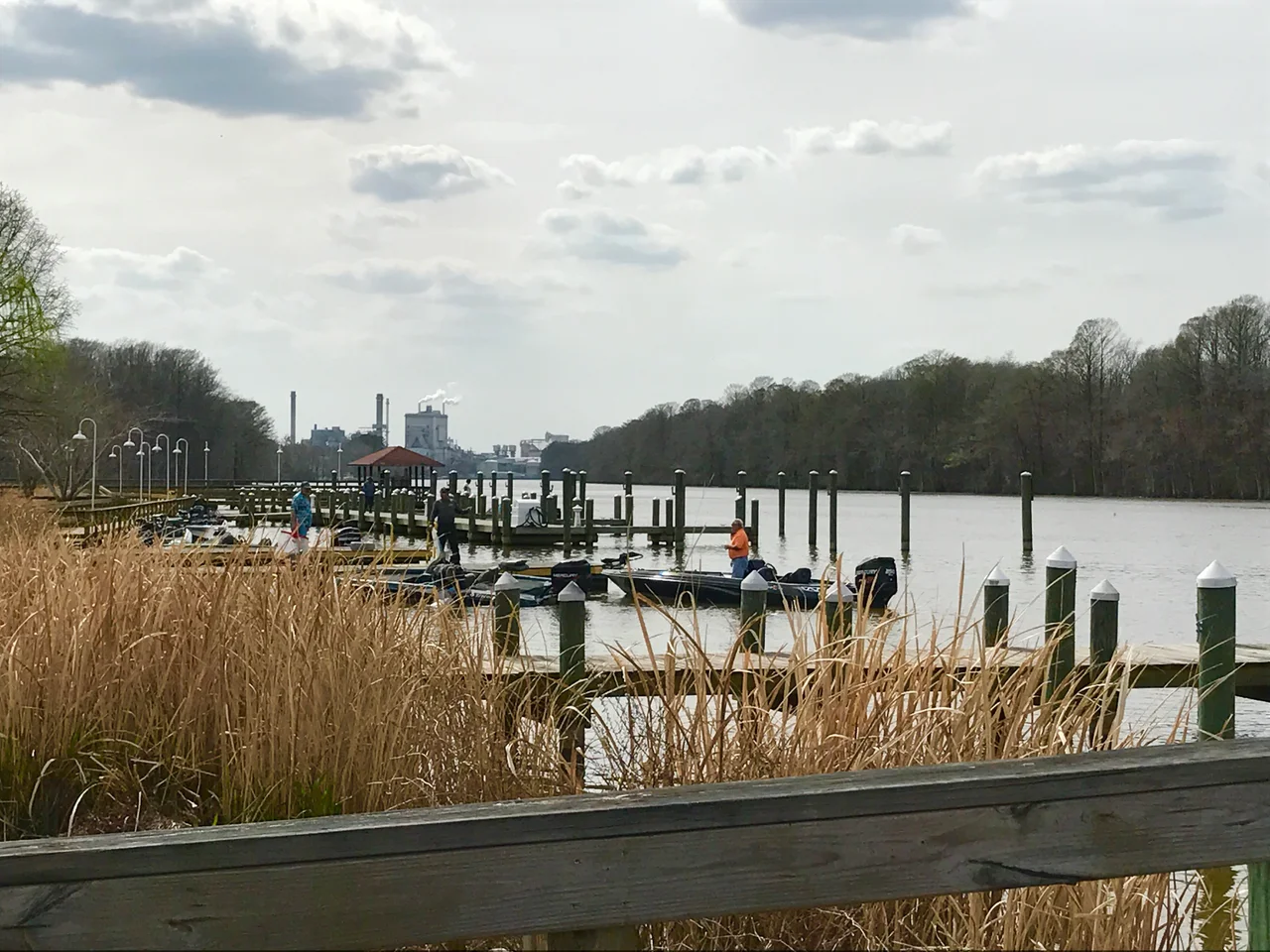
Plymouth's modern economy was built around the paper mill. Domtar's facility has been the largest employer in the area since 1937, when it was the Kieckhefer Container Company. It was merged into Weyerhaeuser in 1957, then sold to Domtar in 2007. In October 2009 the company announced it would end paper machine operations and convert the plant to fluff pulp alone, cutting the workforce by a third to about 360 employees. The town has been rebuilding its identity since. A riverfront boardwalk now runs along the Roanoke, with views of the wide blackwater. The annual North Carolina Black Bear Festival, held the first weekend of June, draws thousands of visitors to a downtown that for half a century had been more focused on shift changes than on tourism. The Plymouth State Normal School, founded after the Civil War to educate African American teachers, moved to Elizabeth City in 1903 and became what is now Elizabeth City State University - a part of the town's history that traveled far beyond it.
From the Air
Plymouth sits at 35.86 degrees North, 76.75 degrees West, on the south bank of the Roanoke River about seven miles upstream of where the river enters Albemarle Sound. From altitude the Roanoke is the dominant feature - dark blackwater, wide channel, cypress-fringed banks. The Domtar paper mill, with its tall stack and large complex on the riverfront, is easy to spot. Plymouth Municipal Airport (W41) lies just southeast of town and serves general aviation. Dare County Regional (KMQI) is about 35 miles east; Pitt-Greenville (KPGV) is about 45 miles west-southwest. Recommended viewing altitude is 3,500 to 5,500 feet AGL on clear days, with best views of the river bend, the historic downtown grid, and the mill complex.
Nearby Stories
- East Carolina University 8.8 km away
- Coast Guard Base Elizabeth City 11 km away
- Princeville, North Carolina 18 km away
- Hertford County, North Carolina 22 km away
- Lake Mattamuskeet 23 km away
- Beaufort County, North Carolina 23 km away
- Albemarle Sound 24 km away
- Halifax County, North Carolina 29 km away