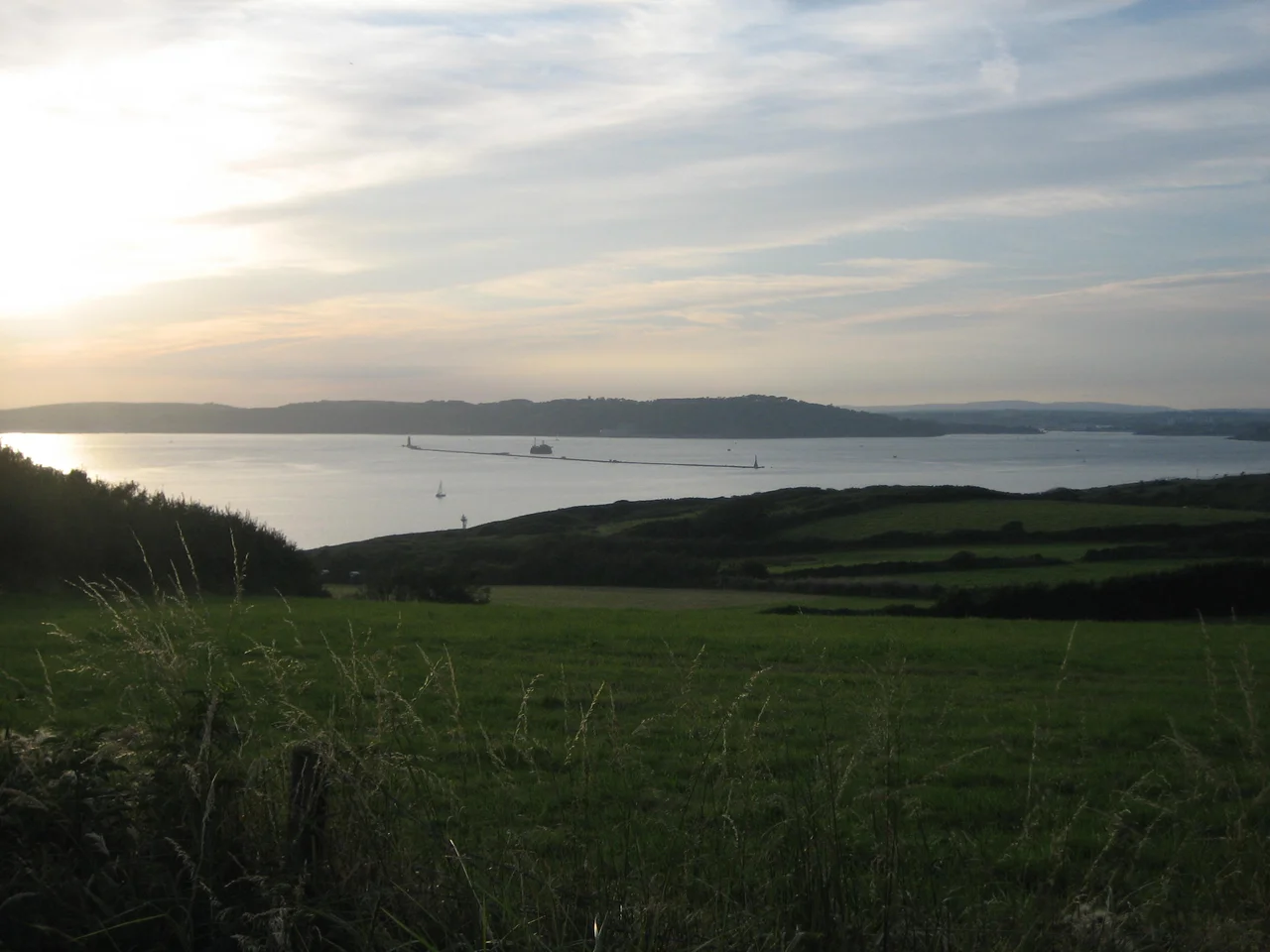

Plymouth Sound
If you were to choose a single body of water that launched more world history per square mile than any other in Britain, you would have to consider Plymouth Sound. The Mayflower departed from here in 1620, carrying the Pilgrim Fathers toward a coastline they had never seen. Sir Francis Drake's Pelican slipped out of these waters in December 1577, to circumnavigate the globe. HMS Beagle weighed anchor in Barn Pool on 27 December 1831 with Charles Darwin aboard, bound for South America and a thought that would change biology forever. The defeated Napoleon Bonaparte sat at anchor here in HMS Bellerophon for nine days in the summer of 1815, while thousands of fascinated English citizens took to small boats to gawk at the man who had nearly conquered Europe. Plymouth Sound is three nautical miles by three nautical miles of sheltered water. It also happens to be one of the great hinges of the modern world.
Three Mouths to the Sea
The Sound has three water entrances, each with its own personality. The main one is the marine entrance from the south, where the English Channel opens into the great bowl of sheltered water behind the Plymouth Breakwater. To the northwest, the River Tamar empties through the Hamoaze, the long tidal channel that hosts Devonport Dockyard, the largest naval base in western Europe. To the northeast, the River Plym disgorges into its narrow estuary, the Cattewater harbour, threading between Mount Batten and the Royal Citadel. The Sound's southwest corner is at Penlee Point in Cornwall, the southeast at Wembury Point in Devon, with Plymouth Hoe forming its northern boundary. Drake's Island, four hundred metres long and a hundred wide, sits in the centre of the northern half. A shallow reef called the Bridge links Drake's Island to the Cornish mainland, less than a metre deep at low water; in the First World War it was reinforced with extra obstructions to keep submarines out of the naval base.
The First Submarine Death
In June 1774, a Plymouth carpenter named John Day climbed into a wooden diving chamber he had built and attached to the sloop Maria. His plan was to descend to the seabed north of Drake's Island, remain there for an extended period, and surface to claim the prize money he had wagered with backers on his survival. He had successfully tested a smaller chamber earlier in the year. This time, with weights designed to be released from inside, he reached the bottom and never came back up. Divers searched for him without success. Day became the first recorded fatality from submarine operations in human history, dying in Plymouth Sound at the very moment that an entirely new category of human endeavour was being invented. The sloop with the chamber still attached lies somewhere in the silt north of Drake's Island; the prize money was never collected; and the engineering questions Day was trying to answer would take another century to resolve.
The Defeated Emperor
On 15 July 1815, less than a month after Waterloo, Napoleon Bonaparte surrendered to Captain Frederick Maitland of HMS Bellerophon off Rochefort. He was brought to Plymouth Sound and held aboard the ship for nine days, from 26 July to 4 August, while the British government decided what to do with him. The Sound filled with small boats. Thousands of Plymothians paid for passage out from the Hoe and the Barbican to see the captive emperor with their own eyes, sometimes catching a glimpse of him at a porthole, sometimes seeing him pace the deck. London newspapers sent artists. A genre of paintings emerged, several of which now hang in the National Maritime Museum at Greenwich; John James Chalon's oil canvas Scene in Plymouth Sound in August 1815 is the most famous. Then on 4 August the Bellerophon was ordered to sea; Napoleon was transferred to HMS Northumberland on 7 August at Torbay, and taken to St Helena, where he would die six years later. He never saw France again.
Forts Around the Edge
For four centuries the Sound was the most heavily fortified body of water in Britain. The line of defences ran around its entire perimeter: Drake's Island and the Royal Citadel on the inner ring; Picklecombe Fort, Cawsand Fort, Fort Bovisand, Staddon Fort, and Stamford Fort on the outer; and at the very mouth of the Sound, the Breakwater Fort planted in the middle of the great wall itself. Many were built or rebuilt during the Palmerstonian panic of the 1860s, when British anxiety about French rearmament prompted the most expensive defence programme of the Victorian era. They were never used in anger against the threat they were built to deter. They were used during the world wars for anti-aircraft duty and signal stations and observation posts, and one by one they were released by the military through the twentieth century. The breakwater was supervised by Joseph Whidbey from Bovisand Lodge, a house with an uninterrupted view down the full length of his great work.
Britain's First Marine Park
In January 2019, Plymouth City Council launched a campaign to make Plymouth Sound Britain's first National Marine Park. The proposal has been gathering momentum ever since. The Sound supports kelp forests, seagrass meadows, reefs, and a rich population of fish, seals, dolphins, and seabirds, much of it within sight of the city. It is also working water: the Royal Navy operates from Devonport, the ferries to France and Spain depart from Millbay Docks, fishing trawlers come and go from Sutton Harbour, marinas at Sutton, Mount Wise, and Turnchapel host hundreds of yachts. The King's Harbour Master controls all waterborne traffic. The challenge of marrying conservation to centuries of intense maritime use is exactly the kind of thing a national marine park is designed to address. The Sound has been many things: highway, sanctuary, battleground, departure point. Its next role may be as a place where humans learn to live more lightly on the sea that has always shaped them.
From the Air
Plymouth Sound is centred on 50.343 degrees north, 4.143 degrees west, a roughly three-by-three nautical-mile inlet on the south coast of Devon and Cornwall opening to the English Channel. From the air it is unmistakable: the long stone Breakwater lies across the southern entrance with the Breakwater Fort sitting inside it; Plymouth Hoe and the Royal Citadel form the northern boundary; the Rame Peninsula with Mount Edgcumbe encloses it from the west; and Mount Batten peninsula juts into it from the east. The Hamoaze and Devonport Dockyard extend northwest from the inner Sound; the Cattewater opens northeast. Nearest controlled airport is Exeter (EGTE), 40 miles east-northeast; Newquay (EGHQ) is 40 miles west. Devonport naval activity creates restricted airspace and dynamic NOTAMs over the area; consult before any low-altitude approach.
Nearby Stories
- Davidstow Circuit 3.7 km away
- Golden Hind 3.9 km away
- Powderham Castle 4.4 km away
- Fowey Lifeboat Station 5.1 km away
- Okehampton Castle 12 km away
- Battle of Plymouth (1652) 19 km away
- Goonhilly Satellite Earth Station 44 km away
- German Submarine U-672 73 km away