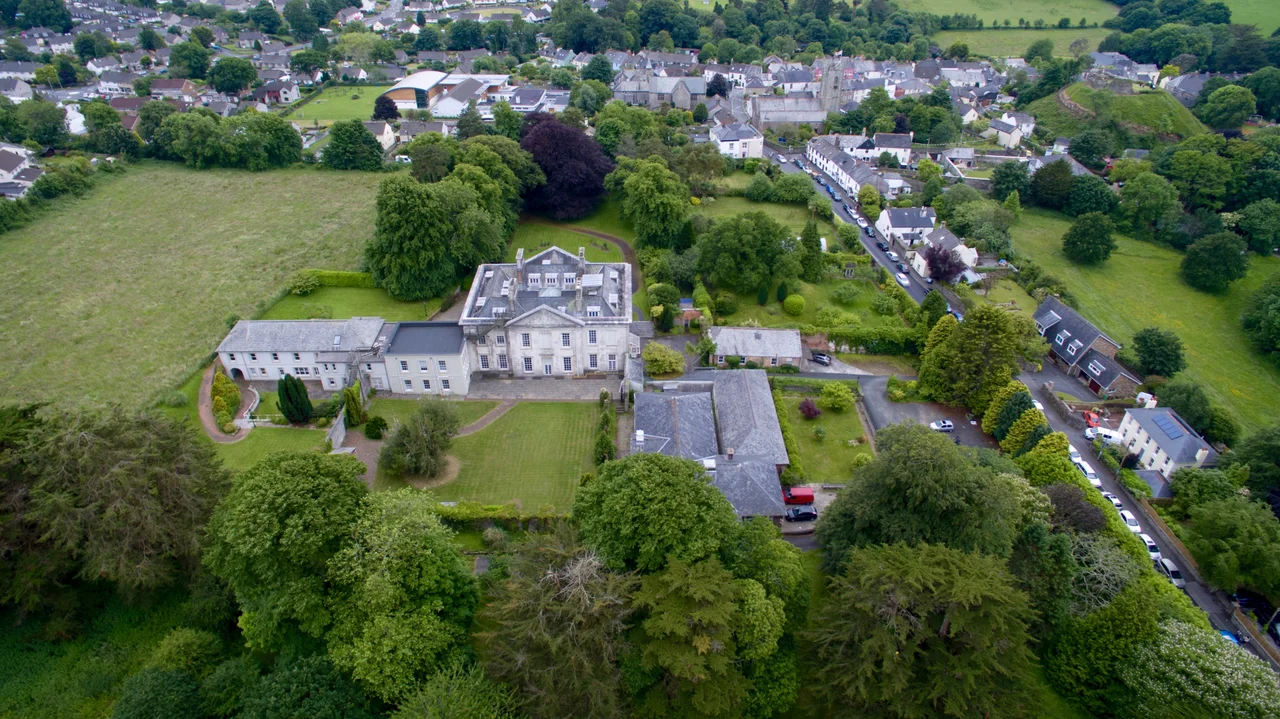

Plympton House
In 1844, an inspector from the Metropolitan Commissioners in Lunacy walked through the outbuildings behind Plympton House and recorded what he saw. Sixty-six pauper patients were confined there in squalor, packed into farm sheds and converted outhouses. Some of the seventeen private patients fared little better. Meanwhile in the main building, a Portland-stone William-and-Mary mansion built between 1700 and 1720 for one of the most distinguished judges in England, the proprietor and his family lived in considerable comfort. The inspector's notes were carefully diplomatic but the picture was clear. A house designed as the seat of a Lord Chief Justice had become a profitable Victorian asylum, and the architectural splendour was now a backdrop for industrial-scale neglect. This was Plympton House's second life. There would be more.
The Lord Chief Justice
Sir George Treby was baptised at Plympton St Mary in 1643, the son of Peter Treby "Gent." He went up to Exeter College Oxford, read law at Middle Temple, and was called to the Bar in 1671. Within five years he was Member of Parliament for Plympton, knighted by 1680, and then briefly out of favour with Charles II. The Glorious Revolution of 1688 was the making of him. He met William of Orange's landing fleet at Exeter, threw his weight decisively behind the new regime, and by 1689 he was Lord Chief Justice of the Common Pleas, one of the four most senior judges in England. With the position came the wealth and prestige to build himself a mansion close to where he had been born. He assembled the site through the late 1690s, on the east side of what was then called Maudlin Street in Plympton, and began construction. He died in December 1700 in his fifty-eighth year, before the work was finished.
The Treby Inheritance
Sir George's son, also called George Treby, completed the house around 1720, working with a mason named William Veale whose name appears in the accounts but whose role is unclear. The architect is unknown. The result is a compact two-storey Portland-stone mansion above a basement, set behind concave brick walls and gates topped with stone heraldic beasts. The estate passed through three childless generations of Trebys before reaching, in 1763, the late Colonel George Hele Treby's sister Charity. She had married Admiral Paul Henry Ourry, the son of a Huguenot refugee from Blois who had escaped religious persecution in France, taken British citizenship in 1713, and obtained an army commission. Their son Paul Treby Ourry took the Treby surname in 1785 by royal licence and became Paul Treby Treby. After his mother died in 1805, he moved to Goodamoor in Plympton St Mary, and the great house was let to a succession of tenants. Then, gradually, it emptied entirely. A guidebook of 1821 records it as "at present uninhabited."
The Asylum Decades
Around the same time, a Dr Duck took a tenancy and began the institution that would define Plympton House for the next century. The asylum operated on a clear hierarchy. The proprietor and his family occupied the main mansion in some style. The pauper patients, sixty-six of them in 1844, were housed in the outbuildings in conditions the official inspectors found troubling. The private patients, seventeen of them that year, lived between these two worlds. This was, in fairness to Dr Duck and his successors, the standard model of Victorian asylum operation, and Plympton House's facilities would have been considered respectable by the standards of its era. Dr J. C. Nixon bought the premises in 1921 and continued the operation as an asylum until 1933. The asylum era at Plympton House ended after roughly 110 years, far longer than the house had spent as a family seat. Most of the people who lived and died here did so in the outbuildings, not the great hall.
The Sisters of St Augustine
In 1934, the Sisters of St Augustine acquired Plympton House and established St Peter's Convent, a home for the mentally ill. The intention was charitable and the operation grew steadily over the following decades. By the late twentieth century the original house had been substantially enlarged with modern accommodation blocks, a chapel, and other extensions, growing to nearly thirty-two thousand square feet of floor space spread across a forty-four-bedroom institution. At its largest, three Sisters supervised a staff of around eighty caring for up to fifty residents. The convent occupied the house for more than sixty years, longer than the Trebys themselves had used it as their seat. When the order finally withdrew, the property was put on the market with five and a half acres of surrounding gardens, including the early eighteenth-century formal garden of three hectares that was the only remaining fragment of the original Treby landed estate.
Fourteen Luxury Houses
By 2015 Plympton House was empty again, watched only by security guards employed to keep it from being squatted or vandalised. On 31 May 2016, Plymouth City Council granted planning permission for conversion to residential use, and a development scheme launched offering fourteen properties between three and six bedrooms across the grade-I-listed mansion, the converted outbuildings, and a small number of new builds. Some plots were sold to self-builders, others as finished homes. Plympton House itself was retained as a single residence with a private driveway and gardens, returning, in a sense, to its original purpose three centuries after Sir George Treby had imagined it. The Portland stone is still there. The heraldic beasts still sit on the gate piers. The eighteenth-century garden remains. And the patients who passed through the outbuildings for a century and a half have left only their numbers in the Metropolitan Commissioners' reports: sixty-six in 1844, gone before the buildings were even rebuilt.
From the Air
Plympton House sits at 50.385 degrees north, 4.046 degrees west, in the parish of Plympton St Maurice on the eastern fringe of Plymouth, about a mile southwest of the A38 dual carriageway and immediately south of the small Norman ruins of Plympton Castle motte. From the air, look for the symmetrical Portland-stone south facade behind concave red-brick boundary walls, with the early eighteenth-century stables and walled courtyards to the northwest. The conspicuous spoil heaps of the Lee Moor china clay workings lie 4 miles to the north. Nearest controlled airport is Exeter (EGTE), 33 miles northeast; the closed Plymouth City Airport (EGHD) site is 2 miles west. Devonport restricted airspace lies a few miles west; check NOTAMs.
Nearby Stories
- Davidstow Circuit 3.7 km away
- Golden Hind 3.9 km away
- Powderham Castle 4.4 km away
- Fowey Lifeboat Station 5.1 km away
- Okehampton Castle 12 km away
- Battle of Plymouth (1652) 19 km away
- Goonhilly Satellite Earth Station 44 km away
- German Submarine U-672 73 km away