
PMQ (Hong Kong)
Sun Yat-sen walked to school on this ground. The school that educated him and a generation of Hong Kong's most prominent citizens was destroyed by Japanese bombing in 1941. The land was cleared, and in 1951 police officers moved in, raising families in 140 single-room and 28 double-room units wedged between Aberdeen Street and Hollywood Road. Two future Chief Executives of Hong Kong grew up here. Then the building sat empty for fifteen years while the city argued about what to do with it. What emerged in 2014 — a creative hub buzzing with design studios, pop-up galleries, and a monthly night market — is the PMQ, a place that has been three entirely different things in under 170 years.
The School That Made Leaders
The story begins not with police officers but with students. The Central Government School, established on Gough Street in 1862, was Hong Kong's first government institution to offer Western-style primary and secondary education to the public. It relocated to a new Hollywood Road campus in 1889 as enrollment grew, was renamed Victoria College, and then Queen's College in 1894. At its height it was considered one of the largest and most expensive buildings in the colony. The school's alumni list reads like a roll call of early twentieth-century Hong Kong and Chinese leadership. Dr Sun Yat-sen, later to be hailed as the Father of Modern China, studied there. So did Sir Robert Ho Tung, who became one of the colony's most prominent business figures. The building that shaped them was reduced to rubble by Japanese forces in 1941, and the remaining structure was demolished in 1948. The ground passed to new owners and a new era.
Police Families Between the Walls
Hong Kong's postwar population swelled rapidly as refugees arrived from mainland China following the Civil War, and the colonial government urgently needed more police officers near their postings in Central. In 1951, the Hollywood Road Police Married Quarters opened on the site of the former school, offering 168 units to rank-and-file officers and their families. The compound became a genuine community — a self-contained neighborhood tucked behind gate walls while the city transformed around it. C.Y. Leung and Donald Tsang, neither yet the public figures they would become, were among the children who grew up within those walls. By 2000 the building had been emptied. A decade of official deliberation followed, the kind of institutional pause that in other cities might have ended in demolition.
Archaeology Beneath the Courtyard
Before anyone could agree on what to build, archaeologists got to work on what had already been built. Between 2005 and 2007, the Antiquities and Monuments Office surveyed the remnants and found fragments of the original Central School still present in the ground: granite shafts, plinths from the boundary walls, quoin stones at the site's corners, and old steps. These were not swept away in the eventual renovation. The granite steps and rubble retaining wall at the Staunton Street entrance were preserved as visible heritage elements, and a tunnel was built beneath the courtyard allowing visitors to walk through the foundations of the former Victoria College. The past was literally underfoot, and the revitalization plan made that the point. A UV-protective glass ceiling was added above the central atrium; the rooftop garden on the fourth floor connector between the two main blocks was named PLATEAU. Heritage and invention found an unusual coexistence.
A Hub Finds Its Footing
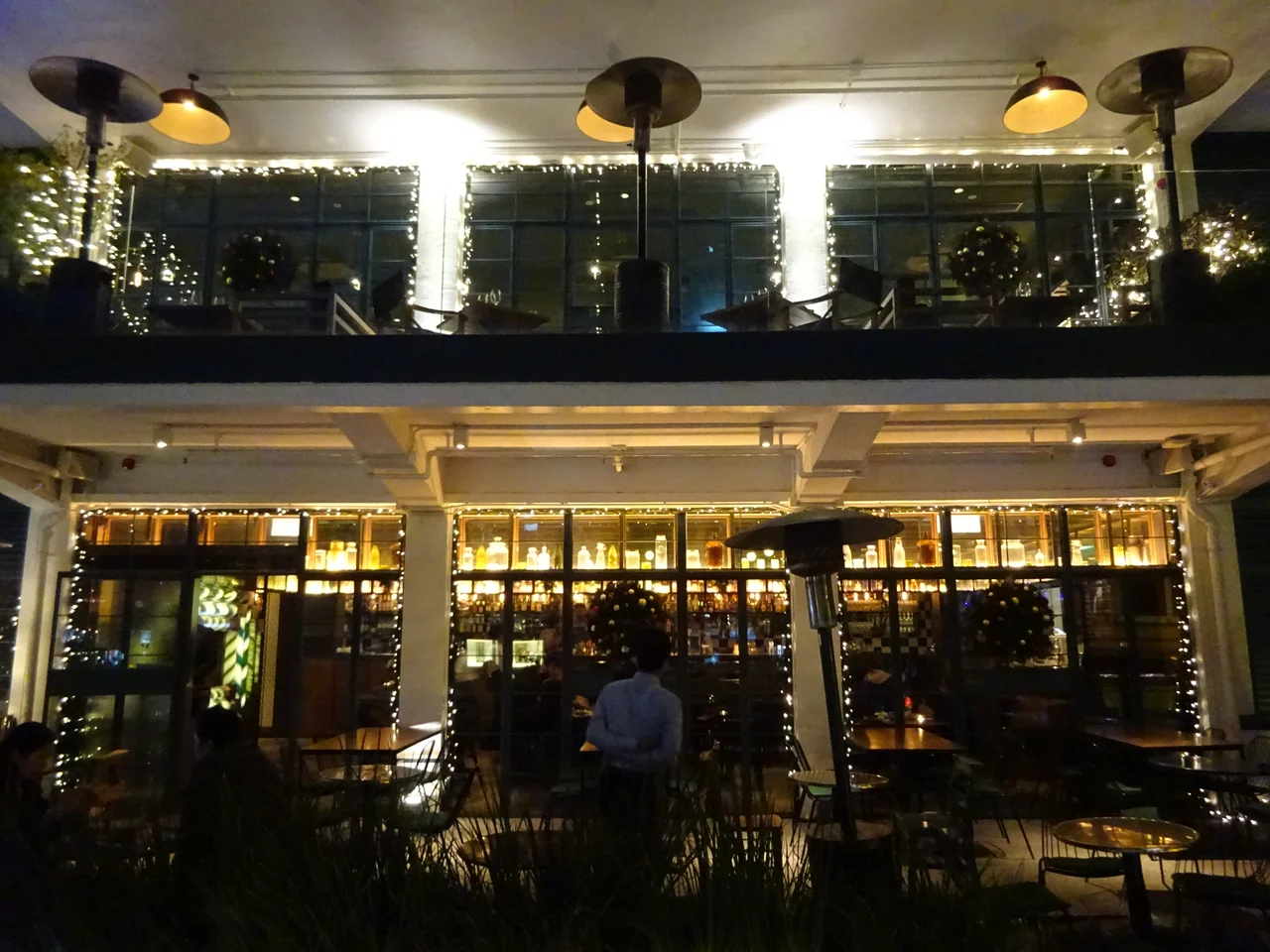
PMQ opened in April 2014, and the location turned out to matter more than anyone could have planned. The compound sits between Hollywood Road's established gallery scene and the bars and restaurants of SoHo, positioning it at the overlap of art, design, commerce, and nightlife. Around 100 design studios, galleries, bookstores, and offices took up the converted units, many of them young Hong Kong designers using the platform to reach a broader audience. Fifteen pop-up units rotate new exhibitions and retail concepts through the complex. The 1,000-square-metre central courtyard has hosted international events including a WWF exhibition that filled the space with 1,600 paper pandas. Monthly night markets mix live music with product design and street food. What the city could not agree on for fifteen years turned out to work quite well.
From the Air
PMQ sits at 22.2834°N, 114.1519°E in the Sheung Wan district of Hong Kong Island, roughly halfway up the slope between the Central waterfront and the Mid-Levels. Flying into Hong Kong International Airport (VHHH), the tight urban grid of Central and Sheung Wan is visible on the northern shore of Hong Kong Island. Hollywood Road runs along the contour at roughly 20 metres elevation, and the two seven-storey PMQ blocks are identifiable from low altitude by their identical form and the open courtyard between them. VHHH is approximately 25 nautical miles to the west-northwest. Optimal viewing altitude for the surrounding neighbourhood is around 1,000 feet above sea level.
Nearby Stories
- Lok Ma Chau Loop 2.3 km away
- Portas do Cerco 2.3 km away
- Kweilin Incident 17 km away
- Wanshan Archipelago Campaign 34 km away
- Nanxiong Formation 115 km away
- Battle of Nanpeng Island 148 km away
- Heyuan 169 km away
- Cape Maobitou 632 km away