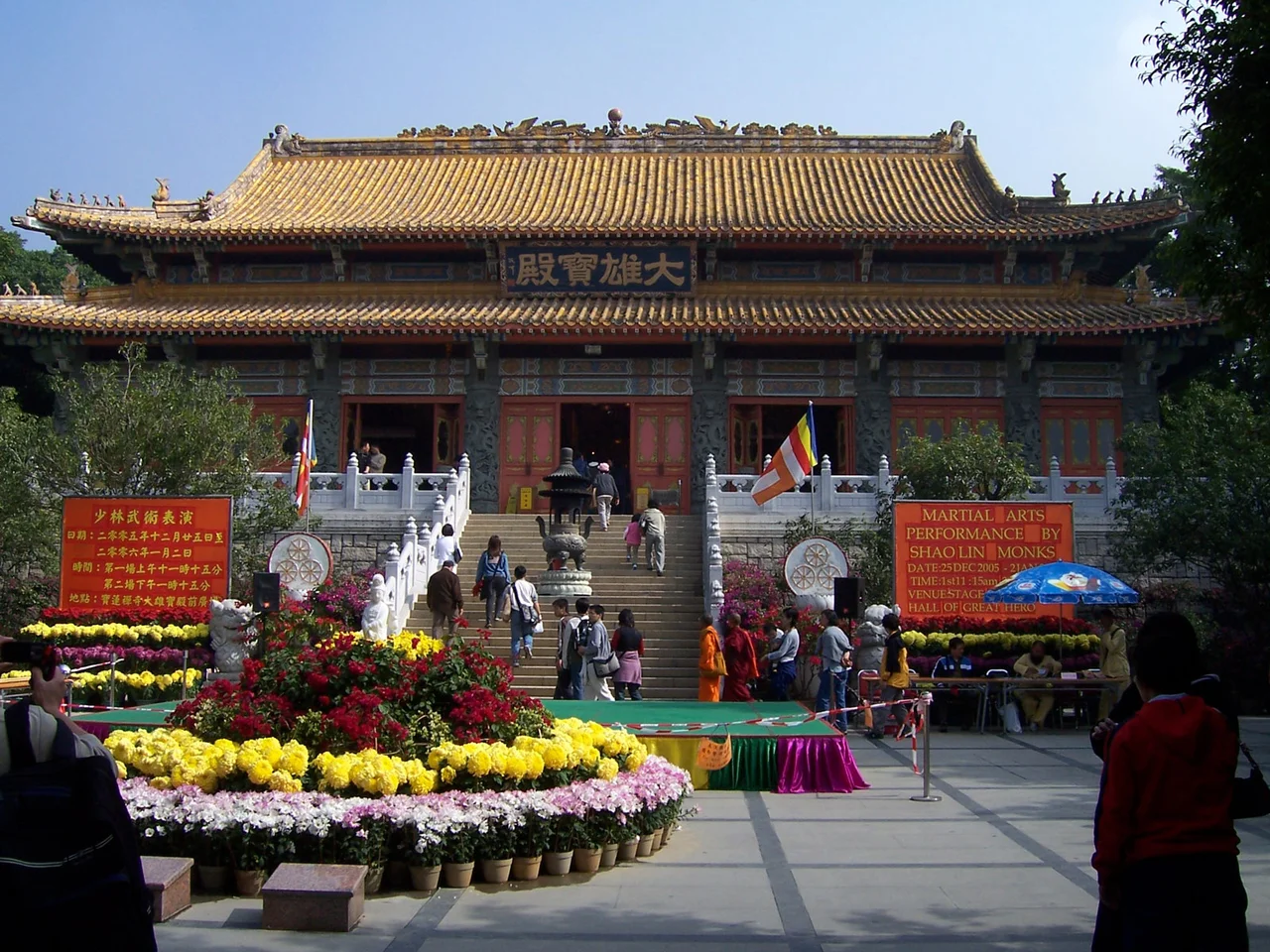

Po Lin Monastery
They arrived on Lantau Island in 1906 and built a hut. Not a temple, not a monastery — a hut, which they called simply 大茅蓬, "The Big Hut." Three monks from Jiangsu Province, drawn to the highland plateau of Ngong Ping, chose this remote and quiet place for contemplative life. Nobody could have predicted that their modest shelter would eventually become Po Lin Monastery, or that the plateau around it would one day draw millions of visitors to stand in the shadow of a 34-metre bronze Buddha visible from aircraft approaching Hong Kong's international airport. The transformation took most of a century, and the monastery's quiet heart persists beneath the scale of everything that has grown around it.
The Big Hut Becomes a Monastery
The three founding monks chose well. Ngong Ping Plateau sits roughly 500 metres above sea level on Lantau Island, cooler and quieter than the densely populated shores below. The plateau was isolated enough for serious practice, accessible enough that the community could sustain itself. The informal settlement they established in 1906 was renamed Po Lin — meaning "Precious Lotus" — in 1924, when the community had grown sufficiently to warrant a proper institutional name. Over the following decades, the monastery built its main structures: the Main Shrine Hall of Buddha, the Hall of Bodhisattva Skanda, residential quarters for the monastic community. The main temple came to house three bronze statues of the Buddha representing his past, present, and future lives, alongside a library of Buddhist scriptures. The monastery became a regional centre of Chan Buddhism, the Chinese tradition that informs what the West knows as Zen.
The Giant Buddha Arrives
In 1993, Po Lin Monastery changed scale permanently. The Tian Tan Buddha — named for the Temple of Heaven in Beijing, whose design influenced the structure's base — was completed after three years of work and installed on a hill above the monastery. The bronze statue itself stands 26.4 metres, with the full structure reaching 34 metres including its lotus throne base, making it one of the largest outdoor seated Buddha statues in the world. The statue faces north, looking out over China. Pilgrims and tourists climb 268 steps to reach the base, where smaller statues of bodhisattvas and devas surround the main figure. The Tian Tan Buddha drew visitor numbers that transformed Ngong Ping, and the transformation accelerated when the Ngong Ping 360 gondola opened, connecting the plateau to the town of Tung Chung below via a cable car with views over Lantau's forested hills and the South China Sea.
The Nunnery on the Lower Hill
In 1918, twelve years after Po Lin was founded, three nuns who had been ordained at the monastery made a different choice. Rather than remain on the main plateau, they descended to Lantau's Lower Keung Hill and established a private nunnery called Chi Chuk Lam — 紫竹林 — dedicated to Guanyin, the Goddess of Mercy. The name means "Purple Bamboo Grove," a reference to one of Guanyin's sacred dwelling places. The nunnery operated as a contemplative community for decades; in the 1950s it housed around twenty jushi (lay practitioners) and nuns. Now only an elderly abbess remains. The Chi Chuk Lam story runs quietly alongside Po Lin's larger narrative — a smaller, quieter community descended from the same founding impulse, holding to its purpose as the world around both places changed beyond recognition.
A Monastery in the Flow of Tourism
Po Lin today occupies an unusual position: a functioning monastic community at the centre of one of Hong Kong's most-visited tourist attractions. The monastery continues its religious life — monks chant, incense burns, the daily rhythms of Chan practice continue — while tens of thousands of visitors arrive each year to see the Tian Tan Buddha and walk the grounds. The monastery is noted for its vegetarian restaurant, which feeds the pilgrim traffic, and for wooden bracelets sold near the Buddha statue that have become a sought-after souvenir. The Ngong Ping village around the gondola terminal offers the full apparatus of tourism — cafés, shops, a cultural village. But the monastery's original structures remain, and if you arrive early enough, before the gondola line forms, the plateau has something of the quiet that three monks from Jiangsu chose it for in 1906.
From the Air
Po Lin Monastery is located at 22.2555°N, 113.908°E on the Ngong Ping Plateau of Lantau Island, approximately 500 metres above sea level. Flying into Hong Kong International Airport (VHHH), which lies just off the northern coast of Lantau approximately 12 nautical miles to the northeast, the massive Tian Tan Buddha statue is visible on the ridgeline in clear weather. The plateau is identifiable by the contrast between the forested slopes and the open highland clearing. The cable car route of the Ngong Ping 360 gondola traces a visible line up from Tung Chung on the northeastern shore. Recommended viewing altitude on final approach from the west is 2,000 to 3,000 feet, where the Big Buddha's silhouette is clearest against the hill.
Nearby Stories
- Lok Ma Chau Loop 2.3 km away
- Portas do Cerco 2.3 km away
- Kweilin Incident 17 km away
- Wanshan Archipelago Campaign 34 km away
- Nanxiong Formation 115 km away
- Battle of Nanpeng Island 148 km away
- Heyuan 169 km away
- Cape Maobitou 632 km away