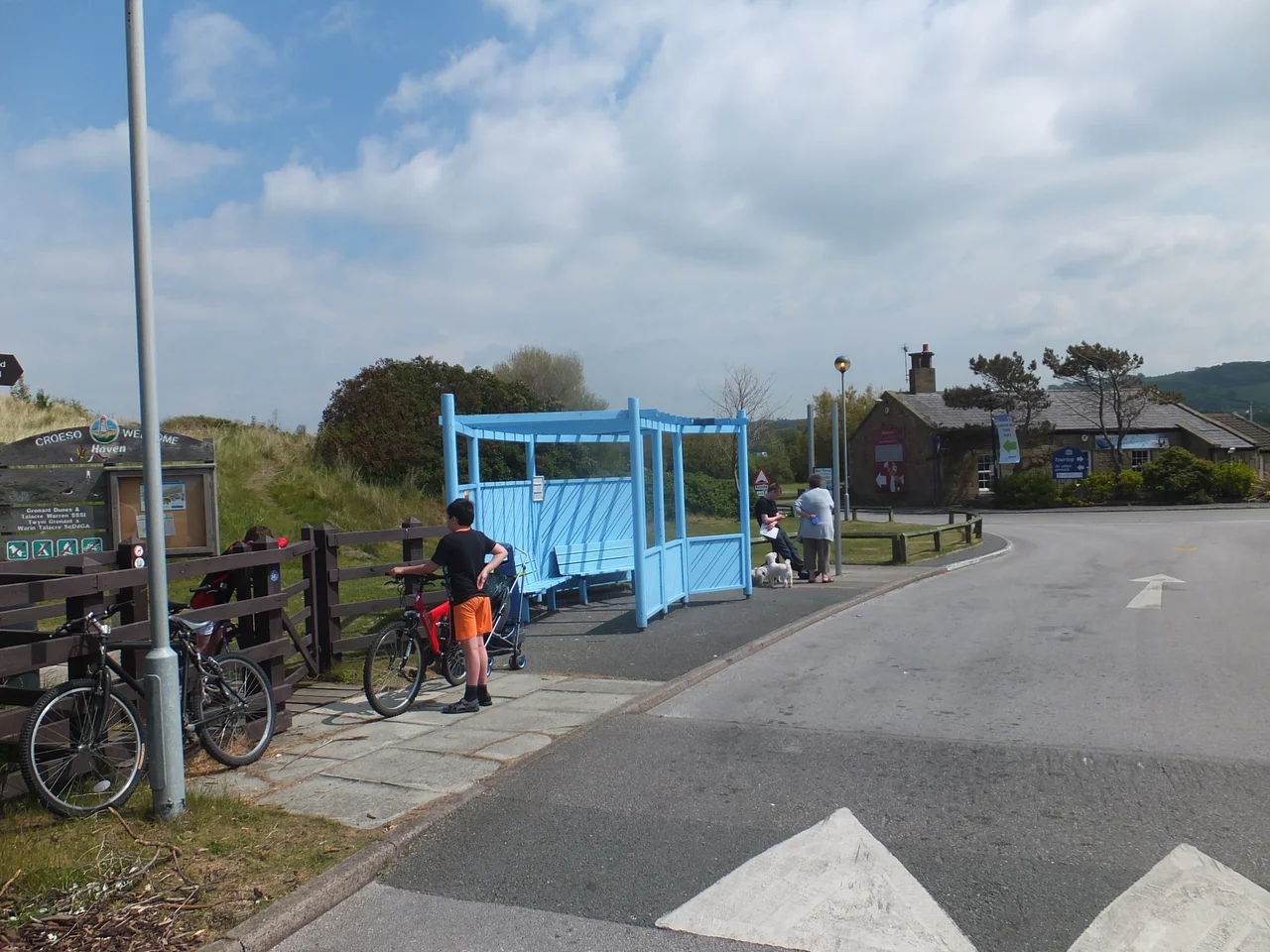

Point of Air Lifeboat Station
Just after 11:30 on 4 January 1857, the Point of Air lifeboat capsized in a winter gale on its way to a wreck off Abergele. Ten of the thirteen crew were washed away at once. Three more clung to the underside of the upturned hull for roughly forty minutes while onlookers watched from the shore, helpless. Then they too were washed away. The boat was non-self-righting; once over, it would not come back. All thirteen drowned. A public fund raised £3,000 for the widows and orphans. The names are carved into a memorial inside the parish church of St Asaph and St Cyndeyrn at Llanasa, three miles inland. The lifeboat, oddly, survived with little damage. Within seven weeks a new crew had been mustered and the boat was back at Gronant ready to launch.
Gronant, not the Point
The station was actually placed at Gronant, two miles west of the Point of Ayr itself, despite carrying the Point of Air name. The reason was launch geography: Gronant gave direct beach access to the deep-water channel called Prestatyn Gulley, where a heavy lifeboat on a launching carriage could enter the water with enough depth under it to row out into the Liverpool approaches. The Liverpool Dock Trustees - the same body that ran the Hoylake station - established the post in 1826 to cover the shipping lanes funnelling into the Mersey from the Welsh coast. A thirty-foot pulling lifeboat arrived first. By 1830 the trustees had swapped it for a smaller twenty-six-foot boat brought over from Magazines on the Mersey, judging that the lighter craft would be better suited to the Gronant carriage launch.
Robert Beck and the Silver Medal
On 27 November 1851, the coxswains of all three Liverpool Dock Trustees stations - Liverpool, Magazines, and Point of Air - were awarded the RNIPLS Silver Medal for years of gallantry. Robert Beck, the coxswain at Gronant, had launched the lifeboat more than sixty times by that date. The award marked the recognition of a system that had been quietly running for a generation: a chain of port-authority lifeboats stretched along the approaches to Liverpool, manned by local fishermen and pilots and watched over by the trustees. The Royal National Institution for the Preservation of Life from Shipwreck - the body that would become the RNLI - was still a young charity in 1851 and not yet operating most of the British coast itself.
The Tempest Disaster
The morning of 4 January 1857 began with the lifeboat answering a call at 08:30 to a vessel aground on the West Hoyle Bank. Beck and his crew got the men off. Returning, they were redirected to a second casualty on Chester Bank, which refloated without assistance. Around 11:30 they were called a third time - this time westward, to the schooner Temperance of Belfast, aground off Pensarn at Abergele. On that leg, in the worst of the gale, the boat capsized. The losses were not just lifeboatmen but neighbours - the crew came from Gronant and the surrounding villages, and the memorial at Llanasa records the names of men known to almost every household in the parish. The Llanasa church holds the carved stone tablet still.
Quick Recovery
What happened next is almost as remarkable as the disaster. The lifeboat, having been refloated and recovered, was found to be largely undamaged. A new master and mate were appointed by 29 January - twenty-five days after the loss. A new crew was assembled by 2 February. On 24 February the crew collected the lifeboat from Mostyn Docks, where it had been brought back from repairs at Liverpool, and sailed it home to Gronant. The station was operational again within seven weeks of losing thirteen men. The pattern speaks to something about nineteenth-century coastal communities: the boat had to go, the men knew it, and refusal was not really an option for the kind of village that derived a third of its livelihood from the sea.
Closing and Renaming
The station kept working through the second half of the century. By 1870 it had a thirty-three-foot Liverpool-class lifeboat that would later be transferred to another station as ON 419. In the 1890s, with traffic at the Port of Liverpool growing and the Mersey Docks and Harbour Board reluctant to keep funding its lifeboat fleet, negotiations between the board and the RNLI resulted in the transfer of all the remaining trustee stations. Point of Air came under the RNLI on 1 July 1894. The new owners decided the station should move. In September 1894 - less than three months later - they closed Gronant and reopened the station two miles east at Talacre beach, renaming it Point of Ayr Lifeboat Station with the Welsh-influenced spelling. The Gronant boathouse was abandoned. The new station carried on under the corrected name.
From the Air
The former Point of Air Lifeboat Station site lies at 53.347°N, 3.368°W at Gronant, on the north Wales coast between Prestatyn and Talacre. Nothing of the original boathouse survives - the location is now part of the dunes between the village and the beach. Best viewed at 1,500 feet AGL. Nearest airports are Hawarden (EGNR) 18 nm east, Liverpool John Lennon (EGGP) 18 nm north-east, and Caernarfon (EGCK) 35 nm west. Look for the line of the north Wales coast running west from the Dee estuary - Point of Ayr lighthouse is visible on the headland to the east; Gronant sits inland from the dune line.
Nearby Stories
- Dolwyddelan Castle 4.6 km away
- Silver Jubilee Bridge 5 km away
- PS Rothsay Castle 11 km away
- Horseshoe Pass 12 km away
- Battle of Bamber Bridge 16 km away
- Combermere Abbey 17 km away
- Birkdale Palace Hotel 21 km away
- Celtic Array 40 km away