
Point of Ayr Lighthouse
Stand at the lighthouse at low tide and the sea is somewhere out beyond the curve of the sand, half a mile distant on the soft pewter horizon. Walk a few minutes and you can touch the bricks of a tower that the Mayor of Chester authorised in 1776, when George III had been on the British throne for sixteen years and the American Revolution was three months from its Declaration. Walk in from the same direction at high water, six hours later, and you will be wading. The Point of Ayr lighthouse has stood for two and a half centuries on sand that the tide rearranges twice a day. It is the oldest surviving lighthouse in Wales, decommissioned almost two centuries ago, currently a private house, and recently the most photogenic prop in a Dulux paint commercial.
Chester's Light
The lighthouse was authorised by an Act of Parliament of 1776 - 16 Geo. 3, c. 61 - and built by a trust of the Mayor, Recorder, and Aldermen of Chester to warn shipping entering the channel between the Dee and Mersey estuaries. At the time, Chester was still hoping to remain a working port, even as the Dee silted up year by year and traffic shifted to Liverpool. The Point of Ayr marked the headland between the two estuaries - the most northerly point of Flintshire and of mainland Wales - and ships approaching either river had to identify the headland correctly to make safe entry. The 1776 brick tower stood roughly sixty feet tall, painted white, with a coal-fired light that burned at the lantern level. By the mid nineteenth century it had been fitted with the standard reflector and lamp system of the era.
Replaced and Decommissioned
By the 1830s, the original Point of Ayr light no longer marked the best position for warning ships off the actual sandbanks. The Liverpool authorities replaced it with a pile light - a screw-pile structure built on iron piles driven into the seabed offshore - which could be placed precisely where the danger lay. The brick tower at Talacre was decommissioned in 1844. The pile light continued in service for several more decades before its own replacement by buoys and modern aids. The old tower never resumed lighting duty. It became, in the language of British heritage, a redundant lighthouse - useful only as a landmark, picturesque from any angle, and inherited by a succession of private owners through the late nineteenth and twentieth centuries.
The Iron Sentinel
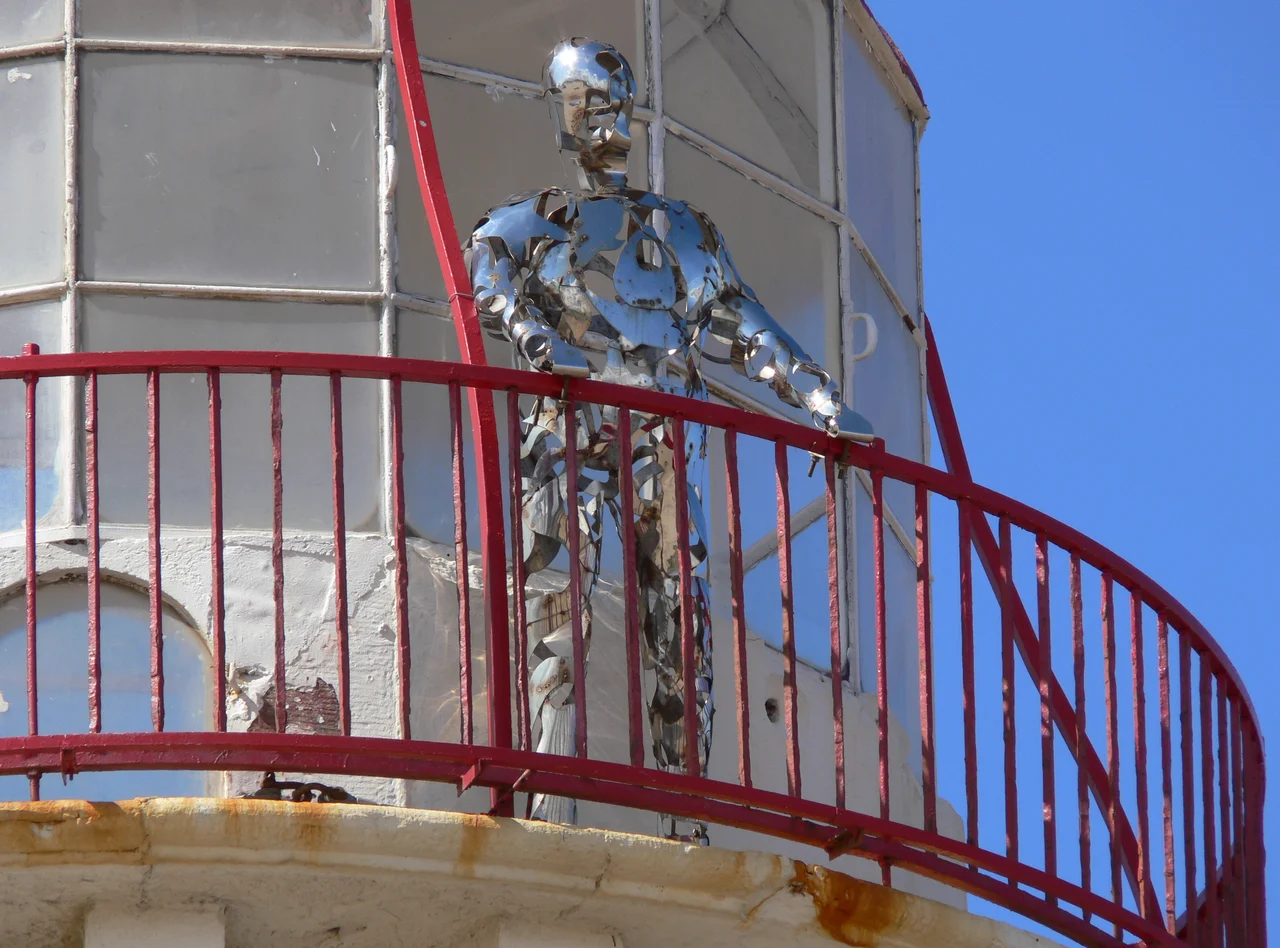
In 2010 the then owner, James McAllister, applied for planning permission to erect what he called a 'serious art installation' on the gallery of the disused lighthouse - a seven-foot stainless-steel figure of a lighthouse keeper, designed by local artist Angela Smith. The application was prompted by the lighthouse's reputation as a haunted site - several alleged ghost sightings on the gallery had been reported in the local press. The figure was approved for a three-year display period. For three years a steel sentinel stood watching from the gallery while photographers and tourists climbed the dune to look up at it. Permission was not renewed at the end of the period, and the sculpture was relocated. The base of the lighthouse, meanwhile, was damaged in storms in 2007 - a hole opened in the masonry and the metal access steps were torn loose. Repairs were funded by the owners of the local caravan park.
Dulux and the Sheepdog
The 1776 lighthouse made an unlikely television debut in 2011, appearing in the background of a Dulux paint commercial marking the fiftieth anniversary of the company's Old English Sheepdog mascot. The shot lined up the dog on the beach with the white tower behind, the surf gently breaking around it, and the brand colours of cream and white perfectly composed against the morning light at Talacre. The lighthouse was sold the following year for £90,000 with two acres of land - listed at £100,000 by the previous owner. The buyers were a private couple who continue to own the building and the land around it. The lighthouse is Grade II listed, which limits external alterations but otherwise leaves the structure in private hands.
Shifting Sands
What sets the Talacre lighthouse apart from other coastal towers is its setting. Most lighthouses stand on rock - granite headlands, basalt islands, reefs at the entrance to harbours. Point of Ayr stands on shifting sand. The dunes around it migrate season by season, blown inland in some years and rebuilt by storm-driven sand in others. The high-water mark moves; the inter-tidal flats expand and contract. The lighthouse has survived 250 years on this surface in part because the foundations were built deeper than the apparent base suggests, and in part because the local geology of the headland has remained, against all probability, broadly stable. Visit at sunset, when the tide is out and the wet sand reflects the sky, and the lighthouse appears to be standing on a pink-orange mirror that runs all the way to the horizon. It does not look real. It is.
From the Air
Point of Ayr Lighthouse stands at 53.357°N, 3.322°W on the dunes of Talacre Beach, on the headland between the Dee estuary and the Irish Sea. The white tower is visible from several miles offshore and forms the most distinctive feature on the headland. Best viewed at 1,000-2,000 feet AGL. Nearest airports are Hawarden (EGNR) 17 nm east-south-east, Liverpool John Lennon (EGGP) 16 nm east-north-east, and Caernarfon (EGCK) 38 nm west. Look for the lighthouse standing alone in the sand with the holiday caravan park inland behind it - the absence of any other tall structure makes it unmistakable.
Nearby Stories
- Dolwyddelan Castle 4.6 km away
- Silver Jubilee Bridge 5 km away
- PS Rothsay Castle 11 km away
- Horseshoe Pass 12 km away
- Battle of Bamber Bridge 16 km away
- Combermere Abbey 17 km away
- Birkdale Palace Hotel 21 km away
- Celtic Array 40 km away