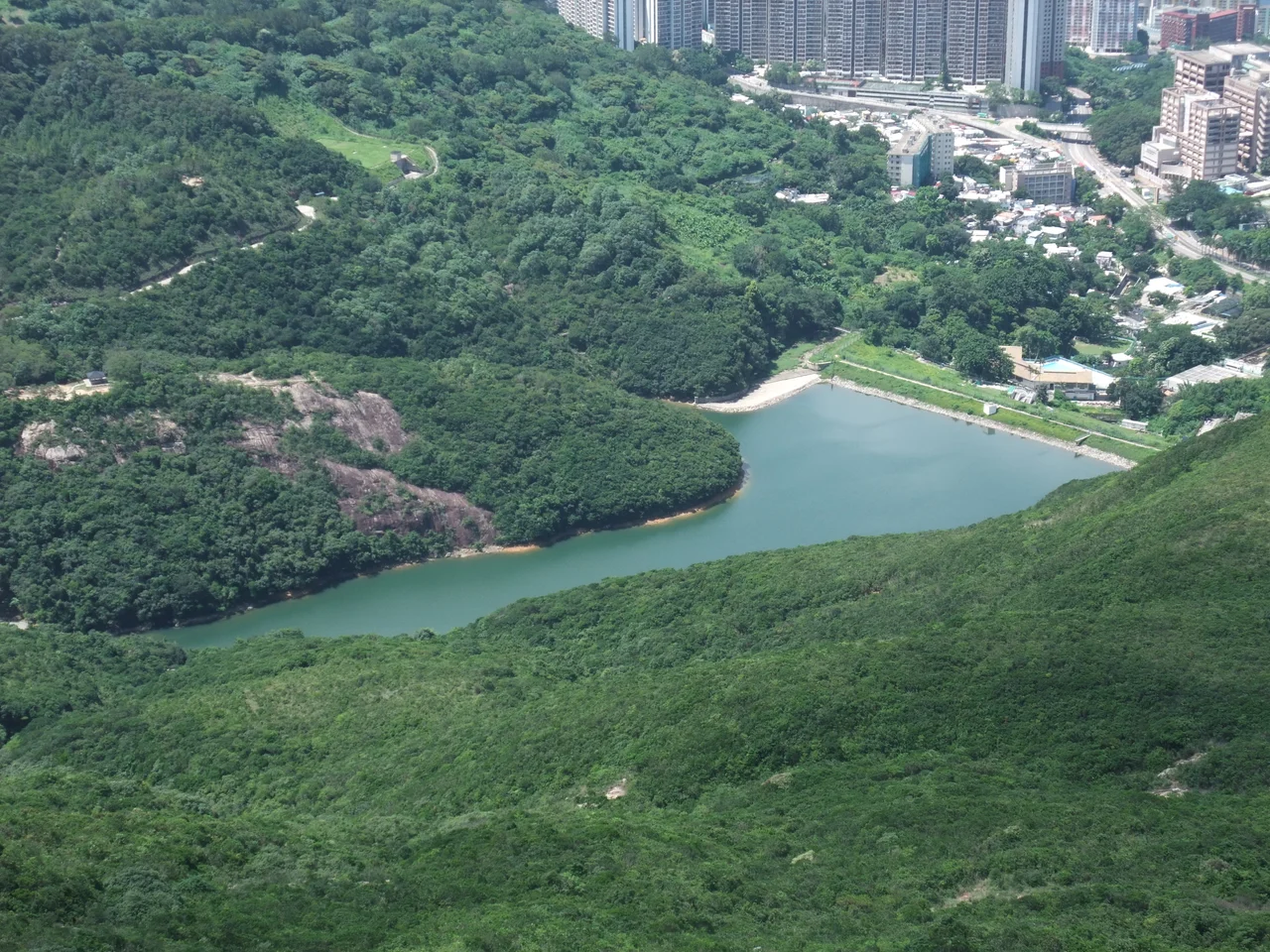

Pok Fu Lam Reservoir
A reward of 1,000 pounds. That was what the colonial government of Hong Kong offered in October 1859 to anyone who could solve the city's water crisis — and by extension, its disease crisis. Polluted wells and overcrowded streams could not keep pace with a population that had exploded since Britain claimed the island in 1841. Cholera did not care about commerce. Something had to be built.
A Clerk's Idea, a Colony's Lifeline
The solution came from an unlikely source. On 29 February 1860, S. B. Rawling, a clerk attached to the Royal Engineers, proposed building a dam across the valley of Pokfulam to collect rainwater. The colonial government allocated a budget of £25,000. Three years later, in 1863, the reservoir was complete — the first in Hong Kong. The Pok Fu Lam valley, tucked between Victoria Peak and the hillsides above what is now Kennedy Town, turned out to be a natural catchment. Rain fell reliably on the peaks above, drained into the valley, and could be held behind a stone dam and piped to the city below.
Never Quite Enough
The reservoir was finished, but the problem was only half-solved. Budget cuts had forced compromises in the dam's scale, and the structure held far less water than the growing colony needed. Within fourteen years the situation was untenable again. By 1877, a second reservoir was constructed above the original, doubling the system's capacity. It was a pattern Hong Kong would repeat throughout the colonial era: build, outgrow, build again. The city's relationship with fresh water was always a race between infrastructure and population.
Stone, Bridges, and a Watchman's Cottage
What makes Pok Fu Lam Reservoir unusual today is how much of it survives intact. In 2009, six historic structures were declared monuments under Hong Kong's Antiquities and Monuments Ordinance. The declaration encompasses four masonry bridges spanning the reservoir's channels, a gauge basin used to measure water levels, and the Former Watchman's Cottage — now the Pok Fu Lam Management Centre. Walking through the site, the Victorian engineering reveals itself in the careful stonework: squared-off masonry, arched bridges, the ordered geometry of a 19th-century hydraulic system. It is quietly impressive in the way useful things built to last often are.
Green Valley Above a Dense City
The reservoir today sits within Pok Fu Lam Country Park, a rare expanse of forested hillside on Hong Kong Island. The city's density presses right up to the park's edges — high-rises visible from the dam wall, the Peak visible above. But inside the park the atmosphere changes. The water is still, tree-covered hills reflect in it, and the sound of the city drops away. It is easy to forget, standing here, that you are on one of the most densely inhabited islands on Earth. The reservoir's practical life as a water source for the city has long since been superseded by larger systems, but its landscape remains. And its stones, laid by colonial-era engineers in a small valley above the sea, have outlasted every prediction anyone might have made for them.
From the Air
Pok Fu Lam Reservoir sits at 22.265°N, 114.137°E in a valley on the western slopes of Hong Kong Island, immediately below Victoria Peak. From the air at 1,500–3,000 feet, the reservoir reads as a dark oval of water amid forested hillside, clearly distinct from the dense urban grid of Kennedy Town and Pokfulam Road below it. Hong Kong International Airport (VHHH) lies approximately 25 km to the northwest. The Peak's summit at 552 metres provides a useful orientation landmark.
Nearby Stories
- Lok Ma Chau Loop 2.3 km away
- Portas do Cerco 2.3 km away
- Kweilin Incident 17 km away
- Wanshan Archipelago Campaign 34 km away
- Nanxiong Formation 115 km away
- Battle of Nanpeng Island 148 km away
- Heyuan 169 km away
- Cape Maobitou 632 km away