The Spirit Boats of Pokekea
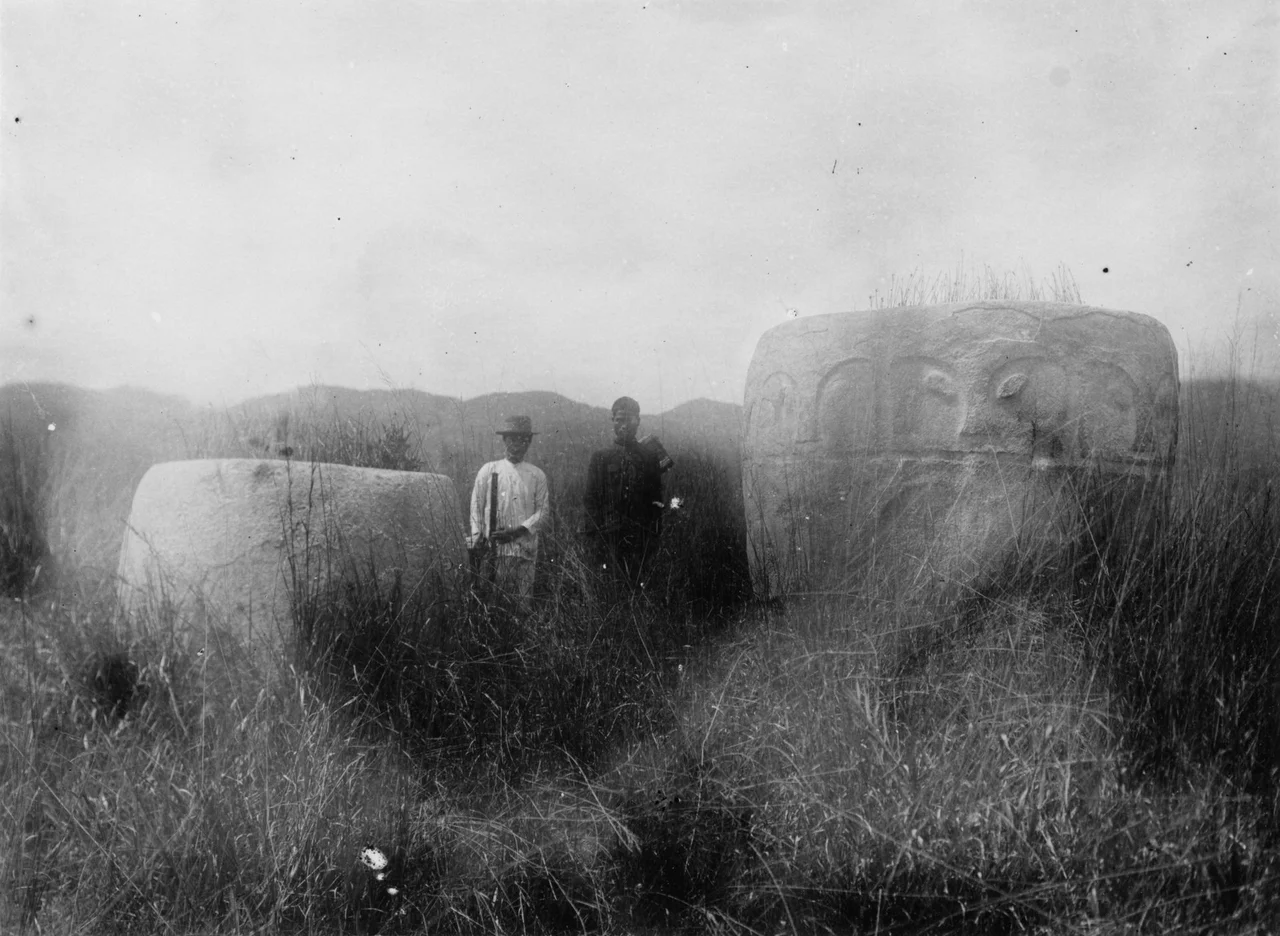
The word kalamba means "spirit boat" in the language of the Lore people, and the name fits better than any archaeological label could. These are vessels built for a voyage no living person would take. Twenty-seven of them sit scattered across the Behoa Valley in Central Sulawesi, carved from single blocks of stone into massive cylindrical vats, some nearly two meters across. Their lids are decorated with small protruding carvings of monkeys and lizards. Their outer walls bear rows of human faces, stylized and staring, arranged in strips like passengers peering over the rail of a ship that never sailed. No one knows exactly who carved them. No one is entirely sure when. But the bones found inside tell us what the kalambas were for -- and the story they tell is both intimate and unsettling.
Stone Drums in the Rice Fields
Pokekea sits at roughly 1,100 meters above sea level in the Behoa Valley, one of several broad highland basins within Lore Lindu National Park. The valley floor is flat and fertile, stitched with rice paddies that catch the light differently depending on the season. Clouds often snag on the surrounding hills, so it is common to see rain falling on one side of the valley while sunlight pours across the other. The kalambas stand among and between these fields, resembling enormous stone drums or barrels half-sunk into the earth. Some are upright, their openings facing the sky. Others have toppled or settled at angles over the centuries. A few still have their stone lids resting beside them, as though someone set them down a thousand years ago and never came back.
The Dead Within
Excavations carried out in 2008 by archaeologist Dwi Yuniawati revealed that the kalambas served as family burial chambers. A single vat could hold the remains of ten or more individuals, their bones showing traces of both cremation and tooth mutilation -- a practice found across ancient Southeast Asian cultures, often marking social rank or rites of passage. Not everyone in the community received a kalamba burial. The evidence suggests these were reserved for the elite, a privileged class whose remains were gathered together in stone rather than returned to the earth. Radiocarbon analysis conducted in 2006 by Wiebke Kirleis, Valerio Pillar, and Hermann Behling dated two of the Pokekea kalambas to between 766 and 1272 AD, though the broader megalithic tradition in the Lore Lindu region may stretch back as far as 3000 BC.
Faces Without Mouths
The artistry at Pokekea is restrained but haunting. The faces carved into the largest kalamba near the park entrance follow a convention found across the Lore Lindu megaliths: eyebrows and nose rendered as a single continuous line, round eyes set wide, and no mouth at all. These same stylistic choices appear on the standing statues, or arcas, found in the nearby Bada Valley -- suggesting a shared artistic tradition spanning multiple valleys and perhaps centuries. The decorative lids add another layer of meaning. Small animal figures, monkeys and lizards, protrude from the edges of the stone covers as though guarding the contents below. Whether these carvings are totemic, protective, or simply ornamental remains an open question. The carvers left no written record. Their intentions survive only in the stone itself.
A Parallel Thousands of Kilometers Away
Archaeologists have long noted the striking resemblance between the kalambas of Central Sulawesi and the stone jars of the Plain of Jars in Laos. Both are large cylindrical stone vessels. Both appear to have served funerary purposes. Both are scattered across highland valleys in clusters that defy easy explanation. The parallel suggests ancient connections between megalithic cultures across Southeast Asia, possibly linked to the great Austronesian migrations that carried people, languages, and traditions across the islands and mainlands of the region over thousands of years. Indonesia submitted the Megalithic Cultural Heritage of Lore Lindu Area to UNESCO's tentative list in 2025, recognizing over 2,000 megalithic monuments across four valley groups as testimony to this deep migratory history.
Quiet Custodians
Pokekea today receives a trickle of visitors compared to Indonesia's famous temple complexes. There are no tour buses, no entrance queues, no souvenir shops. The traditional customs of the Lore people remain strong in the surrounding villages, where wooden houses roofed with ijuk -- sugar palm fiber -- still line the roads. Visitors who make the journey into the Behoa Valley often stay in these traditional homes. The kalambas wait in the fields as they have for centuries, their carved faces watching the clouds gather and break against the hilltops. Lore Lindu National Park, which encompasses the site, has been a UNESCO Biosphere Reserve since 1978, protecting both the archaeological heritage and the montane forests that climb the valley walls to elevations above 2,600 meters. The spirit boats are not going anywhere. They never were.
From the Air
Pokekea Megalithic Site sits at approximately -1.69N, 120.21E in the Behoa Valley of Central Sulawesi, at roughly 1,100 meters elevation. The valley is a broad, flat basin surrounded by forested hills rising to 2,600+ meters. From the air, look for the patchwork of green rice paddies in the valley floor with the Lariang River system threading through. The nearest significant airstrip is Mutiara SIS Al-Jufrie Airport in Palu (WAML), approximately 100 km to the northwest. Approach from the north over the mountain ridges for dramatic views of the cloud-trapped valleys below.
Nearby Stories
- The Vanishing World of Lake Poso 9.7 km away
- Stone Faces in the Cloud Forest 30 km away
- The Island That Shouldn't Exist 59 km away
- Central Sulawesi: Where the Earth Remembers 65 km away
- The Drum of God 113 km away
- Land of the Heavenly Kings: Tana Toraja 119 km away
- The Ground Beneath Mamuju 163 km away
- The Invisible Wall of Makassar Strait 165 km away