.png)
Polesie State Radioecological Reserve
Before it was a wildlife sanctuary, it was home. Aravichy had 923 people. Dzernavichy had more than a thousand. Kazhushki, Kalyban, Pirki, and a dozen other Belarusian villages had families, gardens, and cemeteries going back generations. Then the reactor across the border in Ukraine burned, the fallout drifted north on the wind, and within two years the government drew a line around 1,313 square kilometers of poisoned land, evacuated everyone inside it, and locked the gate. Today the Polesie State Radioecological Reserve is one of the emptiest places in Europe and, by a bitter irony, one of the most alive.
The Line Drawn on the Map
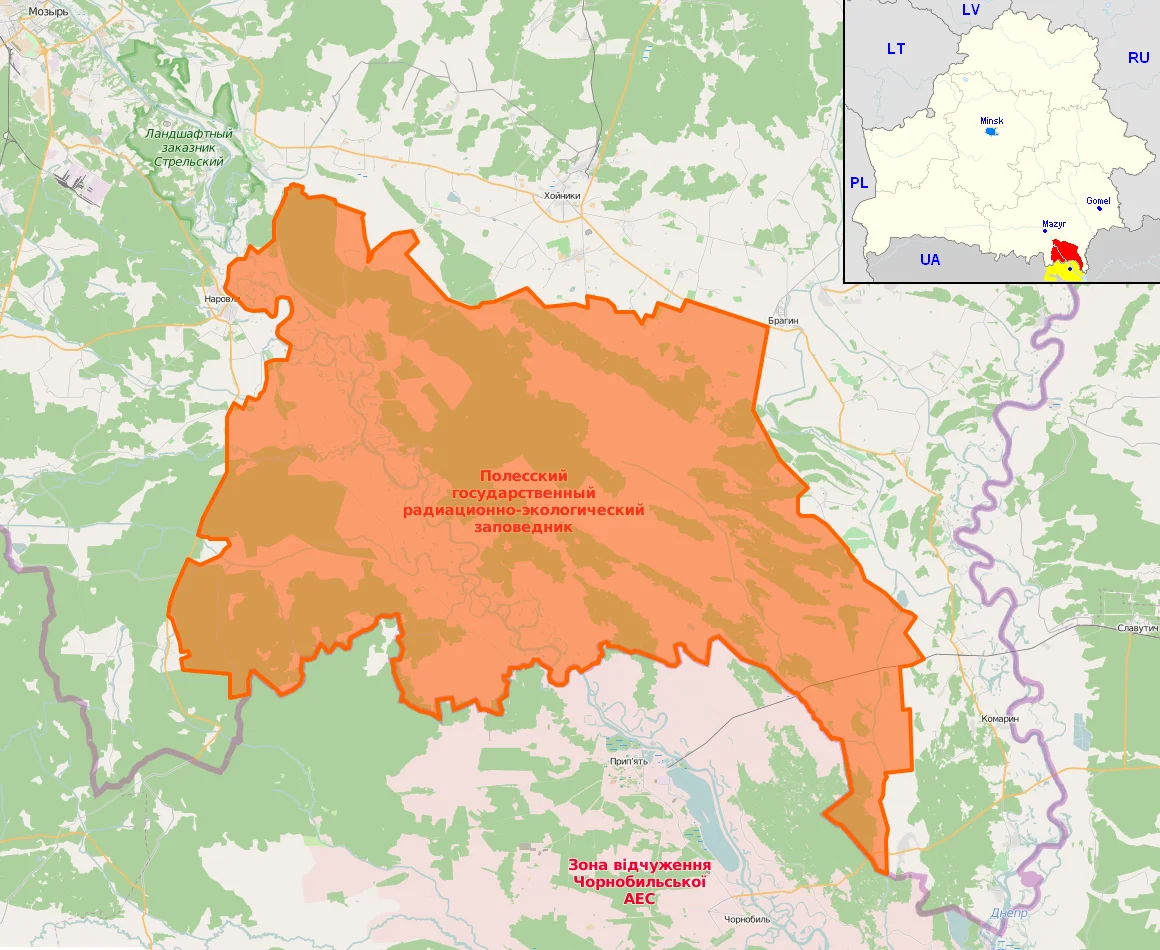
Chernobyl's plume did not respect borders. Some of the heaviest contamination fell not on Ukraine but here in Belarus, across the Polesie lowlands north of the plant. Two years after the disaster, on 18 July 1988, authorities extended the exclusion zone into the worst-hit ground and sealed it as a reserve closed to the public. The Pripyat River still winds through it. The city of Mazyr sits 36 kilometers from the northwestern gate. A rail line clips the southern edge, running past villages whose names now appear only on evacuation lists and old maps. What the reserve encloses is not wilderness in the usual sense but abandonment made permanent: fields returning to forest, houses collapsing into the trees, and everywhere the invisible weight of radionuclides in the soil that will outlast everyone who remembers this land as home.
The Villages Left Behind
The reserve's boundaries swallowed whole communities. The population figures come from the 1959 census, taken when these places were still farming villages full of children: Dzernavichy with 1,016 residents, Aravichy with 923, Kalyban with 977, Babchyn with 839. When the order came after 1986, families packed what they could carry and left the rest. Entire households departed by the hundreds, and the villages have stood empty ever since, slowly disappearing under moss and birch. It is easy to see this landscape as a nature story, and it is one, but the ground remembers a different account: kitchens, wells, orchards, and burial grounds that belonged to people who never chose to leave and were not allowed to return.
The Wild Returns
Into that silence the animals came. With humans gone, the reserve became a stronghold for species that struggle elsewhere in Belarus: European bison, Przewalski's horses, elk, brown bear, golden eagle, and white-tailed eagle. It holds the largest population of the European pond turtle anywhere in the world. Administrators count 46 species of mammal, 213 of bird, and dozens of reptiles, amphibians, and fish, with 70 of these listed in international and Belarusian red books of threatened wildlife. More than 1,251 plant species grow here, over two-thirds of the entire flora of the country. Bison were even reintroduced by hand. As one government report put it, the removal of human pressure created ideal conditions for the animal world to recover. The paradox is total: poison the land, remove the people, and life floods in.
Life Under an Invisible Sun
Radiation still leaves its fingerprints on this thriving place. Researchers have found higher rates of cataracts in voles, partial albinism among barn swallows, fewer of the bacteria that normally live on birds' wings, and a decline in cuckoos. The dramatic, visible mutations happened mostly in the first years after the accident; the effects now are subtler, biological rather than monstrous. Meanwhile a small staff based in the town of Khoiniki works to keep the contamination in place, monitoring radiation, fighting wildfires that could carry old fallout into the air, and planting trees to hold the poisoned soil against erosion. It is a strange kind of stewardship, tending a sanctuary that no one is meant to enter, guarding a wilderness that exists only because of a catastrophe.
From the Air
The reserve is centered near 51.65 N, 29.98 E, straddling the Pripyat River in Belarus just north of the Chernobyl zone. View from 7,000 to 10,000 feet in clear conditions; the broad braided channels of the Pripyat and the checkerboard of overgrown, abandoned fields are the clearest signatures. The area is restricted airspace; the nearest airports are Gomel (UMGG) to the northeast and Kyiv-area fields such as Antonov/Hostomel (UKKM) well to the south.
Nearby Stories
- Chernobyl Exclusion Zone 4.9 km away
- Liubech 14 km away
- Oster 47 km away
- Ovruch 50 km away
- Malyn 93 km away
- Principality of Novgorod-Seversk 184 km away
- Mogilev Ghetto 189 km away
- Nesvizh Castle 245 km away