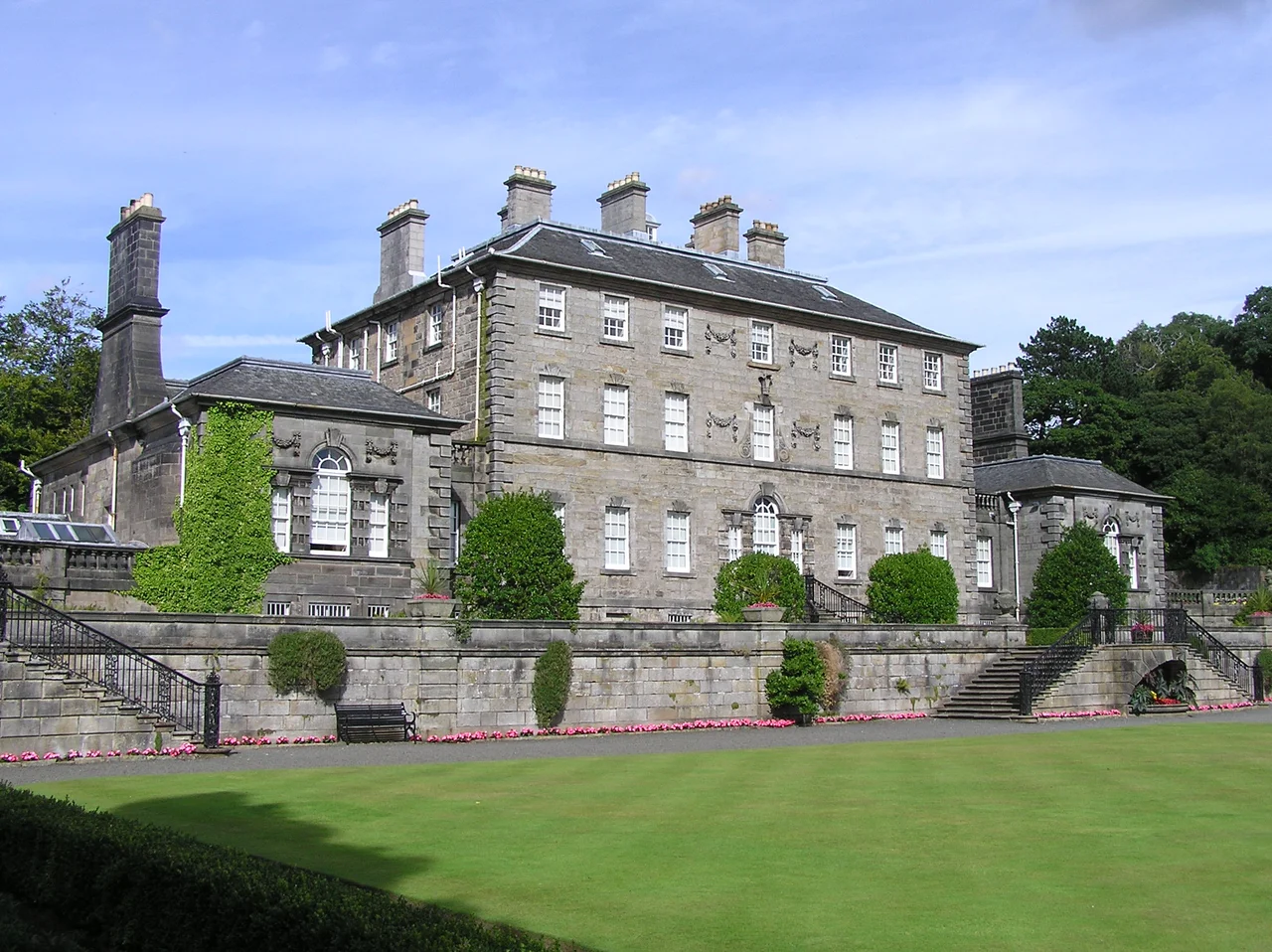

Pollok House
Almost seven hundred years. From the medieval period until 1966, the Stirling-Maxwell family held the lands of Pollok on the south side of Glasgow. When Dame Anne Maxwell Macdonald finally gifted the estate to the City of Glasgow in 1966, she ended a tenure that began before Bannockburn and ran through the Reformation, the Union of the Crowns, the Industrial Revolution, two world wars, and the rise of the modern welfare state. The house that anchors the estate - Pollok House, built in 1752 - sits inside Pollok Country Park, which also holds the Burrell Collection. Inside the house is something genuinely unexpected for a Glasgow country mansion: a private collection of Spanish paintings considered one of the finest in Britain.
An Adam House by the White Cart
The house was built in 1752 and is originally thought to have been designed by William Adam, though Adam may only have been consulted rather than fully commissioned. It was extended in the early 20th century by Rowand Anderson, the prolific Edinburgh architect best known for the National Portrait Gallery in his own city. Alexander Hunter Crawford modernised the interior in 1899. The stone arch bridge that carries the approach over the White Cart Water was built in 1757. The heraldic lions on the gate piers were carved in 1950 by John Marshall to a design by Huw Lorimer. The whole composition - house, bridge, stable courtyard, lions - has the unhurried symmetry of a country seat that knew it would be there forever. Until, of course, it stopped being so.
The Spanish Paintings
How a Glasgow country house ended up with paintings by El Greco, Francisco Goya, Alonso Sánchez Coello, and Bartolomé Esteban Murillo is a story of one family's deep and unusual taste. Sir William Stirling-Maxwell, the 19th-century baronet, was one of the first British scholars to take Spanish art seriously - his book Annals of the Artists of Spain helped establish the field in English. He collected accordingly. The Pollok collection now includes major works by all four Spanish masters, plus paintings by Rubens and William Blake, glass, silverware, porcelain, and antique furniture. The downstairs servants' quarters are accessible free of charge and include two shops and a restaurant - a quiet acknowledgment that for most of the history of houses like this, more people lived and worked below stairs than above. The whole house closed in November 2023 for approximately two years of work as part of a £4 million renovation project announced by the National Trust for Scotland.
The Pollok Witches
In 1677, six people were arrested for attempting to murder Sir George Maxwell of Pollok by witchcraft, allegedly causing his illness by roasting a wax image of him. The accused were five women and one man: Jonet Mathie, Annabell Stewart, John Stewart, Bessie Weir, Marjorie Craige, and Margaret Jackson. The official record describes them as apprehended and imprisoned, suspected guilty of witchcraft by entering into a pact with the devil, renouncing their baptism, and committing several malefices. The Scottish witch trials killed approximately 2,500 people between 1563 and 1736 - a per-capita rate higher than almost anywhere in Europe. Most of the accused were women, most were working class, and most were tortured into confessions of impossible crimes. We name Jonet, Annabell, John, Bessie, Marjorie, and Margaret here because their names survive in the record and they deserve to be remembered as people, not as a footnote to a baronet's illness. The 2022 National Trust for Scotland report on the witch trials, alongside a formal apology from the First Minister of Scotland the same year, has begun the slow public work of reckoning with what was done to them.
The Gardens and the Beech
Pollok's gardens are extensive enough to hold a collection of more than 1,000 species of rhododendrons. Behind the main house grows the Pollok Park Beech, a Fagus sylvatica thought to be 250 years old. Its trunk is unusually swollen - seven metres in girth at the ground, ten metres at ten metres of height - and the branches form a gnarled and improbable mass overhead. Trees of this age are rare in any urban setting. To stand under one in central Glasgow is to remember that this land was deeply rural until very recently. Beyond the gardens lies Pollok Country Park itself, with its herds of Highland cattle, its woodland walks, and the Burrell Collection nearby - the eclectic art museum holding Sir William Burrell's gifts to the city. Together the house and the park form one of the most generous civic bequests in Glasgow's history.
From the Air
Located at 55.828 degrees N, 4.3185 degrees W in Pollok Country Park on the south side of Glasgow. Best viewed from 1,500-3,000 feet. The Burrell Collection is the most prominent modern building nearby. Nearest ICAO airports: Glasgow International (EGPF) about 7 nm northwest and Glasgow Prestwick (EGPK) about 22 nm southwest. Look for the extensive parkland of Pollok Country Park surrounding the house, with the White Cart Water flowing through the grounds. The Highland cattle herds and rhododendron gardens are visible in the wider park during summer.
Nearby Stories
- Mauchline 3.6 km away
- Shotts 4.2 km away
- HMS Ulysses (1917) 7.7 km away
- Rothesay Castle 8.8 km away
- Inchcailloch 10 km away
- Strachur 14 km away
- Battle of Dollar 16 km away
- Crawford Castle 16 km away