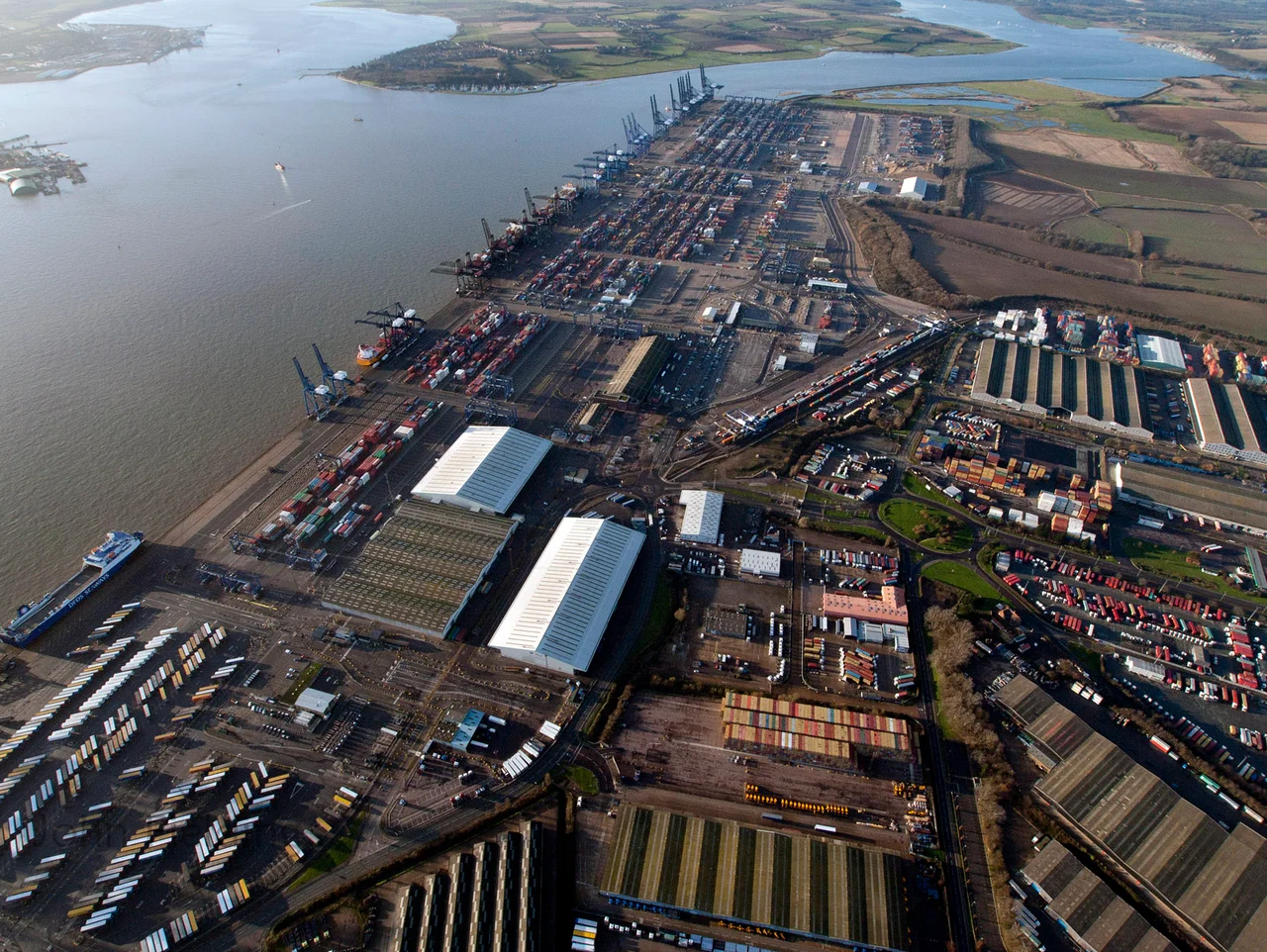

Port of Felixstowe
The math is staggering: nearly half of every container arriving in Britain passes through this single stretch of Suffolk coast. Felixstowe handles 48 percent of the United Kingdom's containerised trade, and on most days the quay-side is a slow-motion ballet of cranes, lorries, and ships the size of small towns. The strangest thing about it is the backstory. In the 1930s, Trinity College, Cambridge - the same college that gave the world Newton and Bacon - bought a stretch of land here that included a dock so insignificant it was excluded from national labour regulations. Six decades later, that overlooked little dock had become the busiest container port in Britain.
The Quiet Backwater
Before 1967, Felixstowe was a seaside resort, not a shipping hub. The Port of Felixstowe was operated by the Felixstowe Dock and Railway Company, a curious entity established by the Felixstowe Railway and Pier Act of 1875 and one of the few limited companies in Britain that does not include the word 'Limited' in its name. Trinity College, Cambridge, the freeholder, had bought the land in the 1930s in part because the dock was too small to be included in the National Dock Labour Scheme. That regulatory invisibility, which would have doomed most ports, became Felixstowe's competitive advantage. In 1967 the company struck a deal with the American firm Sea-Land Service and built Britain's first dedicated container terminal for 3.5 million pounds. Containers were still a novelty in Britain. Felixstowe bet early.
The Rise of the Box
By 1980 Felixstowe was the largest container port in the United Kingdom. Two new terminals, Dooley and Walton, opened in April 1981. The continuous quay now stretches more than 2.3 kilometres, served by 29 ship-to-shore gantry cranes, and the main channel has been dredged deep enough to accept Maersk's Triple E class, the leviathans launched in 2013 that carry 18,000 twenty-foot equivalent units at a time. The arithmetic of containerisation favours the biggest ports, and Felixstowe simply kept expanding. By 2017 it ranked 43rd among the world's busiest container ports and eighth in Europe. In March 2025, Hutchison Port Holdings announced the sale of its international port business, Felixstowe included, to a consortium led by MSC's Terminal Investment Limited (TiL) with BlackRock as co-investor - a quiet reminder that the global supply chain runs on capital flows as much as it does on steel boxes.
South Reconfiguration
In 2008, work began on Felixstowe South, a wholesale rebuild of the port's southern flank. The plan called for 1,300 metres of new quay, 12 additional ship-to-shore gantries, and clearance suited to extra-large box carriers. Inland, the rail line between Felixstowe and Nuneaton was cleared to W10 loading gauge so that hi-cube containers could ride trains all the way to the West Coast Main Line. Network Rail finished the Ipswich-to-Peterborough enhancement in 2008; the wider Nuneaton scheme came in at an estimated 291 million pounds. Hutchison Ports also helped fund capacity upgrades at the Copdock interchange, where the A14 meets the A12 outside Ipswich. The point of all this engineering is mundane and consequential: keeping the boxes moving once they leave the cranes.
Dockers Deserve Better
In the summer of 2022, the port stopped. Unite members voted 92 percent in favour of industrial action on an 81 percent turnout, after the company offered a 5 percent pay rise while retail price inflation ran at 11.9 percent. Coverage of the strike revealed that some Felixstowe dockers were relying on food banks and struggling to make mortgage payments - workers in Britain's largest container port unable to feed their families. On 24 August, footage spread across social media of a dock worker surfing in front of an Evergreen container ship, a Unite flag streaming behind him, AC/DC's Back in Black scored over the top. The image became a symbol of the dispute: tiny human, vast hull, defiance set to a guitar riff. The hashtag #DockersDeserveBetter trended.
The Choreography of Trade
From the air, Felixstowe is a geometry of coloured rectangles - stacked containers in red, blue, and rust - and the long arms of gantries that swing each box ashore in roughly 90 seconds. The port maintains its own police force, fire service, and ambulance crew, a small municipality dedicated to keeping freight in motion. A port chaplain from the Apostleship of the Sea works the gangways, offering practical help and a familiar voice to seafarers who may not have set foot on home soil for months. Look down on the orderly chaos of the quay and you are looking at the seam where a globalised world stitches itself together: shoes from Vietnam, electronics from Shenzhen, car parts from Germany, all queueing for a place on a British lorry.
From the Air
Coordinates 51.95 N, 1.31 E, at the mouth of the Orwell and Stour estuaries on the Suffolk coast. From cruising altitude, look for the geometric grid of stacked containers and the long quay lines stretching south-east into the North Sea. Nearest major airport is London Stansted (EGSS), about 50 nautical miles south-west; Norwich International (EGSH) lies 50 nm to the north. The Thames Estuary and London traffic patterns lie just to the south. Best viewed in clear conditions when the colours of the container stacks read against the grey-green of the North Sea.
Nearby Stories
- Ickworth House 3.6 km away
- Framlingham 7.9 km away
- Castle Hedingham 8.6 km away
- Battle of Assandun 8.6 km away
- Margate Surfboat 33 km away
- 1382 Dover Straits Earthquake 41 km away
- Four Days' Battle 48 km away
- Battle of Lowestoft 85 km away