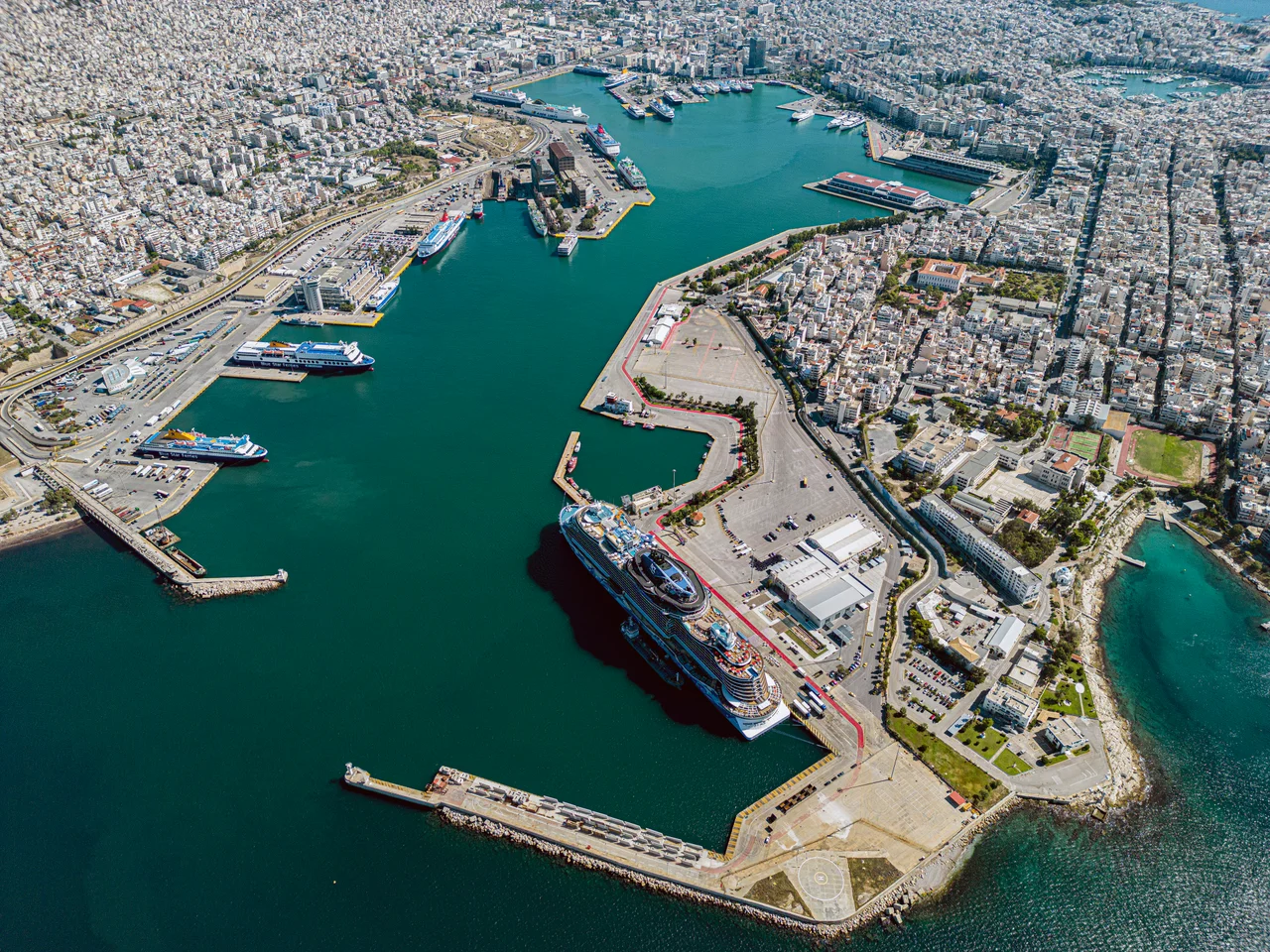

Port of Piraeus
In 480 BC, the Athenian fleet sailed from Piraeus to meet the Persian navy at Salamis, twelve kilometers away, and won one of antiquity's most consequential naval battles. The port that made that victory possible has been continuously active ever since — through Byzantine decline, Ottoman occupation, and Greek independence — and is still, two and a half millennia later, the most important maritime gateway in Greece. What Themistocles could not have imagined is that today its container terminals are majority-owned by a Chinese state shipping company, and that it ranks among the busiest passenger ports in Europe.
From Rocky Island to Naval Powerhouse
Before the third millennium BC, Piraeus wasn't connected to the mainland at all — it was a rocky island separated from Attica by a low-lying corridor that flooded with seawater most of the year. Gradual silting eventually bridged the gap permanently, creating the natural harbors that would define Greek naval history. The main harbor, Cantharus, was flanked by two smaller ones, Zea and Munichia. In 493 BC, the Athenian statesman Themistocles recognized what those harbors could become and began fortifying them. When the Athenian fleet relocated from the older harbor at Phaleron to Piraeus in 483 BC, the strategic picture shifted decisively. By 471 BC, the Themistoclean Walls were complete, enclosing the most formidable naval base in the Greek world. The fleet that departed from those docks defeated the Persians at Salamis, securing Athenian dominance for generations.
The Long Sleep and the COSCO Transformation
After the classical era, Piraeus fell quiet. The harbors served intermittently for the Byzantine fleet and lay largely dormant during the Ottoman period. Modern revival came slowly after Greek independence, and by the twentieth century Piraeus had grown into a major passenger port — the launching point for ferries to Crete, Rhodes, the Dodecanese, and the islands of the Aegean. Then came the debt crisis of 2009, and with it a radical change of ownership. Greece, desperate to raise cash, leased its container berths to the China Ocean Shipping Company — COSCO — in October 2009. The results were rapid and dramatic. In 2009, the entire port had handled only 450,000 TEUs (twenty-foot equivalent container units). By 2019, that figure had climbed to 5.65 million TEUs. By 2016, COSCO had bought 51% of the port outright for 280.5 million euros, and by 2021 held 67% of shares.
One of Europe's Busiest Passenger Ports
Container traffic gets the headlines, but Piraeus has long ranked among the busiest passenger ports in Europe, a fact that surprises people who associate that distinction with Rotterdam or Hamburg. In 2014, it processed about 18.6 million passengers — the ferries alone to the Greek islands generating enormous traffic. The passenger terminal operates around the clock. Terminal A, open 24 hours and within walking distance of central Piraeus, handles 1,200 passengers per hour; Terminal B, built in 2013, accommodates the mega cruise ships that have become a fixture of Mediterranean tourism, handling 1,500 passengers per hour with space for 120 tour buses. By 2019, 622 cruise ships called at Piraeus, which the port authority has consistently marketed as the top cruise destination in Greece, ahead of Santorini, Mykonos, Rhodes, and Crete. The port won 'Best Cruise Port in the Eastern Mediterranean Region' from MedCruise in 2019.
The Human Cost of Transformation
The efficiency gains under COSCO came with profound disruption for the workers who had built their lives around the port. Before privatization, union safety rules required nine workers to operate a single gantry crane; COSCO's contracts required four. The Greek government's 2012 austerity legislation reduced wages at public companies — including the port authority — by 35 to 40 percent. Port workers staged repeated strikes and demonstrations against the privatization and its terms, representing a genuine dispute about what prosperity means when it flows to shareholders while the people operating the cranes take pay cuts. The tensions were real and unresolved. That said, the port's financial performance strengthened considerably: pre-tax profits reached 112.9 million euros in the period ending 2024, a 17.4 percent increase year-on-year.
Where Antiquity Meets the Belt and Road
Piraeus now sits at the western end of China's Belt and Road Initiative — the overland and maritime network Beijing has developed across Eurasia and beyond. Containers that arrive in Piraeus by sea are loaded onto freight trains headed north and east through the Balkans toward Central Europe, bypassing the heavily congested northern European ports. This geographic positioning — at the intersection of three continents — is what made Piraeus attractive to the Athenians and to Themistocles, and what makes it attractive to COSCO today. The deepwater harbor that once sheltered the triremes of the Athenian fleet now berths some of the largest container ships afloat. The geography hasn't changed. Only the scale, and who profits from it.
From the Air
The Port of Piraeus lies at 37.94°N, 23.64°E on the Saronic Gulf, about 10 km southwest of central Athens. From altitude, the port is unmistakable: a sprawling complex of quays, container cranes, and passenger terminals extending into the blue water of the gulf. Cruise ships and large ferries are often visible at the passenger terminals along the northern edge of the port. Athens International Airport (LGAV / Eleftherios Venizelos) is approximately 35 km to the east-southeast. The coastal approach to Athens from the west passes directly over Piraeus, making the port one of the first recognizable landmarks for aircraft inbound from Italy or Western Europe. Recommended viewing altitude is 3,000–5,000 feet for a good perspective on the harbor layout and the distinction between the three passenger terminals and the container docks to the south.
Nearby Stories
- Parnitha 3.4 km away
- Kea (island) 7.3 km away
- Sanctuary of Apollo Maleatas 11 km away
- Sousaki Volcano 12 km away
- Battle of Leuctra 14 km away
- Great Sand Beach 18 km away
- Agios Georgios (island) 23 km away
- Skyros 84 km away