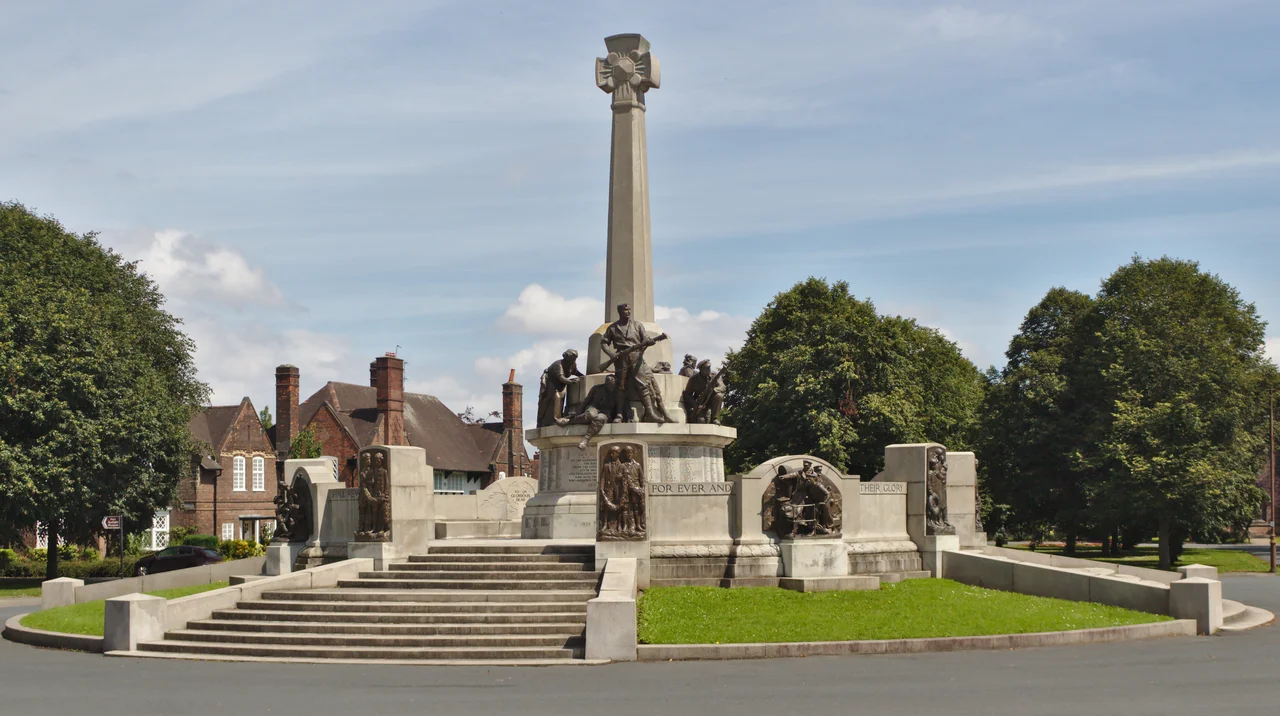

Port Sunlight War Memorial
Sergeant Eames had been blinded at the Somme. Private Robert Cruickshank had been awarded the Victoria Cross for charging Turkish positions in Palestine. On 3 December 1921, the two of them - chosen by ballot of all the Lever ex-servicemen - stood together at the heart of Port Sunlight and pulled the covers off the new war memorial. There was no royalty, no archbishop, no field marshal. William Lever, the soap magnate who had built the village, had insisted that the men who had served should be the ones to do this. Over 4,000 of his employees had gone to the war. Five hundred and three had not come back. The memorial they unveiled that December afternoon now stands at the geographic centre of Lever's model village, where its two broadest avenues - The Causeway and The Diamond - cross.
Defence of the Realm
Most war memorials of the period showed soldiers, angels, or grieving women. Lever wanted something different. As chairman of the Empire War Memorial League he had thought hard about how to commemorate a war that had threatened civilians as well as armies. Although he was 63 when war broke out, he had joined the Birkenhead and District Volunteer Training Corps - a kind of proto-Home Guard - because he genuinely expected an invasion. He wanted his memorial to argue that the war had been fought to protect the people back home, not only the soldiers at the front. So he asked the Welsh sculptor Goscombe John to design a memorial with the theme Defence of the Realm. The figures would include not just soldiers but women, children, a nurse, a Boy Scout. The civilians would be commemorated alongside the dead. It was unusual then. It still is now.
The Sculptor's Eye
Goscombe John was already in his sixties when Lever approached him in 1916, but he was at the peak of his powers. He had trained in Paris under Rodin's contemporaries and brought a French sensibility to British public sculpture. For Port Sunlight he produced eleven larger-than-life bronze figures arranged around an octagonal granite plinth, surmounted by a runic cross 11.6 metres high. Three soldiers - one wounded, attended by a nurse. A seated woman cradling a group of infants. A girl with her younger brother. A Boy Scout standing watch. When he exhibited the models at the Royal Academy in 1919 and 1920, what impressed the critics most was their realism. The wounded soldier looked wounded. The mother looked like a mother. The bronze had weight and breath. Some critics complained the figures were too realistic for a memorial. Lever's own company architect James Lomax-Simpson thought it was all too complicated and would have preferred something simpler. Lever and Goscombe John ignored them.
Four Reliefs Around the Parapet
Around the circular parapet at four points face the road, Goscombe John set four bronze reliefs depicting the services. The Naval relief. The Military relief. The Anti-Aircraft relief - an acknowledgement of how the war had brought bombing to civilian skies. The Red Cross relief, honouring the nurses and stretcher-bearers and ambulance drivers. Between these run four more reliefs of children carrying wreaths, all of them different children, none of them generic. The whole monument is 22.4 metres in diameter, a circle deliberately matched to the model village's grand avenues. You can sit on one of four stone seats built into the parapet and read the inscription carved on the back of each: TO OUR GLORIOUS DEAD. The names of the dead - the 503 from the First World War, with later names added after the Second - cover the sides of the plinth. Lever had originally wanted every employee who served listed, but there were over four thousand of them, and the granite could not bear that much carving.
Two Wars and a Promotion
By the time the Second World War ended, new names needed adding. The dates 1939-1945 were carved on the lower part of the back of the plinth, with the additional dead inscribed alongside the originals. The memorial was first listed for protection on 20 December 1965 at Grade II - the standard heritage designation. On 28 October 2014, after decades of scholarly reassessment, Historic England raised the listing to Grade I, the highest category, reserved for buildings of exceptional interest considered sometimes to be internationally important. Only a handful of war memorials in England hold Grade I status. Nikolaus Pevsner, the great chronicler of English buildings, called it genuinely moving and free of sentimentality. The current Buildings of England volume calls it deeply moving. The British Pathe newsreel of the 1921 unveiling still exists - you can watch Eames being led forward by Cruickshank, the two of them tugging the silk cords together, the bronze figures emerging into Cheshire winter light.
Standing at the Crossroads
Lever's model village was built around a moral argument: that working people deserved beauty, fresh air, and dignity in equal measure with wages. The streets are wide. The cottages are picturesque. The Lady Lever Art Gallery sits at one end of The Diamond. Every part of the village converges on this memorial at the centre, and the memorial in turn looks outward at the houses where the dead had lived. It is impossible to walk through Port Sunlight without encountering it. The Causeway runs east-west through the heart of the village. The Diamond runs north-south. They cross at this monument. Lever died in 1925, four years after the unveiling. His ashes are interred at Christ Church in Port Sunlight, a short walk from the memorial he commissioned. He kept his promise to commemorate the men who worked for him. He just had not expected to be commemorated alongside them.
From the Air
Port Sunlight War Memorial sits at 53.353°N, 2.998°W at the centre of Lever's model village on the east bank of the Wirral Peninsula, just south of Birkenhead. Best viewed at 1,500-3,000 ft. Liverpool John Lennon Airport (EGGP) is 6 nm east-southeast across the Mersey. Look for the regular geometric pattern of the model village's wide avenues converging on a central circular monument - the memorial sits at the precise intersection of The Causeway and The Diamond.
Nearby Stories
- RAF Wrexham 3.3 km away
- Birkdale Palace Hotel 3.7 km away
- Turton Tower 4.1 km away
- Tatton Park 5.6 km away
- Abergele Rail Disaster 9.6 km away
- Diglake Colliery Disaster 13 km away
- Ysbyty Ifan 16 km away
- Celtic Array 62 km away