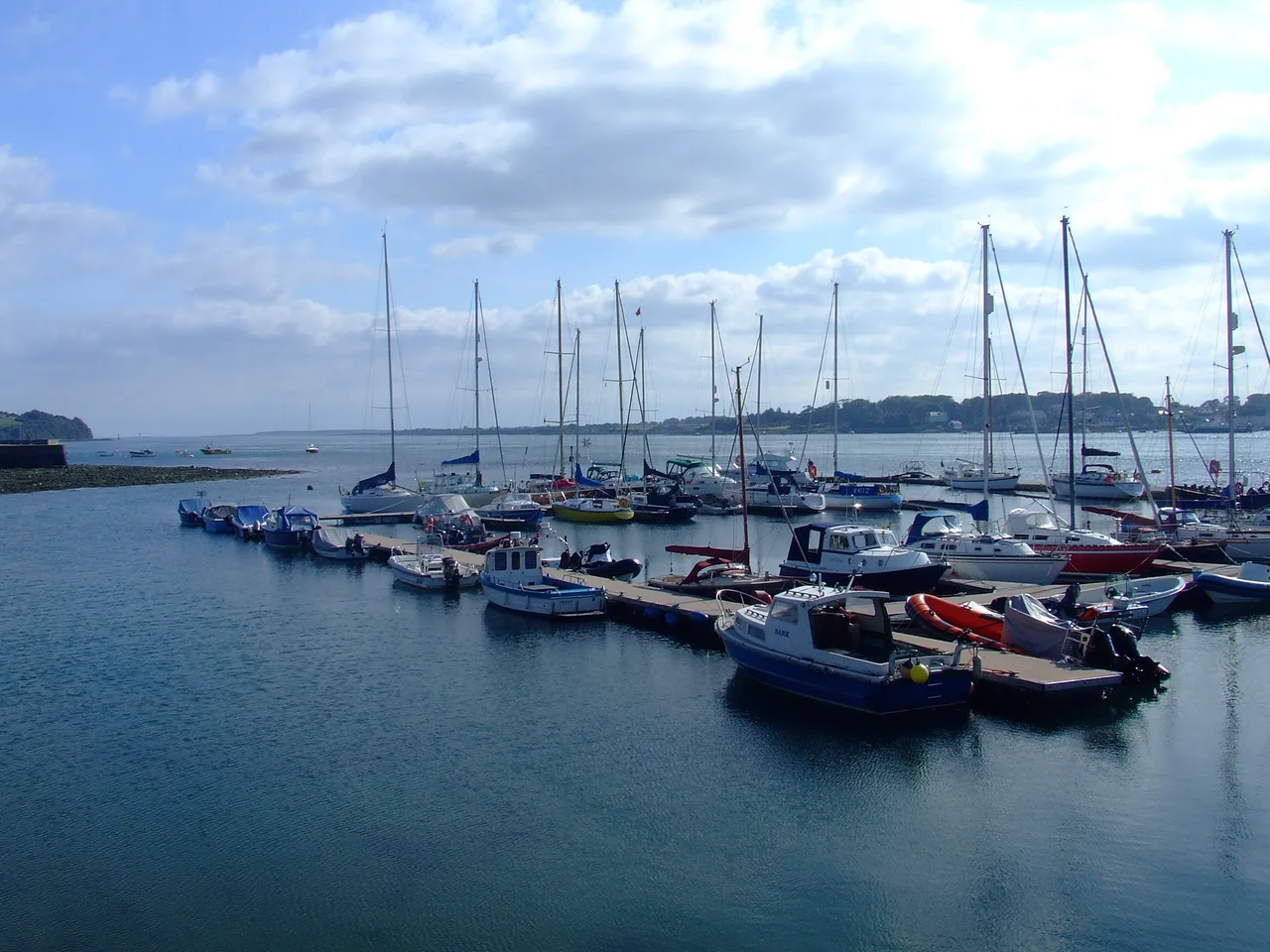

Portaferry
Two engineers, two centuries apart, looked at the water rushing past Portaferry and saw the same thing - a force begging to be harnessed. The first, Cistercian monks at Nendrum, built a tide mill in the seventh century whose timber pilings still survive in the mud nearby. The second, working in 2008, lowered a 1.2-megawatt twin-rotor turbine called SeaGen into the Narrows just offshore and powered a thousand homes from the same daily flood. Between them lies a small village of around 2,500 people at the tip of the Ards Peninsula, where every thirty minutes a stubby car ferry pushes off across less than a mile of churning water to reach Strangford on the opposite bank.
A Village at the Narrows
Portaferry sits where the Ards Peninsula curves toward its conclusion and Strangford Lough drains into the Irish Sea. The channel here, the Narrows, is barely 1,500 metres wide but funnels 400 million gallons of seawater in and out twice a day. The village faces this gauntlet head-on, with Georgian buildings ringing a small square and a Market House now repurposed as a community centre. The ferry that links Portaferry to Strangford has run for nearly four centuries without a meaningful break, and it still carries about 500,000 people a year. The crossing takes eight minutes. The alternative is a 47-mile drive around the lough, which takes about an hour and a half - a fact every commuter on the peninsula understands intimately.
Two Thousand Species
Strangford Lough is the largest sea inlet in the British Isles, 150 square kilometres of mudflat, island and tidal current. It is also one of the most biologically dense marine sites in the world. More than 2,000 marine species have been recorded here, and the lough holds the most important common-seal breeding site in Ireland. Queen's University Belfast runs a marine research laboratory on Portaferry's shorefront, studying everything from coralline algae beds to the carpet sea squirt, an invasive species that arrived in 2012. The lough was designated Northern Ireland's first Marine Nature Reserve, and the village's Exploris aquarium lets visitors meet the rays and sharks that share these waters. In winter, three-quarters of the world population of pale-bellied brent geese arrives to feed on the eelgrass beds.
Where the Tide Becomes Electricity
The same currents that make the Narrows treacherous also make them valuable. SeaGen, installed in 2008, was the world's first commercial-scale tidal stream generator, exporting 11.6 gigawatt-hours to the grid before its decommissioning began in 2016. Marine biologists monitored it carefully and found that seals learned to transit at slack water when the rotors were still. Today the Swedish company Minesto operates a workshop and offices in the village, testing tidal-kite turbines that swoop through the water like underwater stunt planes. The lough has effectively become a laboratory for the renewable-energy industry - tidal power, unlike wind or wave, can be predicted to the minute, decades in advance.
Saints, Lifeboats and Linen
Two miles outside the village lies Cooey's Wells, where a church is thought to have stood since around the seventh century and three springs still draw pilgrims seeking healing. In the village proper, the RNLI maintains an Atlantic 85 lifeboat - at speeds up to 34 knots, it is the fastest seagoing rescue craft in the institution's fleet, an essential service for the fishermen working prawns and crabs in the lough. Portaferry once played its own quiet role in industry too: the linen company Thomas Somerset and Co. employed women across the town to embroider handkerchiefs, and realising they worked faster in long daylight, installed the first electric light fittings outside Belfast in any Ulster village - one bulb per household with a working woman, plus a bus service to bring more workers in from along the peninsula.
The People Who Left
For a village of its size, Portaferry has produced a remarkable diaspora. Hugh Glass, born here in 1817, sailed for Australia and became one of the great pastoralists of Victoria. Joseph Tomelty, born in 1911, became one of Ireland's most beloved actors and playwrights. Father Vincent McNabb, the Dominican priest and philosopher, was born in the village in 1868. More recently, middle-distance runner Ciara Mageean, born in 1992, has carried the village name onto international athletics podiums, and singer-songwriter Ryan McMullan has done the same in music. Bishop Robert Echlin, who held the see of Down and Connor from 1612 to 1635, never left - he is buried in the ancient ruins of Templecraney just off Church Street.
From the Air
Portaferry sits at 54.38N, 5.55W on the Ards Peninsula tip in Northern Ireland. From altitude, look for the long thin shape of Strangford Lough opening into the Irish Sea through the narrow Strangford channel; Portaferry occupies the eastern bank. Nearest airport is Belfast City (EGAC), about 23 nautical miles northwest. George Best Belfast City Airport is the typical inbound; Belfast International (EGAA) lies further west. Recommended viewing altitude 2,000-4,000 feet for the contrast between the dark sheltered lough and the open Irish Sea. Watch for the ferry crossing the Narrows on a regular cadence.
Nearby Stories
- Silent Valley Reservoir 1.7 km away
- Drummore 3 km away
- Copeland Islands 5.2 km away
- Castle Upton 8.4 km away
- Hillsborough Castle 9.5 km away
- Bradda Head 11 km away
- Pasages (steam trawler) 20 km away
- Chicken Rock Lighthouse 41 km away