.jpg)
Porth Hellick Down
There is more Bronze Age burial architecture concentrated on Porth Hellick Down than anywhere else on Earth. Walk the heath south-east from Holy Vale, climb a low rise above the bay, and you find yourself among at least six entrance graves, scattered cairns, and the faint stone line of a 4,000-year-old field boundary. The largest of them is a structure that the Franco-British antiquarian George Bonsor excavated in 1899 and chose to name, with no apparent modesty, The Great Tomb. The Isles of Scilly hold dozens of these graves across their few square kilometres of land, but Porth Hellick Down is the densest collection anywhere in the world.
What an Entrance Grave Is
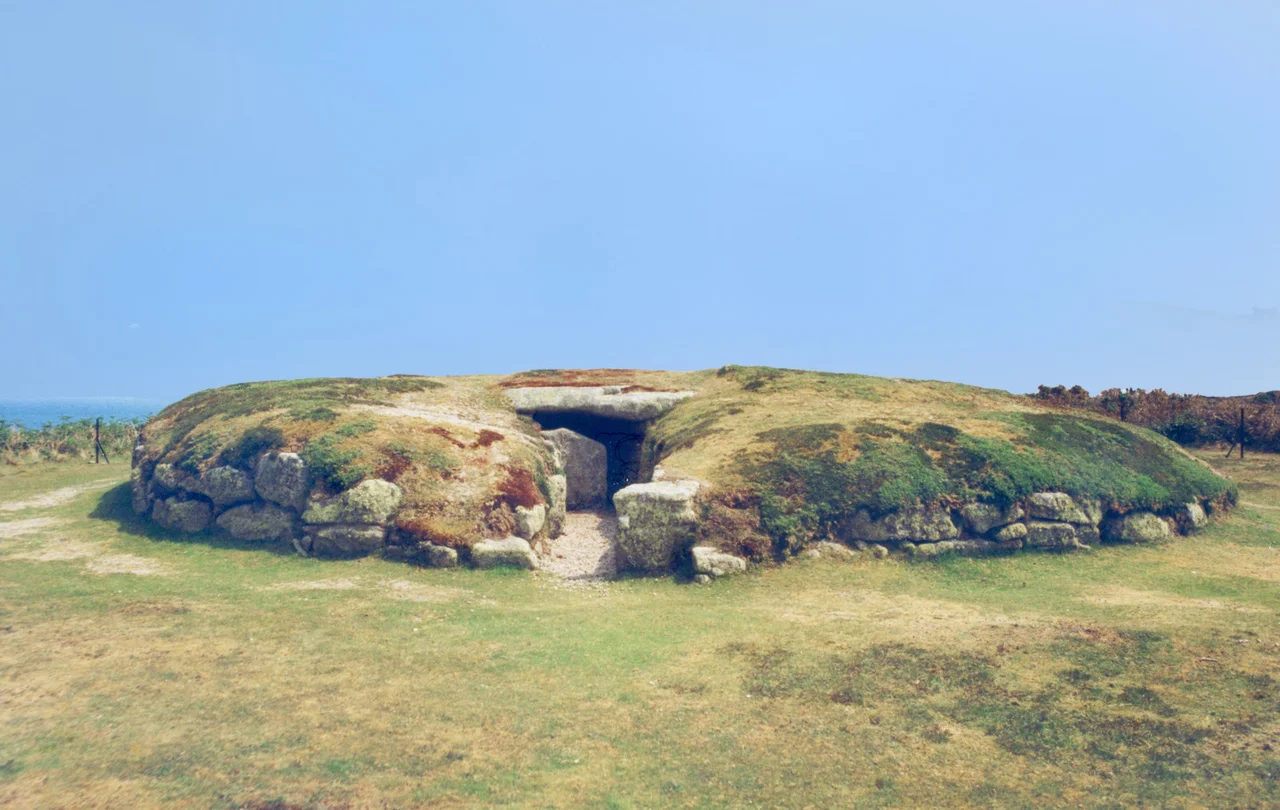
An entrance grave is a Neolithic and Bronze Age burial monument built mainly along the Atlantic coast of Cornwall, the Isles of Scilly, and the south-west of Ireland. A low circular mound of stones is held in shape by a kerb of larger slabs. A short passage leads from the edge of the mound into a rectangular or D-shaped burial chamber roofed by flat capstones. The chamber typically held cremation deposits, sometimes accompanied by pumice, pottery fragments, or beads. The form is local. You will not find true entrance graves in central Britain. Their concentration on Scilly suggests that the islands were a culturally distinctive community across the Bronze Age, more closely linked to the sea routes of the western coasts than to the inland tribes of southern England.
The Great Tomb
The largest and best-preserved entrance grave on Porth Hellick Down stands on the north-western slope, near the line of the prehistoric field boundary. The mound is 12.25 metres across and rises to 1.6 metres high, retained by a kerb of large slabs. The chamber inside is D-shaped, 3.5 metres long by 1.5 metres wide, and 1 metre high. Four heavy capstones roof it, each 2.5 metres long by 1.25 metres wide. Constructed between roughly 2000 and 1500 BC, it was excavated by the Franco-British antiquarian George Bonsor in 1899. Earlier unrecorded diggings had emptied most of the chamber; Bonsor found a piece of pumice and a few late Bronze Age pottery fragments. His work was nonetheless the first excavation on Scilly to be properly recorded. He named the structure The Great Tomb.
The Coffin Grave
The westernmost entrance grave at the site is known as the coffin grave, named for the shape of its chamber. The mound's kerb measures 8.3 by 8 metres. The chamber inside runs 7 metres long, narrowing at both ends and bulging out in the middle, like a coffin or a boat hull seen in plan. The walls are lined with stone slabs and four capstones roof it. The entrance, partly blocked, faces east. The boat-shaped chamber is unusual; most entrance graves are simple rectangles or D-shapes. Whether the resemblance to a boat reflects a deliberate maritime symbolism, or is simply the geometry that fitted the available stones, is not knowable. But the people buried here lived on islands. The line between vessel and tomb may not have been as fixed for them as it is for us.
A Grave That Used the Earth
One of the entrance graves on Porth Hellick Down is built directly into a massive granite rock outcrop. The natural rock is part of the burial chamber, integrated into the structure rather than removed or worked around. The grave consists of a 13-metre-wide mound of stacked rubble, 1 metre high. The southern end of the chamber is lined with slabs on the west side, with a large boulder on the east. A capstone bridges them. This grave is mostly intact, having lost only a single capstone over the millennia. The use of natural outcropping in the construction is uncommon even for Scillonian entrance graves, where every monument seems to be slightly different from every other. Whoever built this one chose to let the island's own stone do part of the work.
Lines on the Land
Across the eastern slope of Porth Hellick Down runs a prehistoric linear boundary, a nearly straight line of small upright stones, each up to half a metre high, spaced 1.5 to 6 metres apart. The boundary stretches south-east to north-west for 17 metres, then continues for another 23. It is barely there. The stones are mostly under heather and turf, and a walker passing by could easily miss the line entirely. But this is part of what makes Porth Hellick Down rare. Linear stone boundaries of this kind are uncommon in prehistoric Britain. The Isles of Scilly, however, hold several, and they tend to associate directly with groupings of burial monuments. The boundary may have separated the dead from the living, or fields from grazing, or one community's land from another's. We do not know.
Flight Context
Coordinates: 49.9183°N, 6.2811°W. Porth Hellick Down rises just inland from Porth Hellick Bay on the south-east coast of St Mary's, between Old Town and the Innisidgen burial chambers to the north-east. From 2,000 feet the down appears as low heath above the curved bay; the entrance graves themselves are hard to spot from the air, registering only as small stone bumps among the gorse. St Mary's Airport (EGHE) sits 1 kilometre to the south-west. The site pairs naturally with Porth Hellick Bay below it and the Bant's Carn entrance grave further north on the same island.
From the Air
Coordinates: 49.9183°N, 6.2811°W. Porth Hellick Down rises just inland from Porth Hellick Bay on the south-east coast of St Mary's, between Old Town and the Innisidgen burial chambers to the north-east. From 2,000 feet the down appears as low heath above the curved bay; the entrance graves themselves are hard to spot from the air, registering only as small stone bumps among the gorse. St Mary's Airport (EGHE) sits 1 kilometre to the south-west. The site pairs naturally with Porth Hellick Bay below it and the Bant's Carn entrance grave further north on the same island.
Nearby Stories
- Penlee Lifeboat Station 5.5 km away
- Black Swan Project 20 km away
- Tater Du Lighthouse 25 km away
- The Brisons 31 km away
- 1979 Fastnet Race 54 km away
- SM U-27 110 km away
- HMS Affray 149 km away
- Tower of Hercules 700 km away