.jpg)
Porth Wen Brickworks
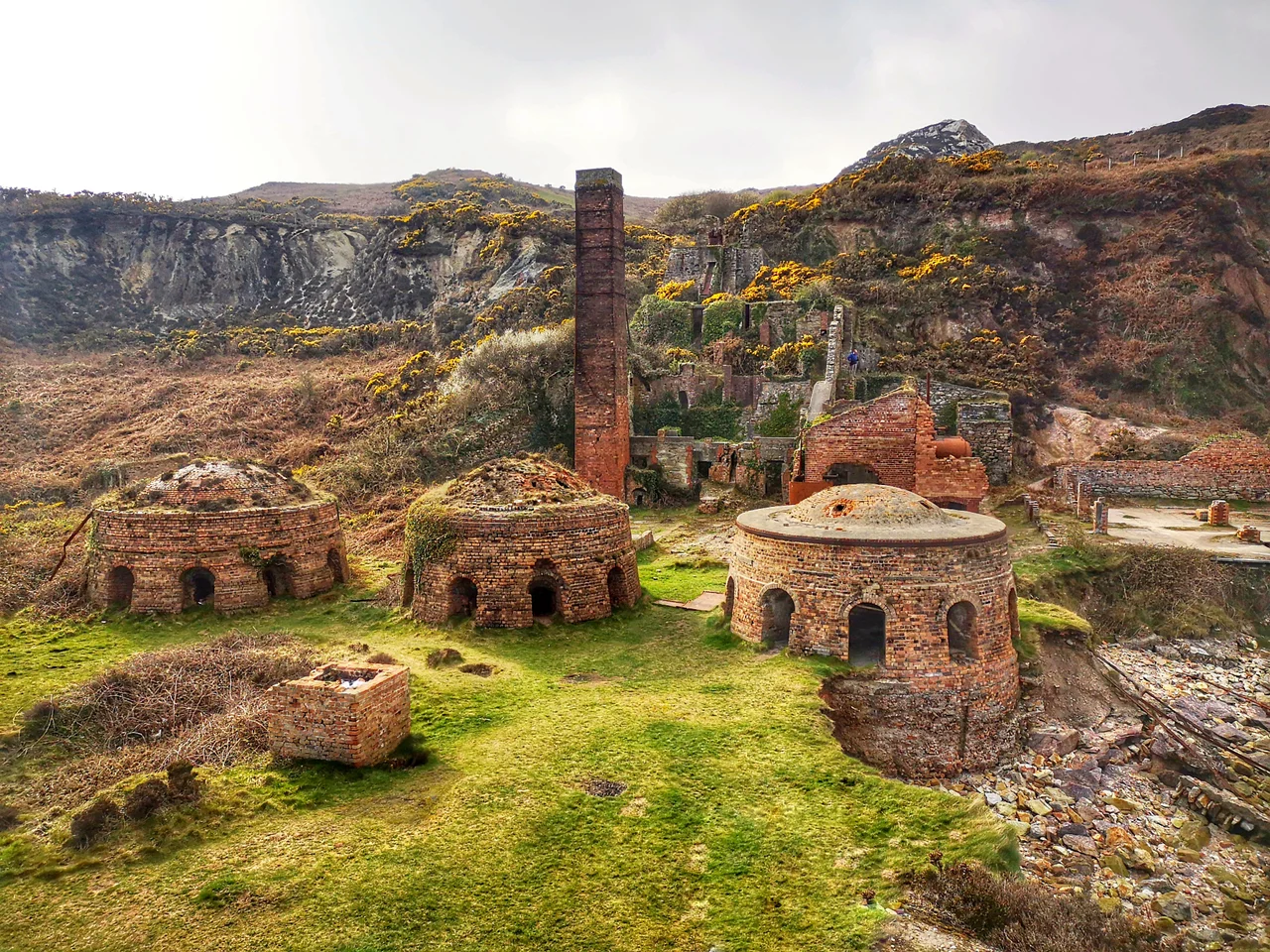
Three brick beehive kilns stand on the ledge above the cove. Their domed roofs are still mostly intact - circular brick structures bound with rusting iron bands, each big enough to walk into through a narrow blocked-up doorway. Beside them rises a tall chimney, the storage hoppers, the moulding shed, the boiler house with the remains of a five-drum Stirling boiler still in place. A gravity-powered incline tramway descends from the quartzite quarries above to the works, and from the works down to the quay where ships once moored to take on cargoes of finished bricks. Production ceased somewhere between 1924 and 1949 - sources differ on which - and Porth Wen brickworks has been sliding back into the cliff ever since. The sea has begun to take the lower buildings. The cliffs are crumbling. What survives is one of the most photogenic industrial ruins anywhere on the British coast.
White Bay and the Quartzite
Porth Wen means White Bay - the name probably comes from the pale quartzite cliffs above the cove. The brickworks sits on the western side of the bay, in the community of Llanbadrig, 2 kilometres west of Porth Llechog and 3 kilometres north-east of Cemaes. Charles E Tidy built the works in the mid-nineteenth century to exploit the quartzite outcropping just above the cliff. Crushed and mixed with lime, quartzite makes silica fire bricks - the material that lines the inside of steel-making furnaces, where ordinary brick would simply melt. The Victorian iron and steel industry needed enormous quantities, and a coastal site like Porth Wen meant the bricks could be loaded directly onto ships. The works expanded through the late nineteenth and early twentieth centuries; most of the surviving buildings date from the major rebuild around 1900. The site lies within the Anglesey Area of Outstanding Natural Beauty - a protected coast since 1967, by then long after the works had stopped.
The Tramway and the Mill
The brickmaking process began at two quarries on the cliff above the works. Stone was cut, broken to portable size, and lowered to the works by an incline tramway. The winding house at the top of the incline held two lateral stone walls supporting a square drive shaft on bearings. Three wheels turned on the shaft - one a banding brake about 2 metres across, two driving wheels at 1.5 metres - and a wooden control beam still survives in front of the drive shaft. The incline was gravity-powered: loaded trucks descending pulled empty ones up by means of the cable wound on the drum. Below the incline, the quartzite was fed into the crushing house where a knapping machine smashed it into smaller pieces. The fragments were chuted down to lower levels for further reduction, in part by hand - the workers wearing iron-covered gloves to hammer the stone into fine powder. The powder was mixed with lime and water in a pan mill, then moulded into bricks in the moulding shed.
Beehive Kilns
The shaped bricks dried in the drying sheds, then went into one of the three circular down-draught kilns. Down-draught kilns - sometimes called beehive or Newcastle kilns - are domed structures that pull the heat down through the stacked bricks before drawing it up the chimney, which gives a more even fire than older up-draught designs. The kilns at Porth Wen still stand essentially complete, made of brick with iron banding holding the domes against the outward pressure of the firing temperatures. Each kiln could fire several thousand bricks in a single load over four or five days. Once fired, the bricks went into the warehouse, then out to ships at the quay. A small engine house contained the steam engine that drove the works; the boiler house held the Stirling boiler. By the late 1920s production had ended. The buildings simply stayed where they were.
Coast as Museum
Cadw designated Porth Wen Brickworks a scheduled monument in 1986, classifying it as a post-medieval industrial brickworks. The Anglesey Coastal Path passes the site, though reaching the ruins themselves requires a careful scramble down the cliff path - there is no official access route, and the National Trust and Cadw both note the structures are in a delicate state. Coastal erosion has already destroyed parts of the quay and lower buildings; the long-term future of the site depends on the rate at which the sea eats the cliff. Photographers and industrial archaeologists make the pilgrimage anyway. The kilns and the chimney, set against the white quartzite cliffs and the green sea, have appeared in countless coffee-table books of British ruins. There is something specific about Porth Wen - the completeness of the surviving equipment, the remote setting, the fact that you have to work to reach it - that has made it one of the iconic industrial ruins of the United Kingdom.
From the Air
Porth Wen Brickworks at 53.42 N, 4.41 W, on the north coast of Anglesey, on the western side of Porth Wen bay between Cemaes Bay (3 km south-west) and Porth Llechog (2 km east). From the air the brickworks are visible as a cluster of brick structures on a narrow ledge above the cove, with three domed beehive kilns and a tall chimney distinguishable in clear conditions. The site lies between the Wylfa nuclear power station (4 km west, with its unmistakable twin reactor buildings) and the harbour town of Amlwch (5 km east). Nearest airports: Anglesey/Valley (EGOV) 13 nm south-west, Caernarfon (EGCK) 19 nm south. The north coast of Anglesey is exposed to Atlantic weather; visibility is best after fronts have cleared.
Nearby Stories
- Llandudno Lifeboat Station 3.8 km away
- Glynllifon 6.1 km away
- German submarine U-1024 9.4 km away
- Irish Sea Bridge 11 km away
- Ysbyty Ifan 12 km away
- Irish Sea 18 km away
- Celtic Array 18 km away
- Birkdale Palace Hotel 56 km away