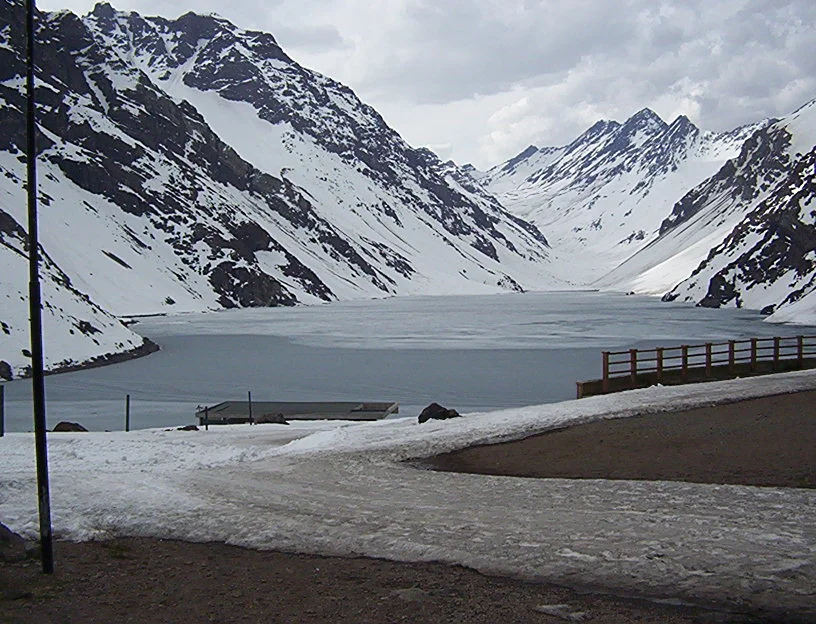

Portillo
There is no village here. There is no town, no cluster of chalets, no main street. There is only a single yellow building, the color of a school bus, standing alone beside a frozen turquoise lake at nearly 3,000 meters in the Chilean Andes. This is Portillo, and its isolation is the entire point. The serpentine road to Mendoza in Argentina runs right past the front door, trucks grinding toward the border tunnel, while skiers carve the slopes that fall away on either side. When winter storms close that road, the hotel becomes an island, and the few hundred guests inside become, for a week, a small and slightly giddy society of their own.
The Yellow Hotel by the Lake
Hotel Portillo opened in 1949, a 125-room landmark built by the Chilean government in a notch of the cordillera the locals called the "little pass." In 1961 the state sold it to two Americans, and the resort has stayed in private hands since, run with the clubby intimacy of a place that takes only a few hundred guests at a time. The setting does the heavy lifting. The hotel faces the Laguna del Inca, a long ribbon of meltwater that glows an improbable blue-green even when the surrounding peaks are buried in snow. Folklore gives the lake its melancholy: an Inca prince named Illi Yunqui is said to have laid his bride, Princess Kora-Illé, to rest in its waters after she fell during a wedding ceremony, and the lake supposedly took its color from her eyes.
The Year the Mountain Fought Back
Portillo's owners wanted the world to notice their new resort, so they made an audacious bid to host the 1966 Alpine World Ski Championships, the first time the event would ever come to the Southern Hemisphere. Then the mountain nearly ended the dream. A year before the races, a ferocious storm battered the Andes with winds reported near 200 kilometers an hour, triggering avalanches that tore out almost every newly installed lift. The resort rebuilt in less than twelve months. In August 1966, the head of the international ski federation stood alongside Chilean president Eduardo Frei Montalva to open the championships. Nearly sixty years later, it remains the only time the worlds have been staged below the equator.
Skiing Off the Edge of the Map
Portillo's terrain rewards people who can actually ski. Open powder bowls spill straight off the lifts into off-piste lines, and the resort runs some of the only "slingshot" lifts on Earth: the va-et-vient, a bar that fires several skiers uphill at once across slopes too steep and avalanche-prone for ordinary chairs. Backcountry powder waits just beyond the road, with almost no competition for the lines. The reward at altitude is a view that stops conversation. Helicopters lift sightseers over the ridgelines, and on a clear day the white pyramid of Aconcagua, the highest peak in the Americas, fills the windows just across the Argentine frontier.
Pisco, Powder, and a Heated Pool
Because there is nowhere else to go, the social life folds inward. Hotel Portillo runs all-inclusive, serving four meals a day with a famous, almost comic efficiency, and the unofficial house drink is the pisco sour, the grape-brandy cocktail that doubles as Chile's national pour. An outdoor pool steams in the cold, warmed by the mountain's own geothermal heat, an absurd and wonderful contrast to the snowfields above. After midnight, staff and locals gather at La Posada just outside the hotel, where the night runs late and the altitude makes everything feel a little more vivid than it should.
From the Air
Portillo sits at 32.83°S, 70.05°W, roughly 2,880 meters above sea level in the Chilean Andes, a few kilometers west of the Argentine border. The unmistakable visual marker is the long turquoise sliver of Laguna del Inca beside the single yellow hotel building, ringed by snow-capped peaks. The Cristo Redentor tunnel route to Mendoza passes immediately below. A scenic survey altitude of 13,000 to 15,000 feet keeps you clear of surrounding ridges while framing both the lake and nearby Aconcagua to the northeast. The nearest major airports are Santiago's Comodoro Arturo Merino Benítez (SCEL) about 145 km west and Mendoza's El Plumerillo (SAME) to the east. Expect strong mountain turbulence, rapid weather changes, and frequent winter whiteouts that close the pass below.
Nearby Stories
- Cerro El Plomo 22 km away
- Battle of Chacabuco 23 km away
- Uspallata 37 km away
- 1965 La Ligua earthquake 42 km away
- Museum of Memory and Human Rights 44 km away
- Bodega Catena Zapata 66 km away
- El Leoncito National Park 83 km away
- Battle of Papudo 123 km away