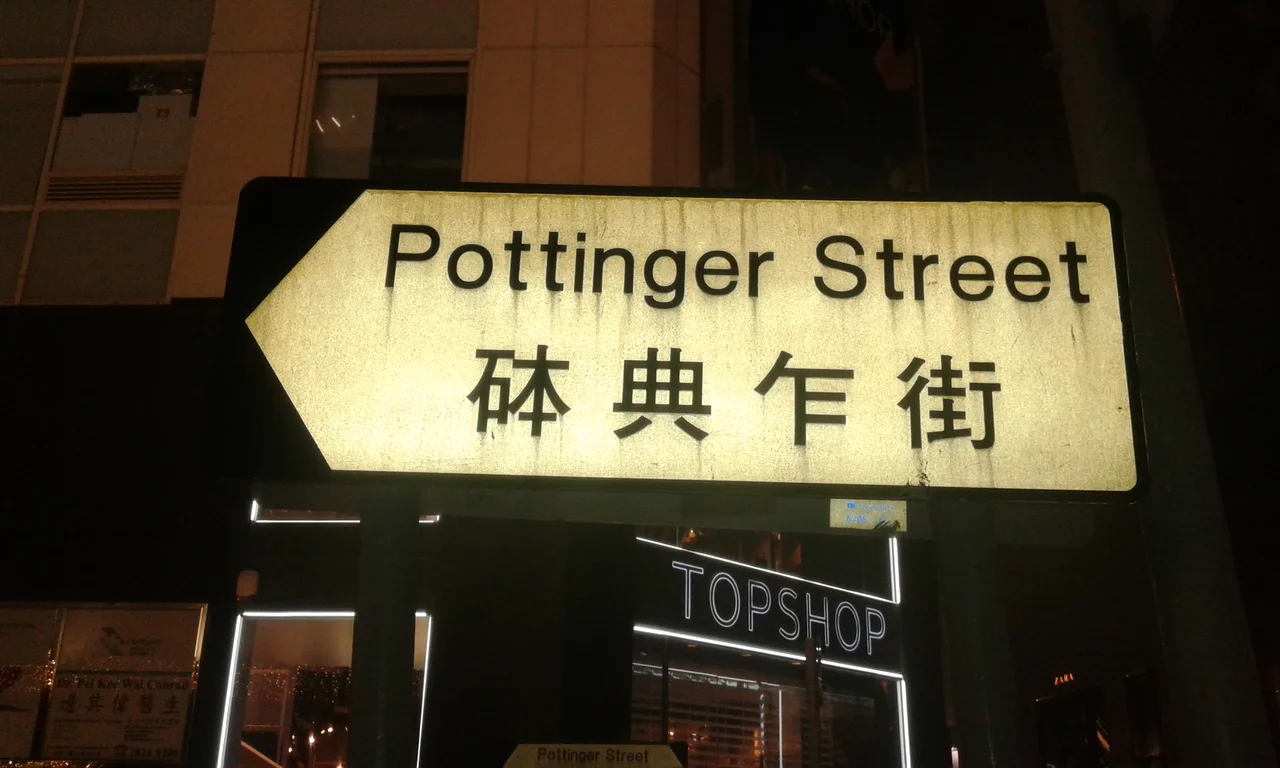

Pottinger Street
Somewhere beneath the granite steps of Pottinger Street, sealed inside bedrock since the 1980s, lies a forgotten tunnel. Engineers dug it in 1940 and 1941 as an air-raid shelter, certain that war was coming. The war came. The tunnel did its job, then the city grew over it and moved on — the way Hong Kong tends to. Above ground, the steps remain: uneven, worn, original. Pottinger Street is one of the oldest streets in Central, and it has spent 180 years collecting layers.
The Stone That Names It
Locals call it Stone Slabs Street — *Shek Ban Gaai* — because the name says exactly what it is. From Queen's Road Central, the street climbs the hillside through Stanley Street and Wellington Street before reaching Hollywood Road, and every centimetre of that ascent is paved in hand-laid granite, uneven and irregular in the way that only genuinely old things are. The stones slope and pitch underfoot. Vendors once lined these steps selling buttons, ribbons, sewing notions, giving the street an informal market character that persists in fragments today. The English name, bestowed in 1858, honours Henry Pottinger — the first Governor of Hong Kong, who held the post from 1843 to 1844. He barely lasted a year in the role, but his name stuck to one of the colony's most enduring streets. The street is classified as a Grade I historic building, meaning the government recognises that it cannot be replaced.
A Line Between Worlds
In the nineteenth century, Pottinger Street served as an informal border. Chinese residents lived mainly to the west of it; Europeans lived to the east. The division was never quite absolute, but it was understood, and the street itself became a kind of seam between two different Hong Kongs occupying the same hillside. That division softened over generations, then faded entirely, but the street's Grade I listing preserves the physical record of that era. At its northern end, the street changes character: land reclamation projects pushed Hong Kong Island's shoreline steadily outward, extending Pottinger Street from Queen's Road north to Connaught Road Central. This newer, wider section allows traffic and has no stone slabs — a practical compromise that the historic stepped section required no part of.
The Cathedral That Burned and Moved
In 1843 — one year after Hong Kong became a British colony — the first Roman Catholic cathedral on the island went up at the junction of Pottinger Street and Wellington Street. It burned in 1859, was rebuilt, and then the diocese decided it needed a different location altogether. The current Cathedral of the Immaculate Conception eventually took shape on Caine Road, completed in 1888. The original corner where the cathedral stood is ordinary now: a street junction in a dense city, no visible trace of what was first built there. These erasures are common in Central, where the pace of development has always outrun the instinct for preservation — which makes the survival of the stone steps themselves all the more notable.
The Afternoon of 15 December 1941
On that afternoon, Japanese aircraft conducted a systematic bombardment of Hong Kong Island's north shore. Bombs struck Old Bailey Street near Caine Road, the junction of Pottinger Street and Hollywood Road, Wellington Street, and the Central Police Station. The Battle of Hong Kong had been underway since December 8th; the island would fall on Christmas Day. The tunnel beneath Pottinger Street may have sheltered people during that attack, or the bombs may have come without warning. The historical record does not specify. What is known is that the street itself survived, as did the steps, and when the war ended the tunnel was abandoned — eventually filled in during the 1980s, leaving no mark on the surface. The steps continued to connect Queen's Road to Hollywood Road, as they had since the 1840s.
Central's Oldest Staircase
Walking Pottinger Street today means stepping through condensed time. The stepped section remains one of the few places in Central where the physical form of the original colony is still underfoot — not reconstructed, not replicated, but continuous with what was laid down before the twentieth century rewrote the city around it. The granite has been worn smooth by generations of feet. The steps are narrow, the incline is real, and on a humid Hong Kong day the stones can be slick. Vendors still appear along the steps, though selling different things than in the nineteenth century. The street connects two of Central's most important historic corridors — Queen's Road below, Hollywood Road above — and anyone walking between them on Pottinger Street is, whether they know it or not, using the same route that Chinese and European residents used when the colony was new.
From the Air
Pottinger Street is located in Central, Hong Kong Island, at approximately 22.283°N, 114.156°E. From the air at 1,500 feet, Central's tight street grid and the distinction between reclaimed flat land near the waterfront and the steeply terraced hillside above Queen's Road are clearly visible. The stepped section of Pottinger Street runs north to south across that hillside between Hollywood Road and Queen's Road Central. Hong Kong International Airport (VHHH) lies approximately 27 nautical miles to the west-northwest on Lantau Island. Victoria Harbour stretches north from Central; the Star Ferry piers and the IFC towers mark the waterfront. On approach to or departure from VHHH, the Central district and its dense high-rise grid appear on the south shore of the harbour.
Nearby Stories
- Lok Ma Chau Loop 2.3 km away
- Portas do Cerco 2.3 km away
- Kweilin Incident 17 km away
- Wanshan Archipelago Campaign 34 km away
- Nanxiong Formation 115 km away
- Battle of Nanpeng Island 148 km away
- Heyuan 169 km away
- Cape Maobitou 632 km away