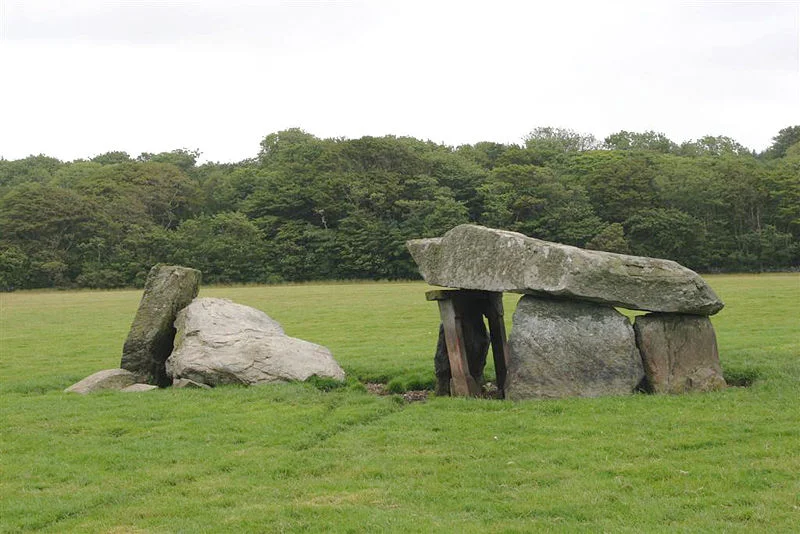

Presaddfed Burial Chamber
Reach the southern tomb through a kissing gate and across two hundred metres of grass, and the first thing you notice is how low the structure sits. The capstone, roughly four metres across, rests on three stout uprights at one end and a single slender pillar at the other, as if the builders were daring gravity to call their bluff. It has not. Five thousand years on, the slab still hangs there above the soil, balanced on stones that the people who placed them did not write down their names for.
Two Tombs, One Question
There are actually two chamber tombs at Presaddfed, only a few metres apart on a low rise about a kilometre northwest of Bodedern, just south of Llyn Llywenan. The southern one is the more complete; the northern one has already lost its argument with gravity, with two uprights still standing but the capstone collapsed and leaning against them. When antiquarians first recorded the site in the eighteenth century, the northern chamber was already in this state of disrepair. Whether the two tombs were ever a single monument or were always independent is a question archaeology has not yet answered. A mid-nineteenth-century report in The Archaeological Journal noted that the chambers were then surrounded by a scatter of small stones. Today that debris has been cleared away, but its former presence is suggestive. The multi-phase tomb at Trefignath, nine kilometres west on Holy Island, sits beneath a single elongated mound — and Presaddfed may once have looked the same.
The Long Recording
Welsh antiquarians were drawn to these stones early. Richard Gough included Presaddfed in his 1798 update of William Camden's Britannia, and a steady stream of nineteenth-century articles in Archaeologia Cambrensis worked over the site. By 1900, J.E. Griffiths had collected it into his Portfolio of Photographs of the Cromlechs of Anglesey and Caernarvonshire — that lovely Welsh word cromlech, capstone country, that English never quite found an equivalent for. About half a mile east, on the ridge between Tre-Iorwerdd and Presaddfed, sits another reminder that this landscape was once dense with mortuary monuments: a tumulus some 55 metres around, excavated in 1870, which yielded a jet bead and cremation urns. Different rites, different generations, the same instinct to mark the dead in a place the living could find again.
What the Builders Knew
Neolithic Anglesey was a busy place. The island sits on the western sea routes that connected Atlantic Europe — Brittany, Ireland, the Isle of Man, the Hebrides — and the chambered tombs strung along the Welsh coast are part of a tradition that runs from Spain to Orkney. Whoever built Presaddfed knew how to raise capstones weighing several tonnes onto upright pillars with rope, ramps, and the kind of patient communal labour that modern engineering has mostly forgotten. They also knew where to place such monuments: on slight rises, near fresh water, visible from a distance but not vain about it. Llyn Llywenan glints just to the north. The land falls gently away. You can see the burial chamber from a long way off without it ever quite dominating the horizon.
Still Standing, Just
The southern chamber needs a little help these days. A wooden frame braces one of the north uprights — a small modern intervention to keep a five-thousand-year-old balancing act balanced. Cadw maintains the site, the Royal Commission on the Ancient and Historical Monuments of Wales curates its records, and the HeritageTogether project has built photogrammetric 3D models so that scholars and the curious can examine the stones without ever leaving home. The field, though, is the thing. Open all year except for a few winter holidays, free of charge, accessible by a roadside pull-in big enough for two cars, the kissing gate, the two hundred metres of grass. Then you are standing under the capstone, where the dead were laid, and the slab is over your head, and the sky goes on past it.
Flight Context
Presaddfed sits at 53.299°N, 4.481°W, on the gently undulating farmland of central-northern Anglesey, about three kilometres south of the north coast and a kilometre northwest of Bodedern village. From the air it is a small feature in a quilted landscape of green fields, hedgerows, and the silvery sheen of Llyn Llywenan immediately to the north. RAF Valley (ICAO EGOV) lies roughly seven kilometres to the southwest; Anglesey Airport shares its runways. Low-altitude transits along the northwest Welsh coast (2,000–4,000 ft AGL) in clear weather show the broader pattern of Neolithic and Bronze Age monuments distributed across the island, with Holyhead Mountain rising prominently to the west.
From the Air
Coordinates 53.299°N, 4.481°W. Recommended viewing altitude 2,000–4,000 ft AGL for the monument and surrounding monument landscape. Nearest airport RAF Valley (EGOV), 7 km southwest. Llyn Llywenan reservoir is the most obvious landmark; the chamber sits in farmland 100 m south of the lake. Holyhead Mountain on the western horizon.
Nearby Stories
- Llandudno Lifeboat Station 3.8 km away
- Glynllifon 6.1 km away
- German submarine U-1024 9.4 km away
- Irish Sea Bridge 11 km away
- Ysbyty Ifan 12 km away
- Irish Sea 18 km away
- Celtic Array 18 km away
- Birkdale Palace Hotel 56 km away