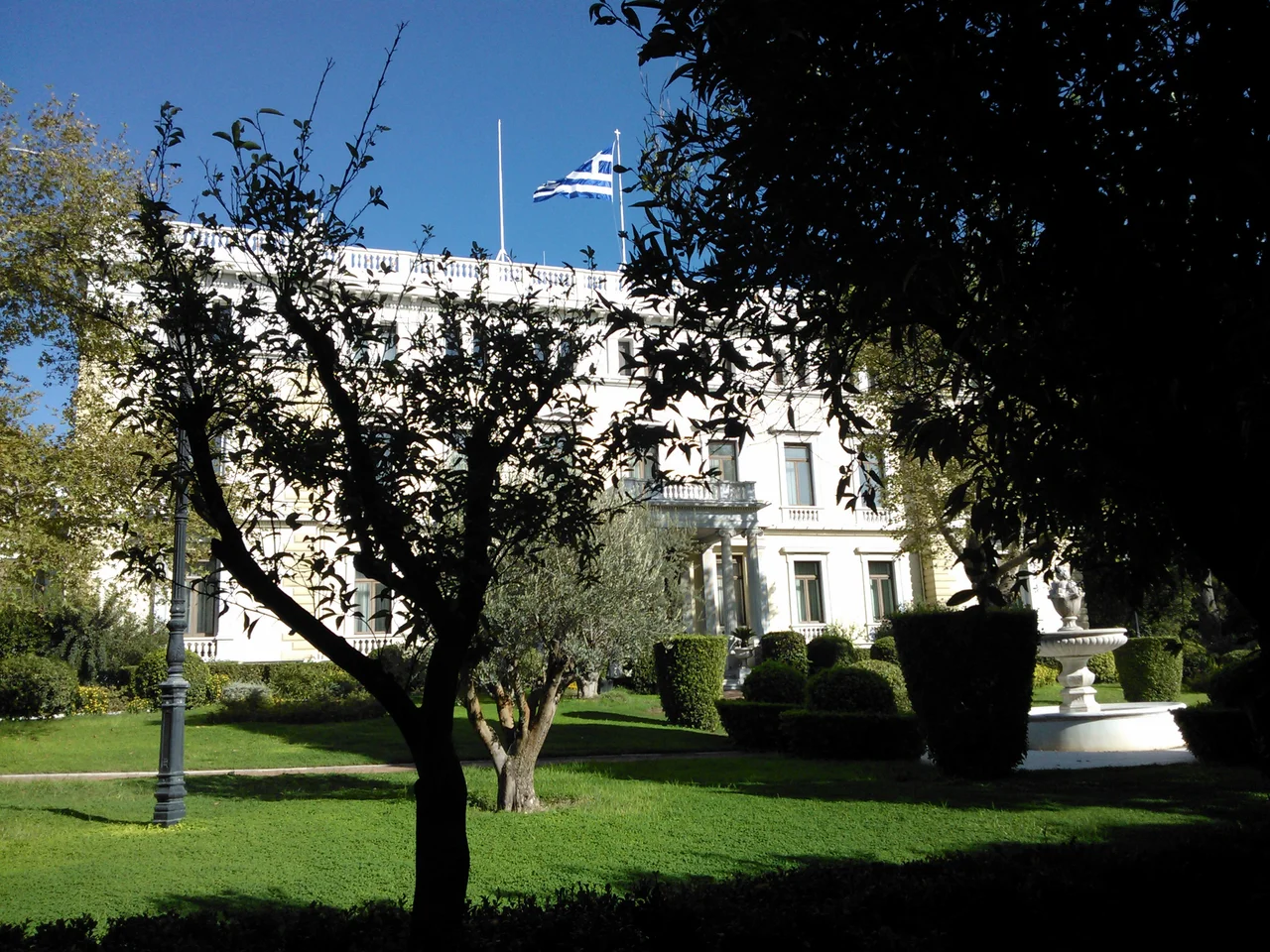

Presidential Mansion, Athens
King George I gave his architect an unusual order: do not make it too grand. The building rising on Herodou Attikou Street was meant for the king's son, the future Constantine I, and the king wanted it to sit comfortably among the other mansions of the wealthy - not to echo the palaces of Europe. So Ernst Ziller, the king's court architect, designed something restrained: three stories, symmetrical, neoclassical, a private home rather than a stage. He could not have known that this deliberately modest house would spend the next century being handed back and forth between kings and presidents, its identity rewritten every time Greece changed its mind about who should govern it.
A House for an Unborn Heir
The decision came in 1868, the year Crown Prince Constantine was born. The state resolved to give the newborn heir a home of his own once he came of age. Twenty-one years later, when Constantine married Princess Sophia of Prussia, the planning of what became known as the Crown Prince's Palace was handed to Ernst Ziller. Construction ran from 1891 to 1897 - six years to build a house for a young couple just starting out. It was sized for that life: a large salon on the second floor served as the main reception room, and no grand ballroom was thought necessary, since the truly large state occasions would be held at the much bigger Old Royal Palace nearby.
The Architect of a Nation's Look
Ernst Ziller was German by birth but had become, in effect, the architect of modern Athens. As court architect to King George I, he designed an estimated 700 buildings across Greece, shaping the neoclassical face the young capital wanted to show the world. His fingerprints are everywhere in the city center. The garden around the mansion was laid out by his technical office in a formal, geometric French style, with symmetrical beds softened by the plane trees, lindens, palms and cypresses that a Greek specialist chose - most of them native to the country. The land had once been the vegetable garden of the royal household, prized for its fertile soil.
Fire, Assassination, and a Promotion
The house outgrew its modest origins through a sequence of misfortunes. On Christmas Eve of 1909, fire tore through much of the Old Royal Palace, and the royal family moved temporarily into the Crown Prince's Palace. That same year Ziller was called back to add the ballroom the smaller house had never been given - the room now known as the Credentials Lounge. Then, in 1913, King George I was assassinated, Constantine took the throne, and the building that had been a prince's residence became the main palace of the king of the Hellenes. A house built to be unassuming had become the center of the kingdom.
Changing Flags, Same Walls
From there the building became a kind of barometer of Greek politics. In 1924 the monarchy was abolished and a republic declared, and it served as the Presidential Mansion until 1935, when the king returned and it reverted to a royal palace. It held that role until 1974, when a seven-year military dictatorship collapsed and Greeks voted in a referendum to abolish the monarchy for good. Since then it has been the Presidential Mansion once more, the official residence of the president of the Hellenic Republic. Every July 24, the president hosts a reception there to mark the restoration of democracy in 1974 - in the very rooms that democracy reclaimed.
A Quiet Corner of Power
Today the mansion and its garden cover about 27,000 square meters - roughly seven acres - a green pocket near the heart of the capital, beside the National Garden and the Hellenic Parliament. Herodou Attikou Street, where its official entrance stands, is one of the most beautiful in Athens and one of the most consequential: the Maximos Mansion, the prime minister's working office, sits on the same road. A girl's orphanage once stood out here when this was the edge of town, beyond the fields and small farms. The city has long since flowed past and around the place, leaving Ziller's modest house exactly where the country's power converges.
From the Air
The Presidential Mansion stands at 37.973 degrees N, 23.741 degrees E on Herodou Attikou Street, near the eastern edge of the National Garden of Athens and just south of the Hellenic Parliament on Syntagma Square. From the air, look for the large green rectangle of formal gardens tucked against the wider National Garden, with the Acropolis a short distance to the west. Best viewed at low altitude in clear conditions. Nearest airport is Athens International (LGAV), about 30 km east-southeast.
Nearby Stories
- Great Sand Beach 5 km away
- Battle of Delium 7.7 km away
- Tower of Aliartos 9 km away
- HMHS Britannic 10 km away
- Saronic Gulf 15 km away
- Sousaki Volcano 17 km away
- Sanctuary of Apollo Maleatas 24 km away
- Skyros 66 km away