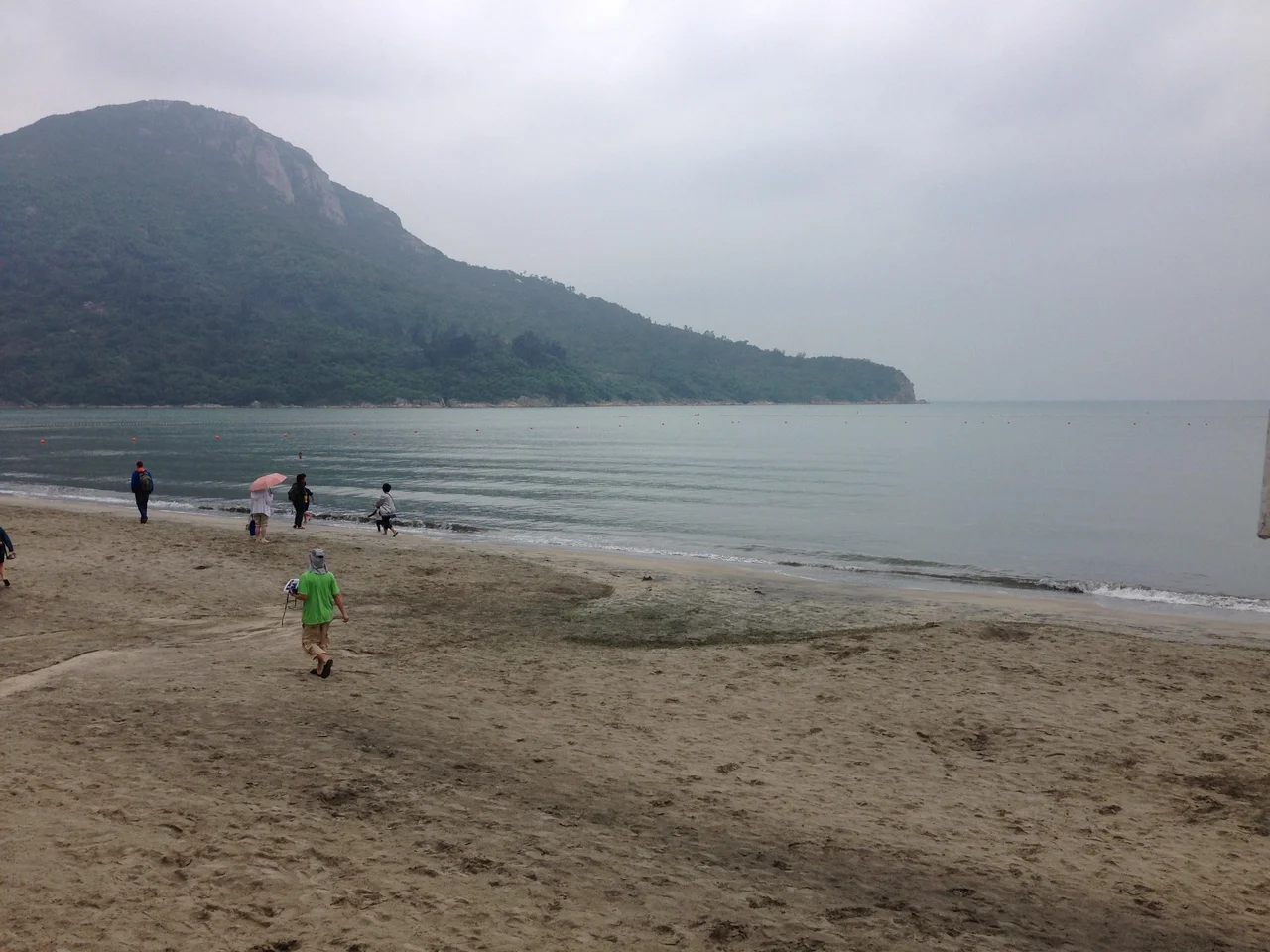

Pui O Beach
The sand at Pui O Beach is not quite the right colour. Depending on where you stand and what the light is doing, it shifts between yellow and black — the result of the geological mix that the surrounding hillsides contribute, minerals ground down and sorted by the river mouths that empty here. Where those rivers meet the sea, the water changes character: brackish at the margins, fresh upstream, salt beyond the break. This particular quality — a beach at the junction of fresh and salt water — gives Pui O a slightly different ecology than Hong Kong's other beaches. The South China Sea arrives on a south-southwest facing shore, and in the evenings it also brings the sunset, which can be watched clearly from the beach.
Where the Rivers Meet the Sea
Pui O Beach runs along almost the entire shoreline of Pui O village, 260 metres of coast framed by the Chi Ma Wan Peninsula to one side and the lower slopes of Sunset Peak to the other. The beach's water supply comes from two sources simultaneously: the open sea, and the river system that drains a valley to the east, gathering in an estuary of wetland before reaching the shore. This confluence of fresh and salt water is not accidental — it is geography. The wetland that forms where the rivers slow was, for centuries, converted into rice paddies by Pui O villagers, who understood that the soil enriched by tidal flooding was fertile. The beach itself is the terminal feature of this whole landscape: the point where everything — hillside, valley, river, sea — arrives at once.
The Two-Colour Sand
Pick up a handful of sand at Pui O and you will see what the geology is doing. Yellow grains, the product of quartz-bearing rock worn from the surrounding hills. Black grains, from darker volcanic rock that also outcrops in this part of Lantau. The mixture is not uniform — at different points on the beach, in different seasons, one colour can dominate. After storms or heavy river flows, the composition shifts. It is one of those details that rewards attention: most beach visitors do not look at sand closely enough to notice what it is made of, but Pui O's unusual mix tends to catch the eye. The government's Environmental Protection Department has rated the beach's water quality as good to fair over the past two decades — a reasonable result for a beach at a river junction, where the freshwater inflow can carry runoff from the catchment.
Camping at the Edge of Lantau South
Pui O sits at the boundary of Lantau South Country Park, and the beach reflects that adjacency. The upper beach has camping facilities — constructed and managed by the Hong Kong government — that make Pui O one of the more accessible wild camping destinations within the city. Families arrive with tents and barbecue equipment, setting up in a landscape that is simultaneously managed park and working coastline. Wooden fences divide the camp bays; the ground is mostly sand. Restaurants line the road behind the beach, selling food and swimming supplies. The combination of facilities and relative remoteness — Pui O is on the South Lantau Road, reachable by bus from Mui Wo, but not a short journey from urban Hong Kong — creates a particular atmosphere, simultaneously relaxed and slightly away from things.
Sunsets Facing South-Southwest
Because Pui O Beach faces south-southwest, it catches the late afternoon sun in a way that north- or east-facing beaches cannot. The sun descends toward the South China Sea, and the beach is positioned to watch the whole arc of it. This is a geography-determined pleasure: the orientation that the Chi Ma Wan Peninsula and the hillsides impose on this particular bay happens to align with the direction of the evening sky. Visitors who arrive in the late afternoon for this specific purpose — and many do — tend to time their arrival to the hour before sunset, when the light on the water flattens and then turns gold. The black-and-yellow sand takes on additional complexity at that light level. It is a small thing, directional orientation, until you are sitting on the right beach at the right time facing the right direction.
Billy
On 23 November 2018, a bull named Billy died on the beach at Pui O. He was eight years old, widely known among regular visitors to the area — water buffalo roam freely in Pui O, one of the few remaining places in Hong Kong where they still do, descendants of animals once used for farming that have since gone feral. Billy's death was not from natural causes. An examination found that his stomach and intestinal tract were blocked with plastic bags, enough to fill two rubbish bins. He had eaten what people had left. His death was reported widely and prompted calls for beachgoers to take their rubbish with them when they leave. The water buffalo are a living piece of Pui O's agricultural past; they have outlasted the rice paddies and the farming economy. Billy had lived on that beach his whole life.
From the Air
Pui O Beach is located at approximately 22.240°N, 113.976°E on the south coast of Lantau Island. From 2,000 feet, the beach appears as a pale arc at the mouth of a valley, with the Chi Ma Wan Peninsula visible as a forested headland to the southwest. The estuary and wetland area behind the beach are visible from the air — a green-and-grey zone where the valley river meets the coast. Hong Kong International Airport (VHHH) lies approximately 16 nautical miles to the north-northwest. The south Lantau coast runs east-west at this point; Cheung Chau Island is visible to the east. The South China Sea stretches south from the beach with no immediate landmass obstructing the view.
Nearby Stories
- Lok Ma Chau Loop 2.3 km away
- Portas do Cerco 2.3 km away
- Kweilin Incident 17 km away
- Wanshan Archipelago Campaign 34 km away
- Nanxiong Formation 115 km away
- Battle of Nanpeng Island 148 km away
- Heyuan 169 km away
- Cape Maobitou 632 km away