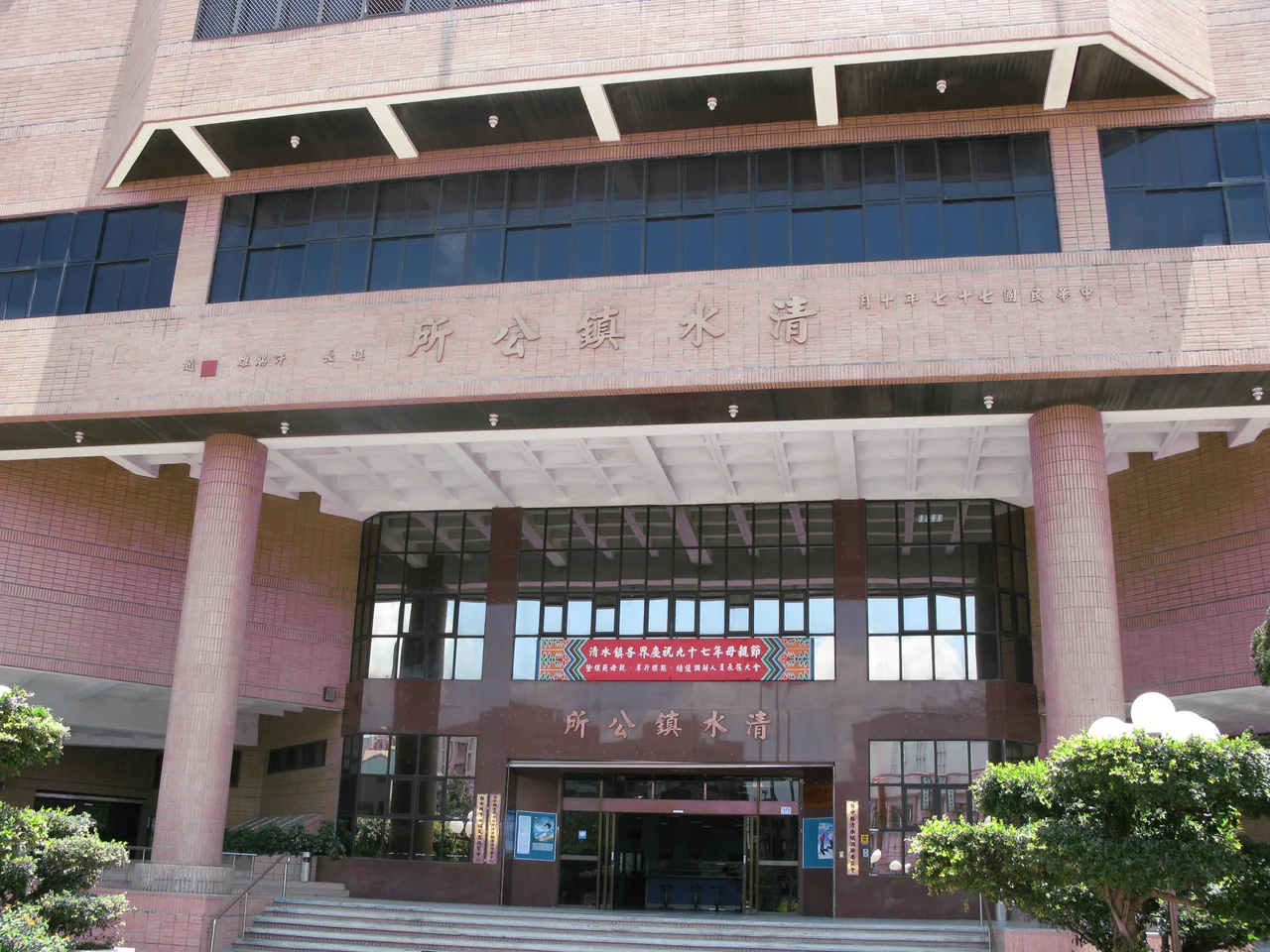

Qingshui District
Liao Tian-ding grew up in Qingshui during the Japanese colonial period and became one of Taiwan's most romanticized folk heroes — a man the colonial authorities hunted and the local people sheltered, a kind of Robin Hood figure whose legend outlasted the regime that pursued him. That someone like that came from Qingshui makes a certain sense. This coastal district on Taichung's western edge has always been a place where layers of power and culture have pressed against each other: Papora people, then Han settlers, then Qing administrators, then Japanese colonial rule, then Nationalist governance. Qingshui absorbed each era and kept going, right down to the Taiwan Strait.
From Gomach to Qingshui
The Papora people, one of Taiwan's indigenous Formosan groups, knew this coastal plain as Gomach. When the Kangxi Emperor of the Qing Dynasty opened the region to Han Chinese settlement, settlers rendered the name phonetically in Chinese as Niumatou — close enough in sound to the Papora original to serve as a placeholder. The two dominant migrant families, the Yang and the Tsai, established themselves here, and those surnames remain the most common in Qingshui today, centuries later.
Japanese administrators who took control of Taiwan in 1895 renamed the settlement Kiyomizu Town, administering it under Taikō District within Taichu Prefecture. Kiyomizu — the same characters as the famous temple district in Kyoto — means "clear water," and when the Nationalist government took over after 1945, they kept the characters but read them in Chinese: Qingshui. In 2010, the area was elevated from township to district when Taichung County merged into a special municipality.
What the Plain Holds
Beneath the farmland and neighborhoods of Qingshui Plain lies the Niumatou Site, the oldest known archaeological site in central Taiwan. People lived and farmed here roughly 4,000 years ago, leaving behind stone tools, pottery, and enough stone hoes to convince modern researchers that agriculture — not just hunting or gathering — was the foundation of their economy. The site was designated a protected historical relic and remains one of the district's most significant connections to deep time.
Above ground, the district's landscape is shaped by water. The Taiwan Strait forms its western boundary. The Dajia River defines its northern edge. The construction of the Port of Taichung to the south changed the local hydrology, causing river sediment to settle in ways that created the Gaomei Wetlands — a 701-hectare protected zone now famous for its wind turbines rising above tidal mudflats and migratory birds.
People Who Shaped a Nation
Qingshui has produced a remarkable concentration of influential figures. Cheng Yen, born here, became one of Asia's most significant Buddhist figures — a bhikkhu and philosopher who founded the Tzu Chi Foundation, an international humanitarian organization with millions of volunteers worldwide. Paul Chu, the physicist who made major breakthroughs in high-temperature superconductivity research, grew up in Qingshui after his family moved there from mainland China in 1948.
And then there is Liao Tian-ding, whose story sits in a different register altogether. During the Japanese colonial period, Liao became a folk outlaw who robbed colonial officials and the wealthy and was protected by ordinary people. Betrayed by an associate and killed in 1909 before the colonial authorities could formally execute him, he became a cultural symbol of resistance — the subject of operas, films, and folk songs that persist today. The Tourism Bureau recognized Qingshui's appeal when it named it one of Taiwan's Top 10 Small Tourist Towns.
Along the Coast Today
Qingshui's shoreline holds more than history. The Gaomei Wetlands draw visitors throughout the year, especially at sunset when the offshore wind turbines cast long shadows across the tidal flats and flocks of migratory birds — herons, egrets, sandpipers — work the shallow water. The wetlands sit on land that was ecological accident as much as design, formed by the interaction of port construction and river dynamics.
The Ziyun Temple, dedicated to Guanyin and dating to 1750 AD, anchors the spiritual geography of the district. Near the port, the Taichung City Seaport Art Center has repurposed industrial waterfront architecture for cultural use. Qingshui Station on the Taiwan Railway connects the district to the broader network, and the Zhongang System Interchange makes it accessible by road. The wetlands, the temple, the Neolithic site, and the port all sit within a few kilometers of each other — Qingshui compressed into the kind of density that comes only with 4,000 years of continuous occupation.
From the Air
Qingshui District lies at approximately 24.30°N, 120.57°E along Taiwan's western coast, where the Qingshui Plain meets the Taiwan Strait. From the air at 4,000–6,000 feet, the district's geography reads clearly: the broad gray strait to the west, the Port of Taichung's breakwaters and container yards to the south, and the distinctive wind turbine array at Gaomei Wetlands marking the northern coastal zone. The Dajia River forms a visible boundary to the north. Nearest major airport: RCMQ (Taichung International Airport), approximately 12 km to the southeast. Visibility across the strait toward Fujian can vary significantly with seasonal haze.
Nearby Stories
- Lukang Tianhou Temple 3.3 km away
- 1916–1917 Nantou Earthquakes 11 km away
- Beipu 15 km away
- Shei-Pa National Park 21 km away
- China Airlines Flight 611 23 km away
- 1991 Miaoli Train Collision 43 km away
- Mudouyu Lighthouse 69 km away
- Battle of Xiapi 1097 km away