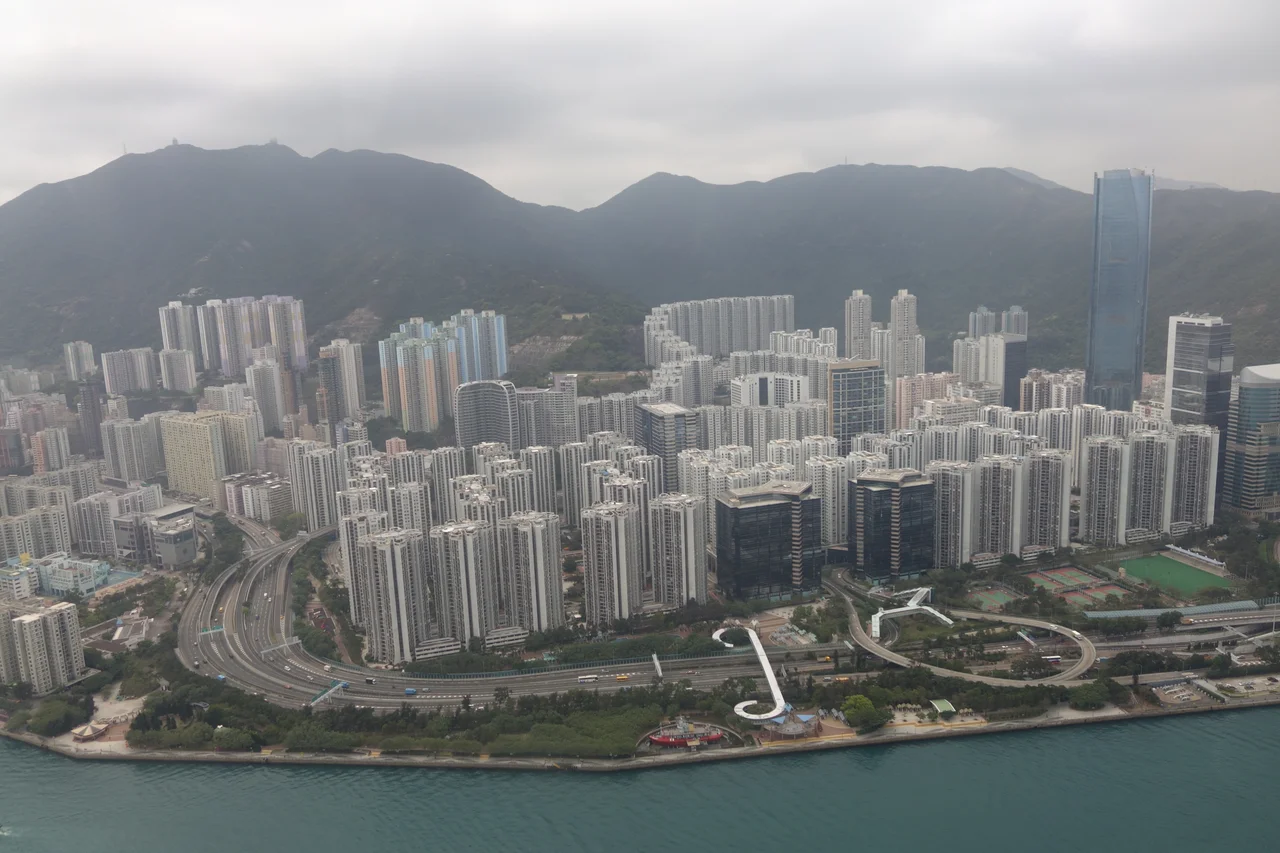

Quarry Bay
The 1819 edition of the Gazetteer of Sun On County does not mention Quarry Bay. Historians have concluded that before the British arrived, it was simply a remote part of the hillside — unnamed, unremarkable, an indent in the north shore of Hong Kong Island where the hills met the water. Within a generation of British colonisation, it had a function: the Hakka stonemasons who settled here after the colonial arrival began quarrying rock from the surrounding hillsides and shipping it out by boat for construction and road building. The English name describes that industry exactly. The Chinese name, Tsak Yue Chung, describes something else entirely — a small creek where crucian carp could be found in the nineteenth century. The English name remembered the work; the Chinese name remembered the water.
From Creek to Commercial District
The quarrying economy that named the area eventually gave way to denser development. Today Quarry Bay is a residential and commercial district in the Eastern District of Hong Kong Island, bordered by Sai Wan Ho to the east, Mount Parker to the south, North Point to the west, and Victoria Harbour to the north. One Island East, among Hong Kong's tallest buildings, anchors the district's skyline. Government departments have relocated offices here from Central and Wan Chai over the years; multinational companies including Ernst and Young, BNP Paribas, LVMH, and Boston Consulting Group maintain offices in the district. Cityplaza and Kornhill Plaza together form one of the larger shopping mall complexes on Hong Kong Island. The MTR's Island Line and Tseung Kwan O Line intersect at Quarry Bay Station, making the district a transit hub as well as a destination.
The Monster Building
At some point — the exact moment is hard to pinpoint — a cluster of five interconnected residential towers in Quarry Bay acquired the nickname 'Monster Building.' The name refers to the complex of Fook Cheong Building, Montane Mansion, Oceanic Mansion, Yick Cheong Building, and Yick Fat Building — five high-rises whose internal courtyards and connecting corridors create a dense, layered residential world of extraordinary visual intensity. Seen from below, looking up through the central atrium, the towers stack and crowd against the sky in a way that feels genuinely excessive. Photographers have made the shot famous; it has appeared in films. The buildings are not remarkable by any individual measure — they are simply residential towers from the dense-construction era of Hong Kong's expansion — but together, in the particular arrangement they happen to occupy, they produce something that people travel specifically to see.
The Fireboat That Came Ashore
In Quarry Bay Park, in the Central Concourse, a retired fireboat named the Alexander Grantham sits in permanent dry dock. It was a working vessel of the Hong Kong Fire Services Department, named after former Governor Sir Alexander Grantham. On 10 March 2006, the boat was hoisted into its current location — a careful operation that moved a large vessel into a space designed to display it. It opened to the public as the Fireboat Alexander Grantham Exhibition Gallery in 2007. Inside, multimedia exhibits cover the boat's history and the history of firefighting in Hong Kong. The fireboat has been replaced in service by newer vessels; its function is now entirely memorial and educational. It is a peculiar and effective monument: a working machine preserved in the middle of a park, doing the thing that museums do best — making the past physically real.
Wartime Traces on the Green Trail
The hillside above Quarry Bay has not forgotten the war. Along the Mount Parker Road Green Trail and the Hong Pak Country Trail, wartime remains — Wartime Stoves and Anti-Air-Raid Caves — have been preserved in the landscape. Hikers encounter them between the benches and pavilions of what is now a recreational trail system. Mount Parker itself, along with Mount Butler and Siu Ma Shan, offers hiking that connects further to Jardine's Lookout and the Tai Tam Reservoirs. Stanley is reachable from Tai Tam via Violet Hill. The trail network makes Quarry Bay a gateway into the eastern hinterland of Hong Kong Island, where the second-growth forest and granite ridgelines feel far removed from the dense residential towers visible below. The Woodside Biodiversity Education Centre, housed in a building known as the Red House on Mount Parker Road, introduces visitors to Hong Kong's wildlife through three themed exhibition galleries.
Taikoo Shing and the Swire Legacy
The largest private residential development in Quarry Bay is Taikoo Shing — 61 mansion blocks distributed along Taikoo Wan Road and Taikoo Shing Road, developed by Swire. The development represents a particular phase of Hong Kong's residential history, when large private estates created self-contained neighbourhoods within the city. Nan Fung Sun Chuen, built in 1978, sits nearby: 2,827 apartment units in 12 buildings along Greig Road and Greig Crescent, developed by Nan Fung, and considered a benchmark for Hong Kong residential development of the late 1970s. Together, these estates and the commercial buildings around them constitute a district that grew from a quarry and a creek into one of the denser communities on Hong Kong Island — a transformation that took roughly a century and a half, and left almost no trace of the beginning.
From the Air
Quarry Bay is located at approximately 22.283°N, 114.213°E on the north shore of Hong Kong Island, with Victoria Harbour to the north and Mount Parker rising steeply to the south. From 2,000 feet, the One Island East tower is the dominant vertical element in the district, with the Taikoo Shing estate visible as a large residential block to the east. The Eastern Harbour Crossing tunnel portal appears at the water's edge. Hong Kong International Airport (VHHH) lies approximately 23 nautical miles to the west-northwest. Kowloon is visible across the harbour to the north. On approach along the harbour corridor, the north shore of Hong Kong Island runs from Kennedy Town in the west through to Shau Kei Wan in the east; Quarry Bay falls in the eastern portion of this run.
Nearby Stories
- Lok Ma Chau Loop 2.3 km away
- Portas do Cerco 2.3 km away
- Kweilin Incident 17 km away
- Wanshan Archipelago Campaign 34 km away
- Nanxiong Formation 115 km away
- Battle of Nanpeng Island 148 km away
- Heyuan 169 km away
- Cape Maobitou 632 km away