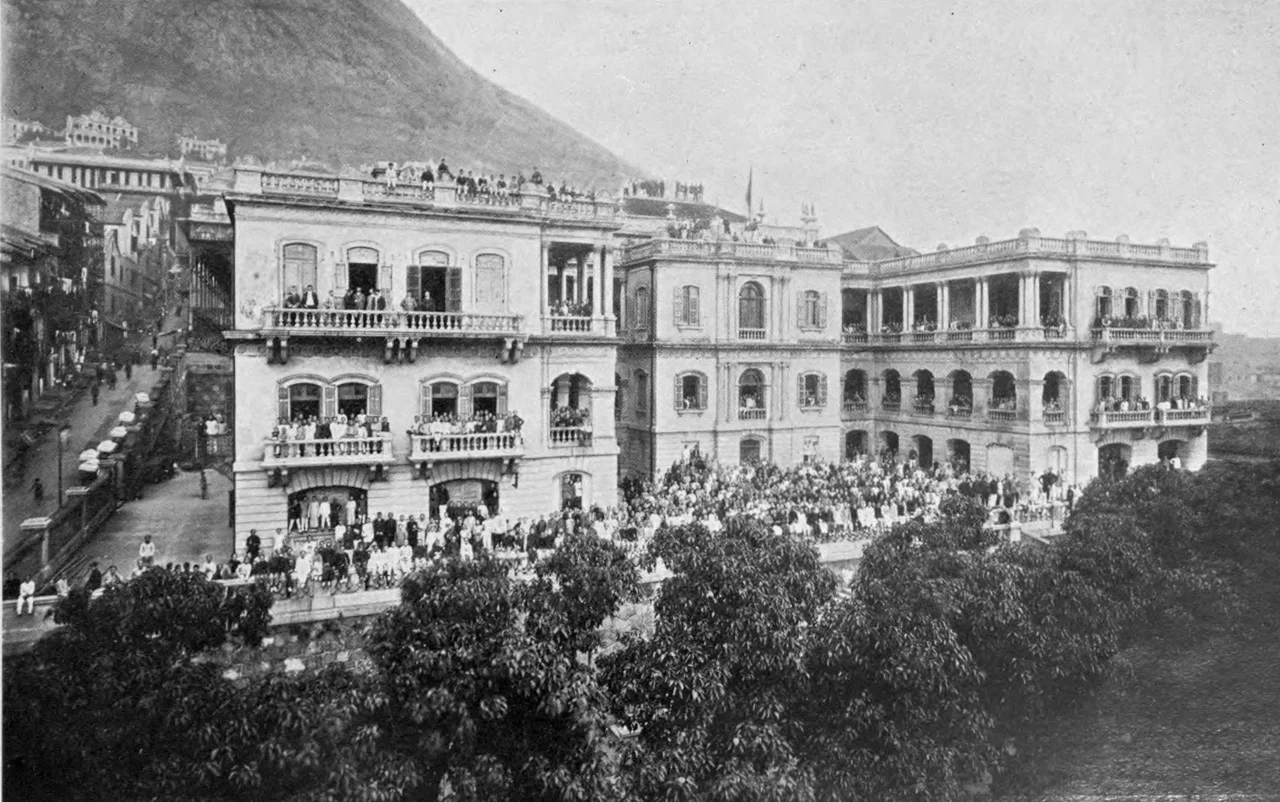

Queen's College, Hong Kong
On 26 April 1884, the Governor of Hong Kong laid a foundation stone on Aberdeen Street for a new school building, and a student in the crowd watched the ceremony. His name was Sun Yat-sen. He would go on to lead the 1911 Xinhai Revolution, become the founding Provisional President of the Republic of China, and be remembered in both Taiwan and the People's Republic as the father of modern China. He was, at the time of the ceremony, a schoolboy. The school was then called the Government Central School, and it would change its name twice more before settling on Queen's College in 1894. What it has always been — for more than 160 years — is Hong Kong's first public secondary school.
Before the School Existed
The roots of Queen's College reach back before the school itself. In 1847, the British colonial government began assessing the Chinese village schools already operating in Victoria City. The Education Committee found three active schools: Taipingshan School with 28 pupils, Chungwan School with 18, and Sheungwan School with 21 — each operating under Chinese masters using traditional texts including the Three Character Classic and the Four Books and Five Classics. These were not colonial institutions; they predated the colony. The government's intervention was incremental: grants first, then oversight, then the 1860 proposal by British sinologist Reverend Dr. James Legge to consolidate the three schools into a single Central School. That school opened in 1862 on Gough Street in Central. Its first headmaster was Dr. Frederick Stewart, who simultaneously served as Inspector of Schools — responsible for supervising every school in Hong Kong until 1879, when the government finally created a separate inspectorate.
A School Divided and United
The Central School's first five years admitted only Chinese students. In 1867, students of other nationalities began enrolling — British, Indian, Parsee, Japanese, Thai. The two groups had different requirements: Chinese students took English classes; students from other nationalities were not expected to study the Chinese classics. This asymmetry reflected the school's uncomfortable position at the intersection of colonial administration and Chinese education. Secular schooling created controversy: the Governor personally intervened in school operations on multiple occasions, and religious schools were eventually brought into competition with the government school through a grant program. The tension between a school designed to serve a Chinese population under British governance, and a British administration that wanted something measurable from education, ran through the institution's early decades. The school kept enrolling students.
HKD 250,000 and a New Name
The Aberdeen Street building, for which Sun Yat-sen watched the foundation stone being laid in 1884, was completed in 1889 at a cost of HKD 250,000 — a sum that made it one of the largest and most expensive buildings in Hong Kong at the time. The Governor's recommendation that the school be renamed Victoria College was followed. Then, in 1894, it became Queen's College. The ambitions for the school did not stop at secondary education: from the 1870s onward, the government had wanted to expand it into a university. That plan was shelved after the Russo-Japanese War in 1904, when fears about Japanese influence in the Far East led the colonial government to decide that a technical and professional university was more urgently needed. Queen's College remained a secondary school. The decision to build that university instead led, by a separate path, to the founding of the University of Hong Kong in 1910.
War, Destruction, and a New Site
The Japanese invasion of Hong Kong in December 1941 closed the school and converted its buildings into a field hospital. Refugees stripped the timber for fuel immediately after the colony fell. During the Japanese occupation, the site was used by Japanese forces. Near the end of the war — 1944 or 1945, the record is not precise — Allied bombing destroyed the campus. After the Japanese surrender, refugees occupied the ruins; fire was common. By 1948, the site was being cleared to make way for what would become the PMQ development. The school reopened in 1947 in a temporary facility on Kennedy Road, sharing a campus with Clementi Secondary School. In 1950, a new campus was built in Causeway Bay. Governor Sir Alexander Grantham announced the reopening on 22 September of that year. Queen's College has been on Causeway Road, opposite Victoria Park, ever since.
The Yellow Dragon and Its Graduates
First published in June 1899, the school magazine *The Yellow Dragon* (黃龍報) is the oldest existing Anglo-Chinese school magazine in the world. By 2005, it had published its 100th volume. The graduates who once read it include an extraordinary range of figures: Sun Yat-sen; Liao Zhongkai, the Kuomintang revolutionary leader assassinated in Guangzhou in 1925; Tang Shaoyi, the first Prime Minister of the Republic of China, also assassinated, in 1938; Wang Ch'ung-hui, a judge of the Permanent Court of International Justice; the co-founder of the South China Morning Post; the co-founder of the Bank of East Asia; and the founder of Hong Kong Sanatorium and Hospital, who practiced Western medicine alongside Sun Yat-sen. The school's history museum, converted from classrooms and opened in 2017, holds a 4,000-piece collection covering this span. Its permanent exhibition is titled 'From Gough Street to Causeway Road: Change and Continuity of Queen's College.' The continuity is real.
From the Air
Queen's College is located in Causeway Bay, Hong Kong Island, at approximately 22.281°N, 114.192°E, on Causeway Road opposite Victoria Park. From 1,500 feet, the school's building and Victoria Park's green expanse are visible together as a distinct landmark on the north shore of Hong Kong Island, east of the Wan Chai commercial district. The Causeway Bay typhoon shelter and Tin Hau MTR station are close by. Hong Kong International Airport (VHHH) lies approximately 25 nautical miles to the west-northwest. The original Gough Street campus site, now occupied by PMQ in Central, is approximately 2 nautical miles to the west. Victoria Harbour separates Hong Kong Island from Kowloon to the north.
Nearby Stories
- Lok Ma Chau Loop 2.3 km away
- Portas do Cerco 2.3 km away
- Kweilin Incident 17 km away
- Wanshan Archipelago Campaign 34 km away
- Nanxiong Formation 115 km away
- Battle of Nanpeng Island 148 km away
- Heyuan 169 km away
- Cape Maobitou 632 km away