.jpg)
Queen's Pier
On the morning of 28 April 2007, the actor Chow Yun-fat arrived at a concrete pier on the Hong Kong waterfront before sunrise. He came not to film a scene but to sign a petition, and to appeal quietly to police not to hurt the protesters who had been camped there for two days. It was an unusual vigil for an unusual structure. Queen's Pier was not grand. It was a modest utilitarian shed of concrete and steel, opened in 1954, unremarkable to anyone who didn't know what happened there. But Hong Kongers knew. Every governor since 1925 had stepped ashore at this spot. Queen Elizabeth II had landed here in 1975. The Prince and Princess of Wales arrived on this same stretch of waterfront in 1989. And now a group of students was staging a hunger strike to stop the government from tearing it down.
The Shore Where Power Arrived
The first Queen's Pier was built in 1925 on the site of the present Mandarin Oriental Hotel, at a cost of HK$20,000, intended to be ready for the arrival of Edward, the Prince of Wales. Construction delays pushed completion to October of that year. The structure it replaced was simpler still — a basic landing stage on Victoria Harbour's edge. The second and final pier, the one that became famous, opened on 28 June 1954, the wife of Governor Sir Alexander Grantham doing the honours. Built in a modern utilitarian style along newly reclaimed waterfront, it had round concrete pillars and arching sheltered bays, functional rather than ornate. What it lacked in architectural grandeur it accumulated in ceremony. Every governor from 1925 onward followed the same ritual: arriving by the official Governor's Yacht, stepping ashore at Queen's Pier, inspecting a guard of honour at the adjacent Edinburgh Place, then proceeding to City Hall for the swearing-in. The pier was simultaneously a threshold of colonial authority and, as the decades passed, a familiar piece of the city's physical memory.
The Reclamation That Closed In
The fate of Queen's Pier was sealed not by any sudden decision but by decades of slow pressure from the Central Reclamation project, a scheme unveiled in 1989 to push Hong Kong Island's northern shoreline further into Victoria Harbour. Phase III of that project required demolishing both the adjacent Edinburgh Place Ferry Pier and Queen's Pier itself. The Antiquities and Monuments Office commissioned a heritage impact survey in 2001. The Antiquities Advisory Board met twice — in March 2002 and December 2006 — and each time declined to object to demolition, asking only that relics be preserved for reconstruction elsewhere. The government unveiled four design options for relocation. At the end of January 2007, facing growing public pressure, officials announced they would postpone demolition until a consensus could be reached. Chief Executive Donald Tsang cautioned that being overzealous in saving the past could hurt Hong Kong's competitiveness. The delay lasted less than two months. On 26 March, following Tsang's re-election, the government pressed ahead.
Blue Ribbons and Hunger Strikes
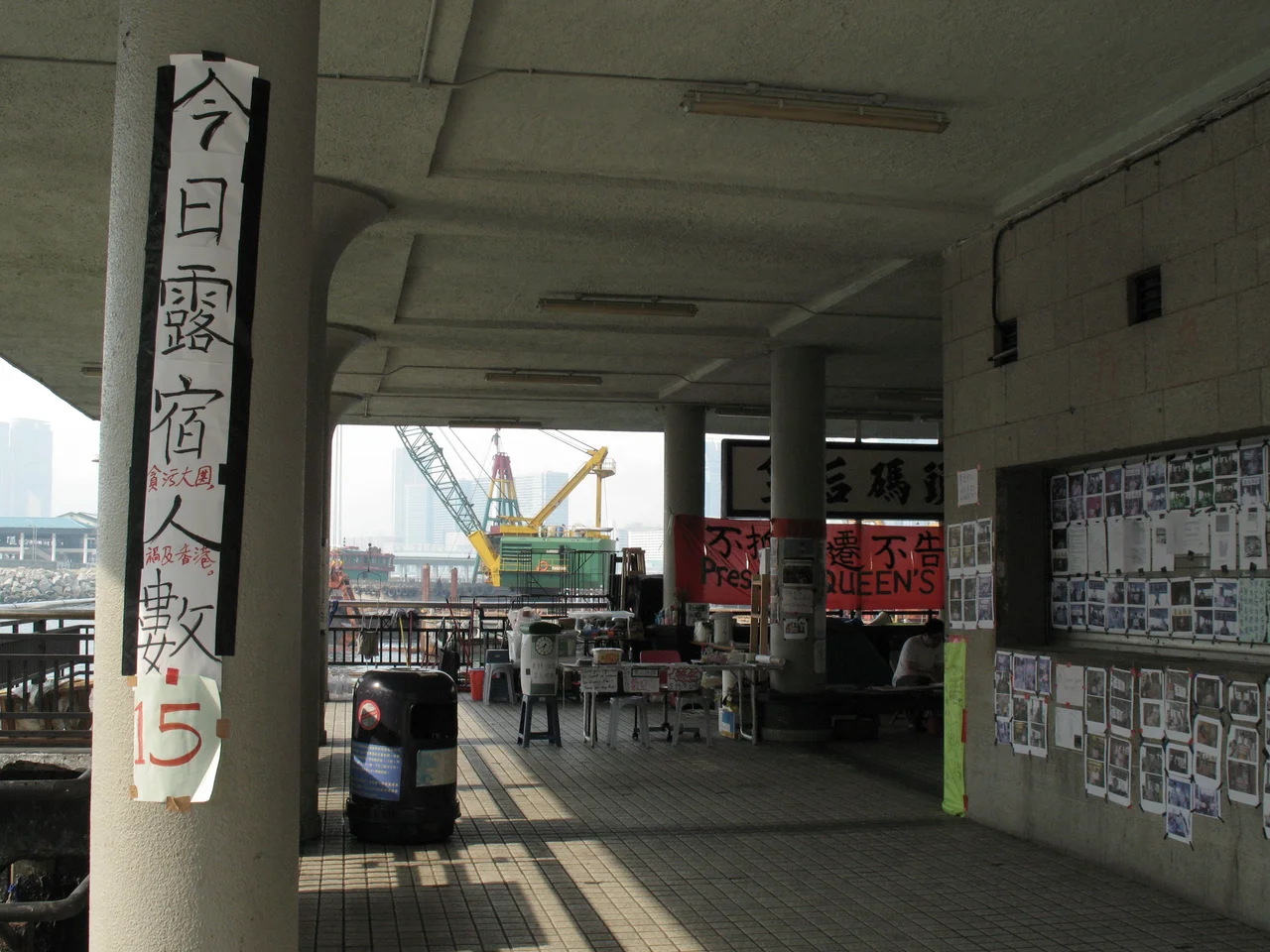
The campaign to save Queen's Pier drew heavily on the recent failure to preserve the nearby Star Ferry pier, demolished just months earlier in December 2006. Activists and ordinary residents arrived at the pier before its planned 26 April closure to tie blue ribbons to its railings. On 22 April, roughly 100 protesters gathered for farewell voyages and a petition collecting signatures from the arts community. Ten activists began an occupation on the closure date itself. On 27 July, three students from a group called Local Action started a hunger strike at the pier. Hunger striker Chan King-fai described the campaign in plain terms: 'The government wasn't chosen by us. All we can do is to use our humble and limited voices.' On 1 August 2007, 300 police officers spent ten hours clearing approximately 30 remaining protesters from the site, amid scuffles. The Hong Kong Human Rights Monitor complained that its observers were denied access during the eviction. Activists filed for judicial review; the High Court heard the case on 7 August and dismissed it on 10 August. The last legal avenue was closed.
Engineered Consensus
After demolition — completed in February 2008, base piles removed in March — the government polled Hong Kong's 16 District Councils on whether to reassemble the pier at the new reclaimed waterfront. Fourteen voted in favour of relocation. But in July 2008, eight councils revealed that preservation in the pier's original location had not been offered as one of the options, and vice-chairmen of two supporting councils said their decisions may not have been fully informed. Then, in August 2008, it emerged that the government had coordinated the submission of identical 'copy and paste' motions by 13 councils supporting relocation. Legislator Albert Ho condemned the government for tampering with District Councils to 'create public opinion.' Dr Li Pang-kwong of Lingnan University called the coordinated votes a rubber stamp and a clear sign that councils lacked independence. Ron Phillips, the pier's original designer, had backed preservation throughout, warning that future generations would come to regret the loss. In 2021, the government acknowledged it was looking at reinstating a version of the pier away from the original Central Harbourfront site.
What a Pier Can Mean
Local Action, the alliance of activists who occupied the pier in 2007, described it as a cornerstone of Hong Kong identity — and deliberately connected its fight to the civic movements of the late 1960s and early 1970s, arguing that Queen's Pier was a symbol not of British colonialism but of Hong Kong's tradition of public voice. That framing proved durable. The pier appeared in TVB programmes, in the music video for Sam Hui's 'Goodbye Bell', and in the 2010 film Dream Home, set in Hong Kong in 2007. Leung Chun-yiu, one of the protesters, spent three nights a week at the site while holding down a full-time job, vowing to resist demolition non-violently. These were ordinary people with ordinary constraints who found the demolition of a concrete pier worth their time, their sleep, and — for three students — their hunger. What they were defending was less the structure itself than the idea that the public gets a say in what disappears. The pier is gone. The argument it generated has not gone with it.
From the Air
Queen's Pier stood at 22.2831°N, 114.1617°E on the Central waterfront of Hong Kong Island, directly in front of City Hall and Edinburgh Place. Approaching from the east at 2,000–3,000 feet, the reclaimed Central Harbourfront is visible as a broad pale expanse between the harbour and the dense glass towers of Central. The pier's former location lies immediately west of the current Edinburgh Place ferry terminal, just east of the Star Ferry pier. The nearest major airport is Hong Kong International Airport (VHHH), approximately 30 km to the northwest on Lantau Island. On clear days the entire Victoria Harbour panorama — Kowloon on the north shore, Hong Kong Island's ridge to the south — is visible from cruising altitude.
Nearby Stories
- Lok Ma Chau Loop 2.3 km away
- Portas do Cerco 2.3 km away
- Kweilin Incident 17 km away
- Wanshan Archipelago Campaign 34 km away
- Nanxiong Formation 115 km away
- Battle of Nanpeng Island 148 km away
- Heyuan 169 km away
- Cape Maobitou 632 km away