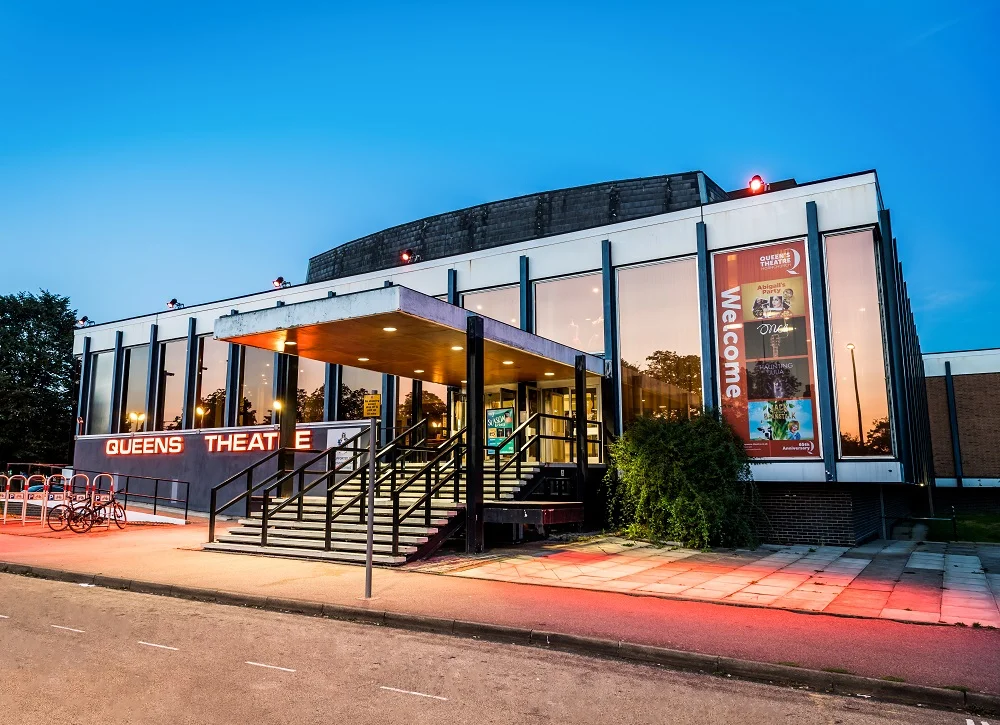

Queen's Theatre, Hornchurch
The doors opened on 21 September 1953, and the man cutting the ribbon was Ralph Richardson - one of the great Shakespearean actors of his generation, sent out to suburban Essex to bless a 379-seat playhouse that had been carved from a derelict cinema. The town was Hornchurch. The play was See How They Run, a forgettable wartime farce. The name was a tribute to the new young Queen, whose coronation had taken place the same year. Nobody was sure whether outer Essex really wanted a serious repertory theatre, or whether a serious repertory theatre could survive in outer Essex. Seventy-plus years later the question has been answered repeatedly, and not always the same way.
The Cinema That Became a Stage
The Station Lane building had served as the Hornchurch Cinema and Super Cinema from 1913 to 1935, and had been falling apart ever since. Hornchurch Urban District Council was one of the very first local authorities to use the Local Government Act 1948 - the law that allowed councils to fund the arts - and bought the building in that year. It took five years and the energy of a small army of volunteers to turn it into a theatre. Productions ran for two weeks at a time, the standard rhythm of British repertory. By the end of the third year the theatre was averaging 70% attendance over seventy productions, including the annual pantomime that has been a fixture in every English regional theatre since anyone can remember. Tony Richardson directed here in 1959, four years before he won the Oscar for Tom Jones. Ian Curteis quit after just eight months in 1963 after a fight with the board. The talent passed through; the building stayed.
Move or Die
By 1970 Havering Council, which had absorbed the old Hornchurch Urban District Council, wanted to demolish the building to make way for a road scheme. A study commissioned in 1968 had even suggested moving the theatre to Romford, where attendance might be 25% higher. The reputation of the existing theatre saved it - not by saving the building, but by securing a new one. The replacement, built on Billet Lane in 1975, was designed by the Havering borough architects with the unusual luxuries of quadraphonic sound, radio assistive listening for hearing-impaired patrons, and air conditioning. It cost £1 million. Havering Council raised domestic rates by half a penny in the pound to pay for it. The Daily Telegraph called the area a "cultural desert" finding its £1 million oasis. The Sunday Telegraph called the funding "£1m. theatre on the rates". Neither tone was meant kindly.
The Funding That Vanished
From 1984/85 the Hornchurch Theatre Trust received an annual £148,000 from the Arts Council. From 1985/86 it received zero. The 1985 Local Government Act had abolished the Greater London Council and the metropolitan counties; the Arts Council shifted funding away from London to fill the gaps elsewhere; Hornchurch fell through the new cracks. For fifteen years the theatre survived on grants from Havering Council and the London Boroughs Grants Committee, plus a stubborn box office. Artistic director Bob Carlton was appointed in 1997 and managed, somehow, to restore Arts Council support after a fifteen-year hiatus. In 2000 a new £50,000 fund for theatres in Outer London was created. The Queen's Theatre received the entire pot. The next year Queen Elizabeth II herself came to the building during her Golden Jubilee tour, marking fifty years of the theatre named after her coronation.
Shows That Travelled
Repertory theatres outside the West End are supposed to be feeder houses, the places where shows are born or refined before larger London houses take them. Hornchurch has done its share of this. Blood Brothers was here in 1987 with Kiki Dee and Con O'Neill, well before the show settled in for its mammoth West End run. Return to the Forbidden Planet, written by former artistic director Bob Carlton, was revived here in 2012 starring Richard O'Brien himself. Made in Dagenham in 2016. Educating Rita in 2017. Priscilla, Queen of the Desert in 2018. As You Like It in 2019, with music by Shaina Taub - the same Shaina Taub who would later win a Tony for Suffs on Broadway. The Stage named the Queen's London Theatre of the Year in January 2020, recognising a venue that had quietly built one of the most adventurous programmes in suburban Britain.
Listed and Reinvented
Building improvement works happened in 2019, including the bar's move into the foyer. The pandemic closed the doors in 2020, and the £100,000 grant from Havering Council in 2021 was one of the things that helped them reopen. In 2022 the theatre was granted Grade II listing - architectural protection that recognised its place in postwar British theatre history. The same year Douglas Rintoul left as artistic director. The theatre then did something rare for British regional theatres: it scrapped the single artistic director model entirely. In May 2023 it announced three creative co-directors - Alex Thorpe, Kate Lovell and Aisling Gallagher - sharing the role. Whether the experiment succeeds is a question for the future. What the building has already proved is that a 507-seat playhouse in outer Essex, named for a coronation, can produce work that London notices. The signs outside still say Queen's Theatre. Inside, the work being made is mostly about who lives in Havering now.
From the Air
The Queen's Theatre sits at 51.57°N, 0.22°E on Billet Lane in Hornchurch, in the London Borough of Havering. The brick building is set back from the road behind a small car park; it shows clearly from the air as a low rectangular block with a distinctive flat roof, surrounded by suburban housing. London City Airport (EGLC) is roughly 7 miles to the southwest; Stapleford Aerodrome (EGSG) is 5 miles to the north. Best viewed from 2,000-3,000 feet.
Nearby Stories
- Waytemore Castle 2 km away
- Prittlewell Royal Anglo-Saxon Burial 4.2 km away
- Sevenoaks 5.6 km away
- Central line (London Underground) 6.4 km away
- River Lea 9.7 km away
- Surrey 11 km away
- Mercury Theatre, Colchester 14 km away
- Faversham Munitions Explosion Memorial 14 km away