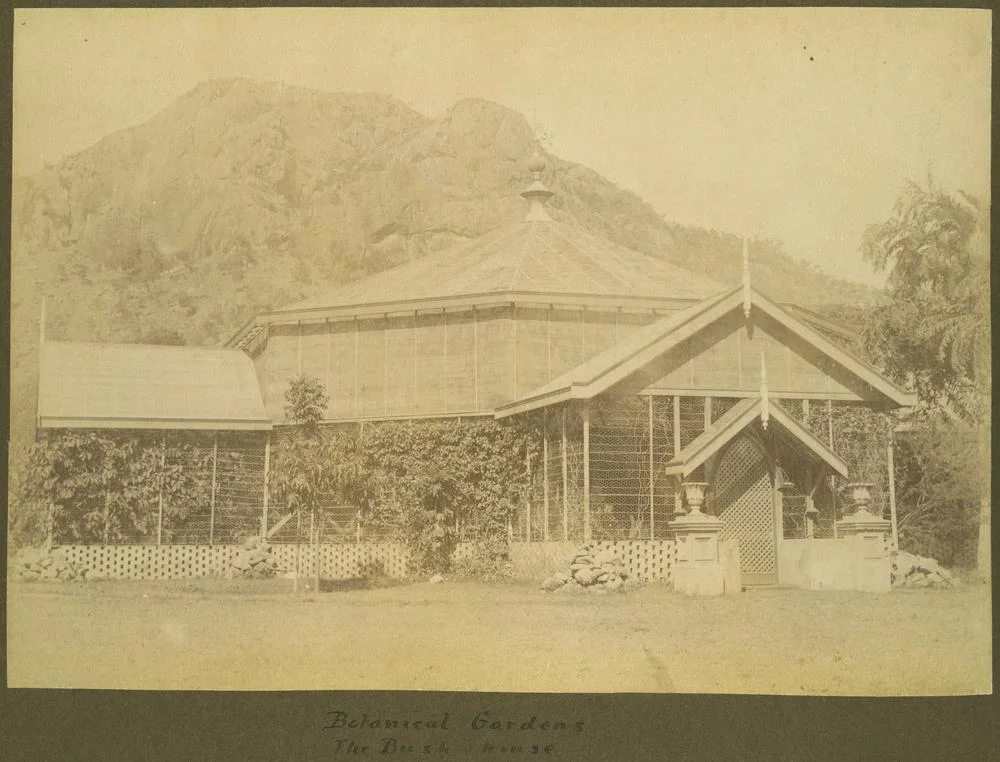

Queens Gardens, Townsville
Some of the trees in Queens Gardens were planted before the camera was common, before Federation, before most of Townsville existed. Walk the eastern boundary beneath the avenue of black beans and you may be looking at the oldest cultivated trees in Australia, living survivors of an 1870s experiment to find out what would grow in the tropical north. The granite face of Castle Hill rises pink behind the lawns, and the whole place feels like an oasis dropped at the foot of the city. It began, though, not as a pleasure garden but as a question: could a young colony make money from this strange hot soil?
An Experiment in Soil
When the Botanical Gardens Reserve was proclaimed in June 1870, it covered a hundred acres and had a frankly commercial purpose. This was an acclimatisation garden, a kind of agricultural laboratory where exotic species were planted to test what the tropics could yield. The early ground held cocoa, coffee, breadfruit, African oil palms, mangoes, even an acre of grape vines, alongside timber trees like mahogany, red cedar, and hoop pine. The hope was that some of these crops might seed whole industries. Most never did. But the testing left a remarkable legacy: a number of the hoop pines and black beans put in the ground in those first years are still standing, and may be the oldest cultivated specimens anywhere on the continent.
The Curator With No Money
Running the place was a thankless job. The town council put up little funding and the gardens languished until trustees were appointed by the Queensland government. The first curator, William Anderson, took up the post in 1878 and lived on site in a cottage built for him, staying until he retired in 1934, fifty-six years later. He was given a garden to make but neither the money to buy plants nor much help to grow them. Anderson begged and bartered, accepting stock from sister gardens in Brisbane, Rockhampton, Melbourne, and Darwin, and from renowned plant collectors elsewhere in Queensland. He even charged the public for picnics and concerts to scrape together funds. Slowly, against the odds, a working botanic garden took shape on the dry plain.
Shrinking to a Jewel
A hundred acres proved impossible to defend in a growing city. Piece by piece the reserve was carved away for a cricket pitch, a grammar school, a gaol reserve, a bowling club, sports grounds and houses. By 1915 the gardens were down to thirty-five acres; by 1948, to ten, which is roughly what survives today. What remained, though, was the heart of it. In 1959 the council brought in landscape designer Alan Wilson to remake the grounds as a formal recreational park, and the gardens were renamed Queens Gardens in honour of Queen Elizabeth II. Wilson's layout, with its long axial path framing the view to Castle Hill, has been kept almost unchanged ever since, even after cyclones Althea and Yasi tore through and forced careful regrowth.
When the Soldiers Came
The garden's quietest century had one loud interruption. During the Second World War, when Townsville swelled into a vast Allied base, Queens Park served as a military camp for both Australian and American units. A transport and movements office, a company of American military police, and a stockade occupied the grounds from 1942 to 1945, the men first under canvas and later in demountable huts. Through it all the order went out to protect the great old trees, and they came through the war intact. That instinct, to shelter the living specimens even amid a global conflict, says something about how the place was valued. Today the gardens host weddings and festivals beneath those same trees, a banyan and a rain tree and the long black bean avenue, shade thrown by an experiment that outlived everyone who planted it.
From the Air
Queens Gardens lies at 19.253 degrees S, 146.810 degrees E, on Paxton Street in the North Ward district of Townsville, tucked against the southeastern foot of Castle Hill. The hill itself is the unmistakable landmark: a steep pink-granite dome rising roughly 290 m directly above the gardens and the city centre, with the garden's main axial path deliberately aligned on its rock face. The Strand and Cleveland Bay are a short distance north; the CBD sits just to the southeast. RAAF Base Townsville and the civil airport (ICAO YBTL) are about 6 km to the west. Best seen from the air at low level in clear dry-season conditions, when the green block of mature canopy stands out against the surrounding suburban grid below Castle Hill.
Nearby Stories
- Ayr 13 km away
- SS Yongala 34 km away
- Great Palm Island 35 km away
- Bindal People 50 km away
- Cardwell UFO Festival 83 km away
- Hinchinbrook Island 113 km away
- Porcupine Gorge 215 km away
- Samarai 998 km away