.jpg)
Queenstown Lifeboat Station
At 2:10 in the afternoon of 7 May 1915, the day was so calm the water off the Old Head of Kinsale looked like polished pewter. Five minutes later the RMS Lusitania was struck by a single torpedo from German submarine U-20. She sank in eighteen minutes. Of the 1,962 people aboard, 1,197 died. Among the vessels that raced to the scene was the Queenstown lifeboat James Stevens No. 20, towed out from the Cobh quayside by a tugboat because there was no wind to sail her. She would pick survivors from the water and transfer passengers between ship's boats and larger rescue craft. The Queenstown Lifeboat Station had been operating for 49 years by then. It would close just five years later, after one of the strangest, smallest stories in Royal National Lifeboat Institution history.
Medals Before Boats
The RNLI was founded in 1824 as the Royal National Institution for the Preservation of Life from Shipwreck, and from the beginning it gave medals for gallantry at sea regardless of whether one of its own lifeboats had been involved. Cork Harbour collected three Silver Medals before it had a station. On 27 January 1861 the Austrian brig Uredon, on passage from Cardiff to Malta, missed the harbour entrance and ran onto the rocks at Guileen. The Queenstown Coastguard fired a line by rocket apparatus and saved twelve of her thirteen crew. Two Silver Medals went to the rescuers, Lt Thomas Goss and Chief Boatman John Stark. A third Silver Medal came in 1866, when six Coastguardsmen in a galley pulled the 13-man crew of the Italian barque Lidia from a gale at Roberts Cove. The Coast had been earning its medals; it just didn't have a boat of its own.
Funded by a Magazine
That changed on 8 April 1866 when the RNLI committee of management accepted a donation of £1,878 1s 11d from a most unusual source: the readers of The Quiver, a Victorian Sunday-reading family magazine published by Cassell, Petter and Galpin under the editorship of the Rev. Thomas Teignmouth Shore. The Quiver Lifeboat Fund initially paid for three boats - Quiver No. 1, No. 2 and No. 3 - originally allocated to Queenstown, an unnamed second station, and an unnamed third. In the end the assignments were shuffled: No. 1 went to Margate, No. 2 to Southwold, and No. 3 to Queenstown. On 22 October 1866 the boat, a 34-foot self-righting Pulling and Sailing lifeboat with ten oars and a single sail, was named in front of what the RNLI's official report described as 'an immense assemblage of spectators' and launched on demonstration.
James Stevens No. 20
Boats came and went over the next half-century - Quiver No. 3, then Endeavour (retired at only 11 years old), and finally the James Stevens No. 20. The James Stevens series was extraordinary in the RNLI's history: 20 lifeboats funded entirely by a £50,000 legacy from a Birmingham property developer named James Stevens. No single private donation before or since has paid for so many lifeboats. The James Stevens No. 20 was the last of them - a 43-foot Watson Class Pulling and Sailing boat, with the sail-and-oar power that was already being made obsolete by motor lifeboats elsewhere on the British coast. She would serve at Queenstown for the boat's most important moment, on a flat-calm Friday afternoon in May 1915.
Towed to the Lusitania
The mayday from RMS Lusitania reached Queenstown Coastguard at 14:15, five minutes after the torpedo strike. All available vessels were dispatched. Because the wind was almost nonexistent that day - which is one reason the German submarine had been able to manoeuvre into firing position so easily - the James Stevens No. 20 could not sail. A tugboat took her in tow. By the time she reached the wreck site off the Old Head of Kinsale, the Lusitania was gone and the work was the cold, mechanical labour of pulling people from the Atlantic and transferring them between vessels. The dead were brought back to Cobh, where they are still buried in the Old Church Cemetery; the survivors disembarked at the same quayside where the lifeboat had been launched. Cobh - then still called Queenstown - became briefly the most reported port in the world.
Quiet Closure
On Friday 9 January 1920, the RNLI committee of management decided to close both the Queenstown and a companion station. After 54 years and unknown numbers of rescues, the lifeboat house just east of the Pilots Jetty on The Mall - granted by the Secretary of State for War and built for £218 7s 4d - went silent. The James Stevens No. 20 was reassigned in 1923, sold from service in 1928, and last reported in the 1970s as a yacht named Eternal Wave moored in Dartmouth, Devon. The honours boards record awards as quiet as the closure: Thanks of the Institution on Vellum to J. Smart, Chief Officer, and R. Cox, Second Officer, both 1889. The boathouse is gone. The crews are gone. The day of the Lusitania is the day that gets remembered. The other 54 years sit in the RNLI archive, where most lifeboat history sits.
From the Air
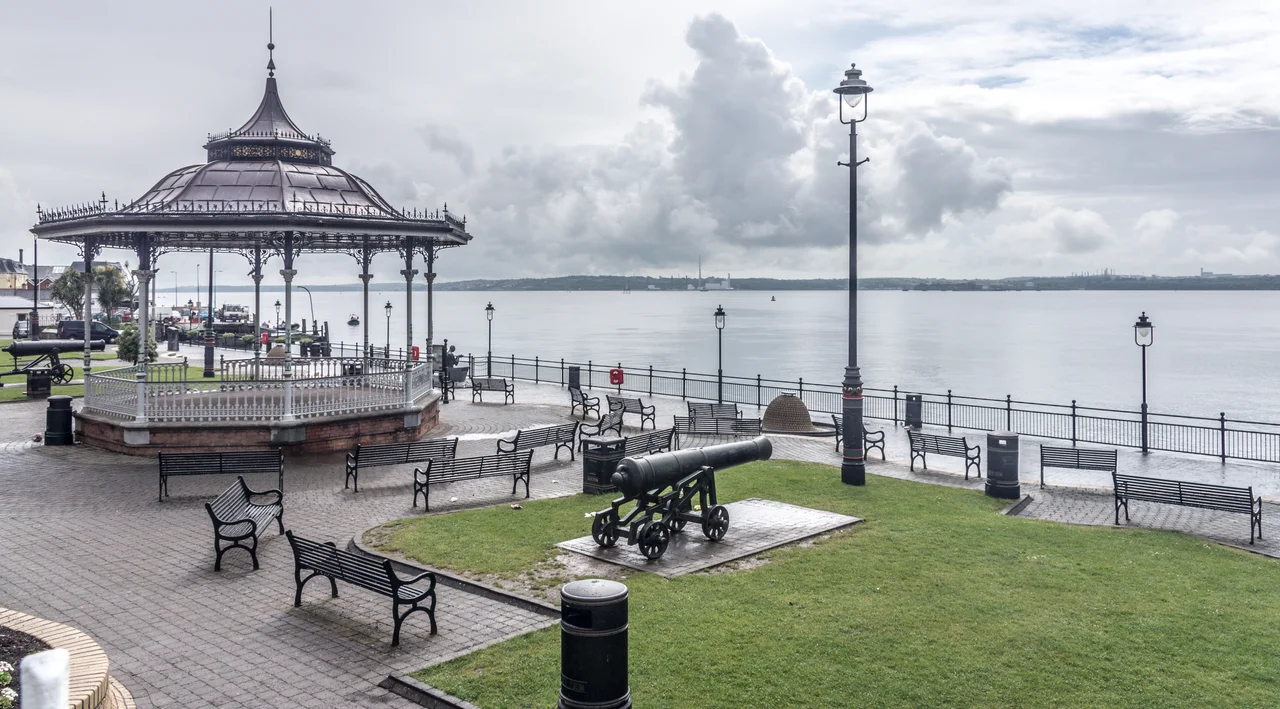
The former Queenstown Lifeboat Station site is at 51.852 degrees N, 8.279 degrees W on the Cobh waterfront, just east of the Pilots Jetty off The Mall. From the air, the location is read from the unmistakable spire of St Colman's Cathedral directly above, with the Cobh promenade and Heritage Centre along the same shore. Cork Harbour mouth and Roche's Point Lighthouse lie about 9 km south. Best viewed from 1,500 to 4,000 feet on a Cork Harbour approach; the cathedral spire makes Cobh impossible to miss. Cork Airport (EICK) is 13 km west.
Nearby Stories
- Walter Siepmann 6.3 km away
- Gaeltacht na nDéise 11 km away
- Fermoy 12 km away
- Canovee 14 km away
- Rathcoole Ambush 16 km away
- SS Folia (1907) 20 km away
- Cloghan Castle, Lough Hyne 35 km away
- SM U-27 91 km away