
Queensway Tunnel
The eighth wonder of the world is how the newspapers described it on 18 July 1934. King George V stood at the Liverpool entrance. Two hundred thousand people lined the approaches and watched him cut a ribbon and declare the new Mersey road tunnel open. It had taken nine years to build. It had cost eight million pounds in 1934 money. At 2.13 miles it was the longest underwater road tunnel anywhere on earth - longer than anything in America, longer than anything on the Continent, longer than anything in the British Empire. Drivers could now cross the Mersey without queuing for the ferry. The old crossing, which had carried traffic across the river since the twelfth century, was about to lose its monopoly to a hole in the ground.
Meeting in the Middle
The plans had been argued over since 1825. An 1830 report killed an early proposal because the engineers worried that mining beneath Liverpool's growing streets would crack buildings above. The 1920s ferry queues finally forced the issue, and in 1925 construction began under chief engineer Sir Basil Mott, supported by Liverpool City Engineer John Brodie. The two crews dug from opposite banks - one from Liverpool, one from Birkenhead - tunnelling through Triassic sandstone and Mersey silt. In April 1928 the two pilot bores met under the river. They missed each other by less than 25 millimetres, the thickness of a pound coin standing on its edge. Seventeen workers died in the construction. The contractors used 250 tonnes of explosives. Brian Colquhoun, the resident engineer for most of the final phase, made the engineering reputation that would carry him through a long career.
Herbert Rowse's Art Deco Cathedrals
The tunnel needed ventilation. Six enormous shafts, three on each side of the river, drew fresh air down and pumped exhaust back up - a constant exchange that prevented carbon monoxide from accumulating in the bore. The architect Herbert Rowse turned these shafts into sculpture. His George's Dock Ventilation Building at the Liverpool Pier Head looks like a temple from Karnak rendered in cream limestone and chrome, a slab-sided Art Deco monument with bronze panels and abstract reliefs of speed and travel. The Woodside ventilator at Birkenhead is its quieter brother. The smaller buildings at Sidney Street, North John Street, Taylor Street, and Fazakerley Street are subordinate but unmistakeably Rowse, all sharing the same flat tower vocabulary. All six are Grade II listed today. They are part of the Liverpool waterfront's permanent silhouette, indistinguishable to casual observers from the city's other Art Deco landmarks.
A Cathedral You Drive Through
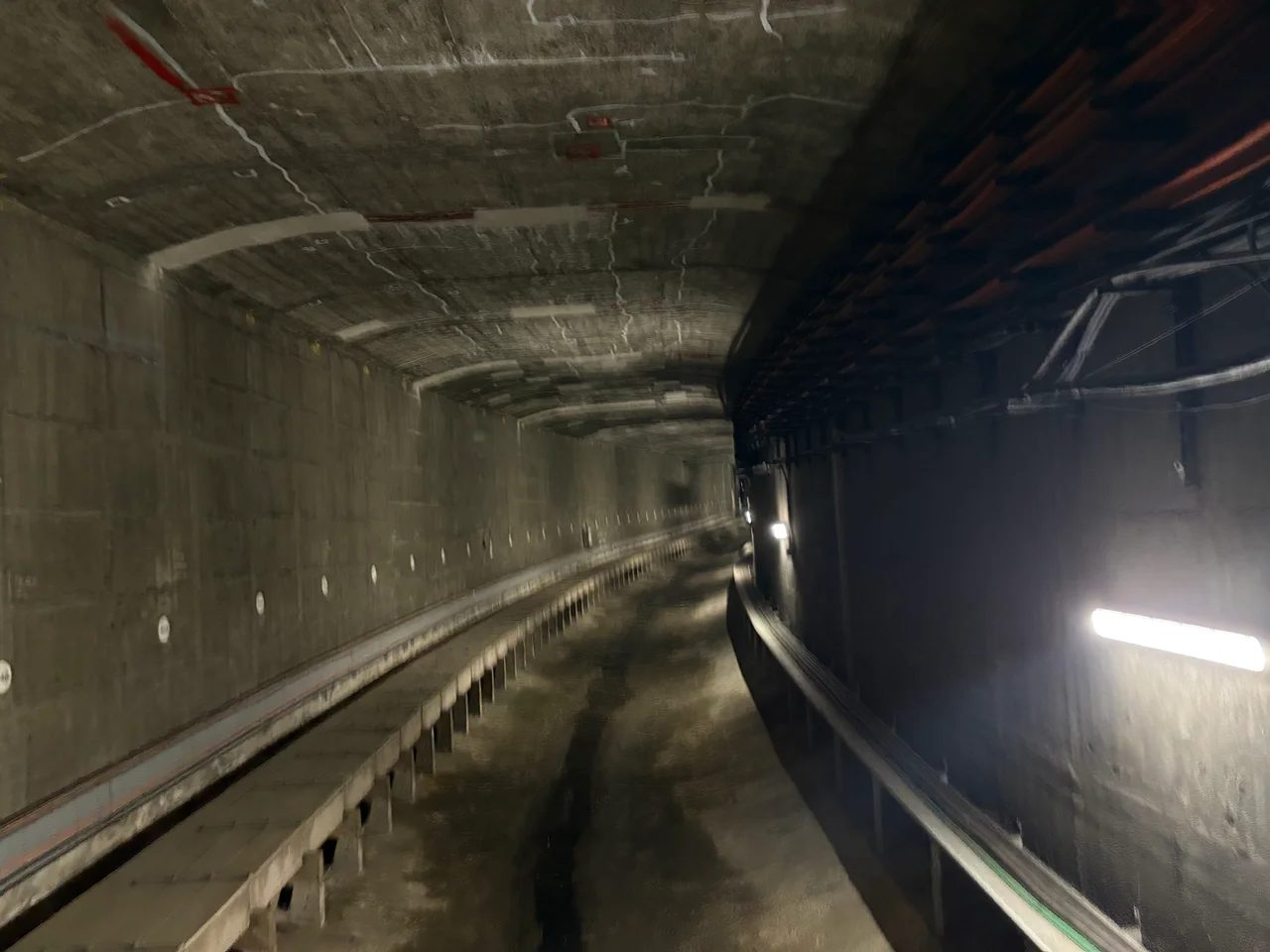
Inside, the tunnel is curved, not straight - a long shallow arc deep below the riverbed, with different height restrictions in the inner and outer lanes because of the geometry. The original wall lighting was famously dim. Drivers complained for half a century before the 1984 upgrade replaced the sidelights with modern overhead fixtures. To install them, the engineers bought several Liverpool double-decker buses, cut the roofs off, fitted them with toilets and tea-making equipment, and used the mobile platforms to ride along the tunnel installing wiring overhead. In 2012 came another refit: 5,999 ceramic-steel panels replaced the corrugated plastic cladding, brightening the tunnel further. Today the Queensway carries about 33,000 vehicles a day. Tolls have been collected continuously since 1934 - residents were told in 1934 that the toll would go when the debt was paid, but the debt got bigger, and the 1980 County of Merseyside Act made the tolls permanent.
The Tunnel That Got a Tunnel
By the 1960s the Queensway was full. The ferry traffic had moved underground, but now the underground traffic was queueing all the way back to the city. In 1971 the Kingsway Tunnel opened to Wallasey, three miles north, to take the M53-bound and goods-vehicle traffic that the older tunnel could no longer handle. The Queensway kept the Birkenhead and inner-Wirral commuters. The two tunnels have shared the river ever since, the Queensway feeding the historic centres on each bank, the Kingsway feeding the motorway system. After the 1999 Mont Blanc Tunnel fire killed 39 people, every major European tunnel was reassessed for safety. The Queensway spent £9 million between 2004 and 2007 building seven emergency refuges below the road deck, each able to hold 180 people, linked by an underground walkway with exits on both sides of the river. The refuges are pumped with fresh air, lined with fire-resistant doors, and connected by video link to the Mersey Tunnels Police control room.
Hello Goodbye
Filmmakers love an empty tunnel. The Queensway has played itself in In the Name of the Father, the Dartford Crossing in Harry Potter and the Deathly Hallows Part 1, a chase venue in Fast and Furious 6, and a Beatles dream sequence in Danny Boyle's Yesterday in 2018 - where the words HELLO GOODBYE roll along its curved walls in giant yellow letters. Twice in its history the Queensway has been closed entirely to traffic and opened to pedestrians: once on its 60th anniversary in 1994 when more than 20,000 people walked through and a tunnel concert had to be abandoned for fear of a crush. There is a Dubliners song - I Wish I Was Back in Liverpool - with a verse about the digging of this tunnel. Ninety years on, the eighth wonder of the world is the workaday old tunnel. Tolls are still collected. The Art Deco towers still vent the exhaust. King George V's ribbon is long since dust, but the hole he opened keeps the Mersey shoreline connected to itself.
From the Air
The Queensway Tunnel runs east-west under the River Mersey between Liverpool and Birkenhead. The Liverpool portal is at the eastern entrance near 53.405°N, 2.985°W, the Birkenhead portal at the western entrance near 53.394°N, 3.019°W. Best viewed at 2,000-4,000 ft. Liverpool John Lennon Airport (EGGP) is 6 nm south-southeast. Look for the George's Dock Ventilation Building at Liverpool Pier Head - a flat-topped cream Art Deco tower just inland from the Three Graces - and the matching Woodside ventilator on the Birkenhead bank.
Nearby Stories
- RAF Wrexham 3.3 km away
- Birkdale Palace Hotel 3.7 km away
- Turton Tower 4.1 km away
- Tatton Park 5.6 km away
- Abergele Rail Disaster 9.6 km away
- Diglake Colliery Disaster 13 km away
- Ysbyty Ifan 16 km away
- Celtic Array 62 km away