
Radford University
In 1910, Virginia carved out a college specifically for women, and tucked it into a double bend of the New River between the Blue Ridge and the Allegheny Mountains. The State Normal and Industrial School for Women at Radford was a frankly practical institution: its purpose was to train teachers for Appalachia, where one-room schoolhouses outnumbered classrooms with running water. More than a century later, Radford University still occupies that same bend in the river - 211 acres of red-brick Georgian buildings, two quadrangles, and a long sloping lawn that runs down toward the railroad tracks and the water beyond.
A College Built for Women, Then Bigger
For its first thirty-three years, Radford trained women for the schoolhouse - first as a normal school, then renamed the State Teachers College at Radford in 1924. The school's center of gravity sat squarely in the Appalachian region it served. Then, in 1943, came an arranged marriage: the state merged Radford with Virginia Polytechnic Institute in nearby Blacksburg, making Radford the women's campus for what was then a male land-grant college. The merger held until 1964. After it dissolved, Radford rebuilt its identity as a coeducational university in its own right, and today it ranks among Virginia's eight doctorate-granting public institutions, with more than 100 undergraduate fields and graduate programs running up to the Psy.D., the D.P.T., and the D.N.P.
The Campus on the Bend
The main academic complex sits in a tidy 76-acre core - administrative halls, residences, classrooms, and dining wrapped around a central lawn and two quadrangles. The Georgian brick anchors the architectural mood, but newer buildings have crept in: a College of Business and Economics building in 2012, a fitness center in 2014, a Center for Sciences in 2016, and a humanities building that fall. U.S. Route 11 and the Norfolk Southern railroad slice between the academic core and a larger athletic and student-apartment district that runs along the New River. Five miles away, the 376-acre Selu Conservancy gives the university a piece of the Little River - reserve, observatory, retreat, and a quiet counterweight to the main campus.
Highlanders and a Planetarium
Radford named its teams the Highlanders in honor of the region's Scots-Irish heritage, and they compete in the Big South Conference. Sixteen NCAA varsity sports run out of the Dedmon Center, which opened in 1981 with a sixth-mile indoor jogging track, an arena, and a constellation of practice fields outside. The men's basketball team has taken the conference tournament three times - 1998, 2009, and 2018. The baseball team has done it twice - 2015 and 2017. And the rugby club, a Division II outfit, won national championships in 2003 and 2008. Less expected, perhaps, is the Radford University Planetarium: a 55-seat theater with a 10-meter dome and a pair of 2K projectors running Digistar 7 software. Work-study students mostly run it. Shows are free, and about 6,000 people come every year.
Notable Hokies and Highlanders
Radford's alumni roster bends toward sport, teaching, and one Paralympic gold. Frank Beamer, who would later coach Virginia Tech for nearly three decades and win 238 games, came through Radford first. Lynne Agee picked up more than 600 wins as a women's basketball coach. Track and field gold medalist Nick Mayhugh took his medal at the 2020 Tokyo Paralympics. The actress and singer Jayma Mays started here too, as did the author Kiera Cass. Randal J. Kirk, who founded New River Pharmaceuticals and led Intrexon, made his pile in biotech. James Hoge Tyler, the Confederate soldier who became Virginia's governor, lived in the home next to campus that now lends its name to the school's main street and a residence hall.
Why the River Matters
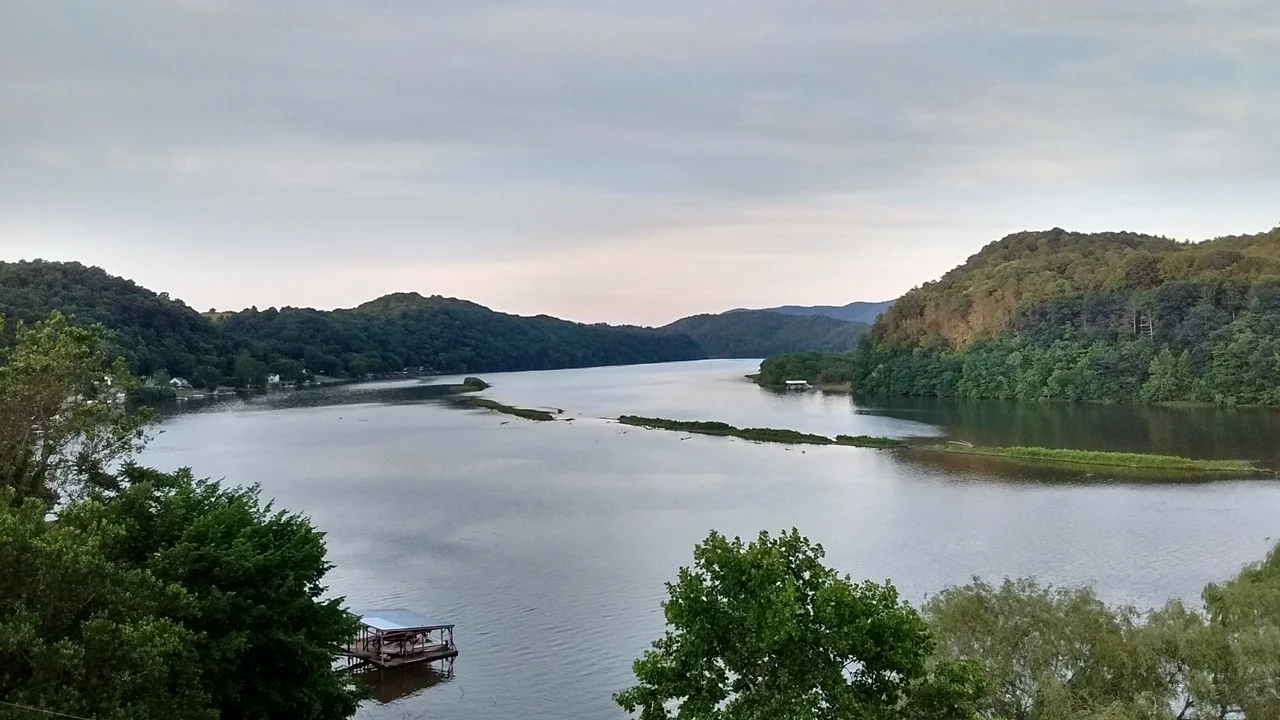
The New River matters more than the name suggests. It is, in fact, one of the oldest rivers in North America - flowing north, unusually, from North Carolina up through Virginia and into West Virginia, where it eventually joins the Kanawha and then the Ohio. At Radford it takes a sharp double bend, and the university curls inside it. The bend explains the railroad tracks (Norfolk Southern still runs Roanoke to Bristol through here), the highway exits, and the geography of student housing across the river. The water is also responsible for one of the more pleasant student traditions: warm-weather afternoons spent floating downstream on inner tubes, a small geography lesson dressed up as procrastination.
From the Air
Radford University sits at 37.139 N, 80.558 W in the New River Valley of southwestern Virginia, at roughly 1,800 feet elevation. From cruising altitude, look for the double bend of the New River and the long red-brick complex on its inside curve, just north of I-81 between exits 105 and 109. The campus lies about 10 miles west of Blacksburg and Virginia Tech. Nearest fields: Virginia Tech Montgomery Executive (KBCB) about 10 nm northeast, and New River Valley (KPSK) about 10 nm west near Dublin. Roanoke-Blacksburg Regional (KROA) is roughly 40 nm to the northeast.
Nearby Stories
- WDBJ 1.9 km away
- Mitchell Stadium 8.7 km away
- Monroe County, West Virginia 18 km away
- Botetourt County, Virginia 34 km away
- Galax, Virginia 35 km away
- Martinsville, Virginia 36 km away
- New River and Greenbrier Valleys 42 km away
- Emory and Henry University 58 km away