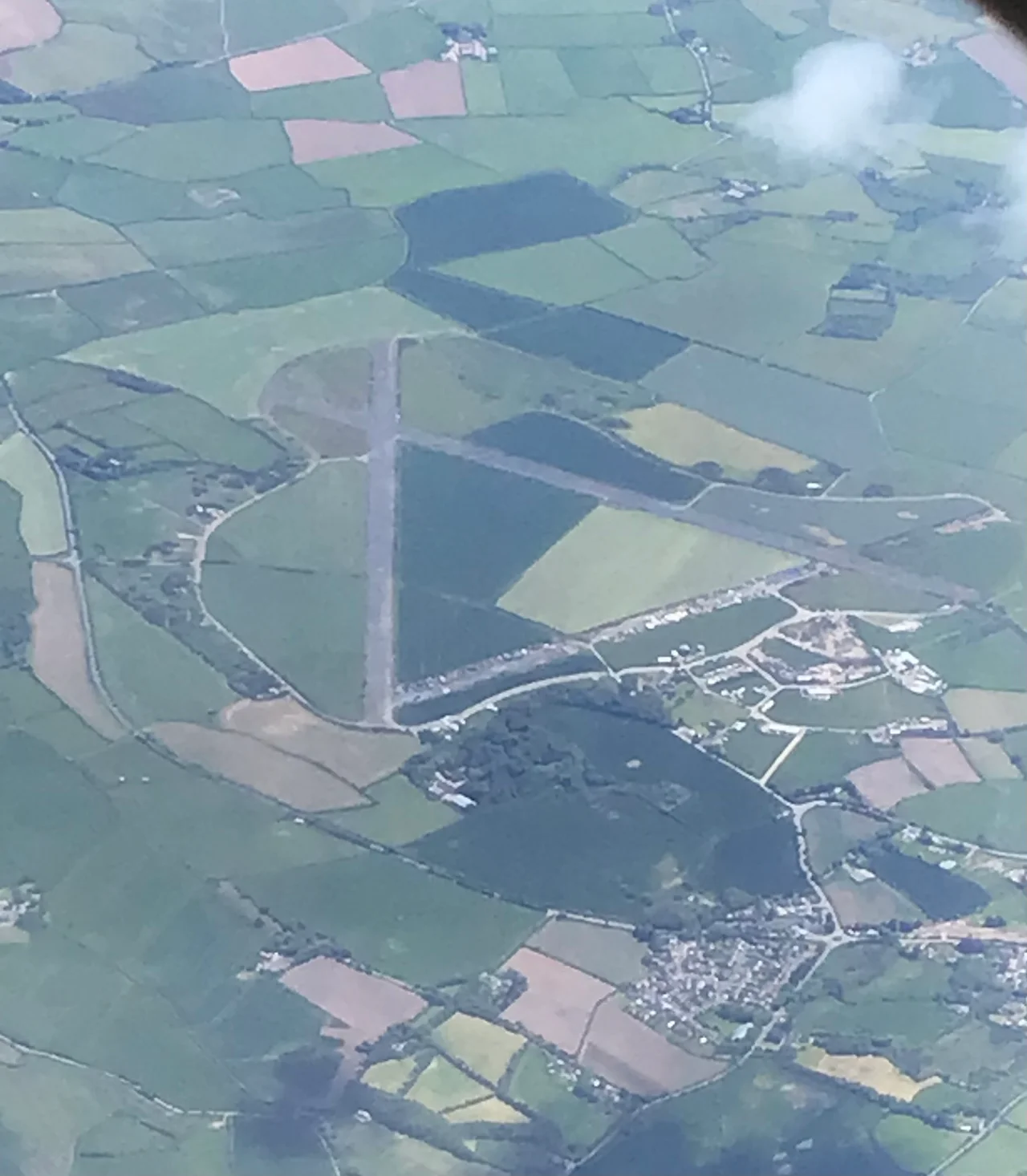

RAF Andreas
They cut the tower of St Andrew's Church down to make the runway safer. That single fact, more than almost any other detail, captures what happened in the parish of Andreas between 1940 and 1946. The church tower had been 120 feet tall, the most striking feature of the island's flat northern plain, visible across the whole parish. The Air Ministry insisted it be reduced to remove a hazard at the southern end of RAF Andreas's main runway. The stubby remnant still stands today, an architectural injury sustained for a war that needed Spitfires to take off without striking masonry. The airfield itself opened in 1941 and closed in 1946, but for those five years it was a busy hinge of the air defence and air training network protecting Liverpool, Belfast, and Glasgow.
Why Andreas
The site was chosen for its position. The flat northern plain of the Isle of Man sat almost equidistant from three vital British ports: Liverpool, Belfast, and Glasgow. Convoys carrying everything from American grain to North African oil came up the Irish Sea, and the German bombers based in occupied France knew it. A fighter station here could intercept night raiders without long ferrying flights from England. Compensation was agreed with the landowners and construction began in earnest by the end of June 1940. The footprint covered 500 acres, with 200 acres from each of Ballaghaue Farm and Braust Farm and a smaller portion stretching into the adjacent parish of Bride. The main north-east to south-west runway was 1,100 yards long and 50 yards wide, with a perimeter track more than three miles in length, twenty-four blast pens for protecting fighters and twin-engined aircraft, and five-foot rolls of concertina barbed wire fencing the whole site.
The Australians
By October 1941 the airfield was ready to receive its first squadron, the Royal Australian Air Force's 457 Squadron, freshly arrived from Australia and working up to operational readiness on Spitfires. After the 457 moved south in March 1942 to join 11 Group at RAF Redhill and the air war over northern France, 452 Squadron RAAF replaced them. Then came 93 Squadron, a rebuilt unit that had previously specialised in night fighter tactics with Havocs equipped with Turbinlite searchlights. The fighter squadrons trained relentlessly over the air-to-ground range at Smeale on the Ayres coast, with the firing zones extending out to sea on both sides of the Point of Ayre. By the end of 1942, 93 Squadron had moved on to Algiers for Operation Torch, the North African landings, and the urgent need that had brought RAF Andreas into being had largely passed.
The Gunners' School
From May 1943, RAF Andreas changed character entirely. It became No. 11 Air Gunnery School, training the men who would crew the rear and mid-upper turrets of Avro Lancasters and Handley Page Halifaxes. Every heavy bomber needed two or three gunners, and Bomber Command's losses required thousands of replacements. The course at Andreas ran ten intensive weeks. Volunteer pupils learned aircraft recognition, sighting, pyrotechnics, clay-pigeon and 25-yard range shoots, the care of .303 and .5 Browning machine guns and 20mm cannon, the manipulation of Boulton Paul and Frazer Nash turrets. They flew in Avro Ansons first, then Vickers Wellingtons withdrawn from operations, with Bristol Mercury-engined Miles Martinets towing targets. Spitfires made up the complement. By the end of the war, over 3,000 air gunners had completed the course at Andreas. Many of them would not survive their operational tours.
Names on a Headstone
The losses at the station itself, while smaller than those over Germany, mattered enormously to the people involved. On 1 December 1941, a Spitfire returning from a sortie struck a builder's foreman crossing the runway in a lorry, killing him instantly. On 8 May 1942, two of 452 Squadron's Spitfires collided over the field practising camera attacks. Sergeant Pilot Reginald Goodhew, flying BL351, died. Pilot Officer William Ford in the other aircraft baled out and survived. Sergeant Goodhew is buried in Andreas churchyard, beside other British, Commonwealth, and Polish servicemen. The most memorable loss came on 23 August 1942, when the station's commanding officer Wing Commander Edward Knowles, aged 33 and an experienced bomber pilot, was killed taking up a Whitley for a short summer afternoon flight. On Sub Lieutenant Robert Shaw Paton, 20 years old, died on 27 October 1944 when his Sea Hurricane crashed on Douglas Head. Each name on a headstone in the churchyard belongs to a young person whose family received a telegram. The runway is grass again now, and a local gliding club shares it with a few private light aircraft, and several of the old E pens still stand, one of them housing a mobile phone mast.
From the Air
RAF Andreas, today known as Andreas Airfield, lies at 54.371N, 4.424W (gcsv7) on the Isle of Man's northern plain between the villages of Andreas and Bride. It remains an active general aviation strip operated by the local gliding club and private owners; runways are grass. The closest active airport is Isle of Man Airport (Ronaldsway, EGNS) about 23 nm south. The truncated tower of St Andrew's Church at Andreas village remains visible 1 nm south of the field, a war-altered landmark still missing the top third of its medieval height. Several E pens (concrete blast revetments) remain along the eastern boundary, distinctive when viewed from low altitude. The Point of Ayre lighthouse stands 3.5 nm north-east. For pattern work, the prevailing wind is south-westerly and the surrounding terrain is flat and forgiving. Be aware of glider winch operations.
Nearby Stories
- Kirkmaiden 3.2 km away
- Isle of Whithorn 4.1 km away
- Santon Railway Station 13 km away
- Solway Firth 16 km away
- St Bees Lighthouse 19 km away
- Portavogie 34 km away
- Walney Island 40 km away
- German submarine U-1024 55 km away