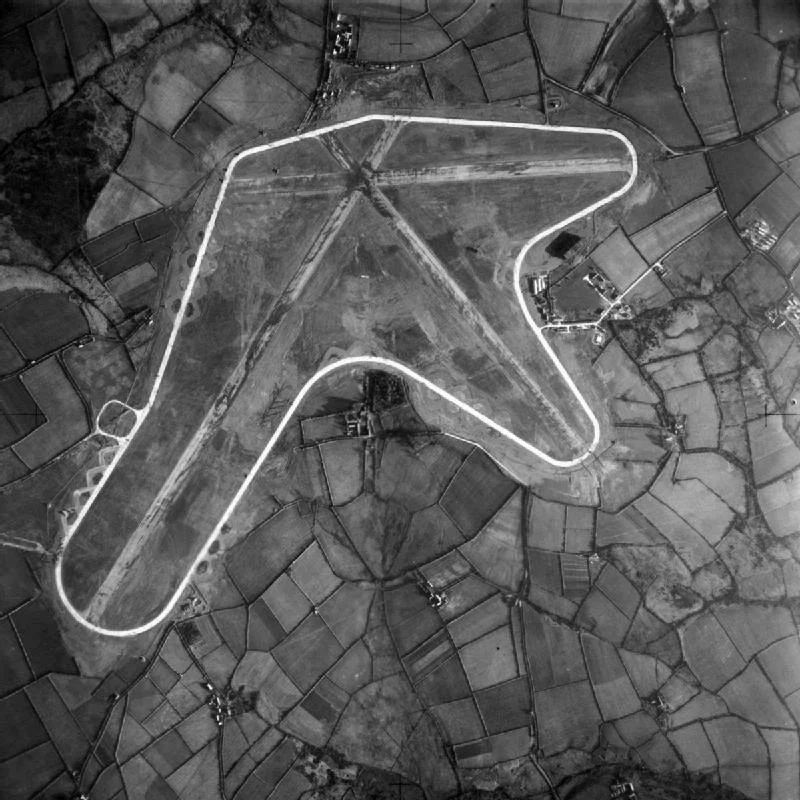

RAF Brawdy
By the late 1970s, anyone driving past Brawdy on the A487 between St Davids and Haverfordwest could see two airfields in one. To the south of the runway, RAF Hawks from No. 79 and No. 234 Squadrons screamed through low-level tactical training, painting black streaks of jet exhaust across the Pembrokeshire sky. To the north, behind double fences and the studied vagueness of a sign that said only "Royal Air Force Station Brawdy," sat a small American installation that officially conducted oceanographic research. It did not conduct oceanographic research. It listened for Soviet submarines passing through the eastern Atlantic, and for twenty-one years its eavesdropping on the GIUK gap was one of the most closely held secrets of the Cold War.
From Coastal Command Outpost
Brawdy opened in February 1944 as a satellite airfield, taking over duties that had overwhelmed nearby RAF St Davids. Halifaxes of No. 517 Squadron flew long meteorological sorties out over the Atlantic, gathering the weather data that made the D-Day forecast possible. Coastal Command's photo-reconnaissance trainees from No. 8 (Coastal) Operational Training Unit arrived with Spitfires and Mosquitos. After the war the Admiralty took the field on loan, renamed it HMS Goldcrest, and used it through the 1950s and 1960s as a Fleet Air Arm training and front-line station. Hawker Sea Hawks of No. 800, 801, 806 and other naval squadrons worked up here before embarking on HMS Ark Royal, Bulwark, Eagle and Albion. Several of those squadrons sailed from Brawdy directly into the 1956 Suez crisis.
The Ears in the Atlantic
In 1974 the Royal Navy paid off Brawdy and the RAF took it back, but that same year a new tenant moved in next door. The United States Navy established Naval Facility Brawdy on April 5, 1974, the terminus of newly laid SOSUS hydrophone arrays that watched the deep water approaches to the British Isles. With around 400 American and British personnel, NAVFAC Brawdy became the first "super NAVFAC," larger than any of the earlier stations. The arrays, draped down the continental slope into the deep sound channel, could detect a Soviet nuclear submarine entering the Atlantic from hundreds of miles away. The 1985 Fixed Distributed System, a new generation of bottom sensors, was tested here. The men and women on watch listened to LOFARgrams, paper strip charts that turned the low rumble of submarine reactors into visible streaks, while their cover story said they were studying the ocean.
Hunters in the Sky
While the Americans listened, the RAF taught its young pilots to kill. No. 229 Operational Conversion Unit relocated from RAF Chivenor in September 1974, took the new title 1 Tactical Weapons Unit, and turned Brawdy into the gateway between Valley's basic jet course and the front-line squadrons. Graduating students went on to fly Buccaneers, Harriers, Phantoms and eventually Tornados. The Hawker Hunter, in service since 1954, kept teaching until BAe Hawks finally displaced it through the early 1980s. The TWU also flew Hunter FR.10s for tactical reconnaissance and Gloster Meteors as target tugs, the last of those venerable jets still drawing operational hours from the British military. The tempo was relentless. Welsh farmers grew used to Hawks rolling inverted at hedgerow height, then climbing for a second pass.
The Cold War Ends
Both halves of Brawdy wound down together. Flying training ceased on August 31, 1992, and No. 202 Squadron's Sea King search-and-rescue helicopters lingered until July 1994. NAVFAC Brawdy decommissioned on October 1, 1995, its arrays "remoted" to the consolidated Joint Maritime Facility at RAF St Mawgan in Cornwall and its mission rolled into a quieter postwar surveillance posture. The British Army then took the airfield, renamed it Cawdor Barracks after the Earls of Cawdor who had owned much of nearby Stackpole, and moved in the Army's electronic warfare unit. Today the Hawk runway is silent, but the ground itself still hums with secrets it cannot quite shake.
What Remains
Drive past Brawdy now and the wartime hangars, the old hard-stands, the control tower, and the perimeter fences are all still visible against the green Pembrokeshire hills. A Hawker Hunter FGA.9 once stood as gate guardian, tribute to the type's twenty-eight-year service. Spitfire PRXIX PS915 spent its retirement here before being recalled to the Battle of Britain Memorial Flight. The base sits one mile inland from St Brides Bay, with Ramsey Island and St Davids Head visible from the runway threshold. On a clear day, you can stand at the edge of the field and see why the planners chose this place. The horizon is mostly Atlantic, and what mattered, the Soviet submarines and the weather fronts coming east, was hidden somewhere underneath it.
From the Air
Former RAF Brawdy / NAVFAC Brawdy lies at 51.88°N, 5.13°W, six miles east of St Davids and seven miles west of Haverfordwest. The 6,000-foot main runway (07/25) remains visible from altitude. Cawdor Barracks now occupies the site. Nearest active airfields are EGFE (Haverfordwest) eight miles east and EGFH (Swansea) about 60 miles east. Look for the distinctive cluster of three interconnected hangars north of the runway. The North Atlantic stretches to the west; the SOSUS cables once ran down the continental slope past Ramsey Island and out into the Celtic Sea.
Nearby Stories
- RAF Angle 0.9 km away
- Cardigan Bay Special Area of Conservation 5.4 km away
- Abercych 11 km away
- Cantre'r Gwaelod 12 km away
- Burry Port Lifeboat Station 22 km away
- Johnstown Castle 61 km away
- Hook Lighthouse 92 km away
- 1979 Fastnet Race 157 km away