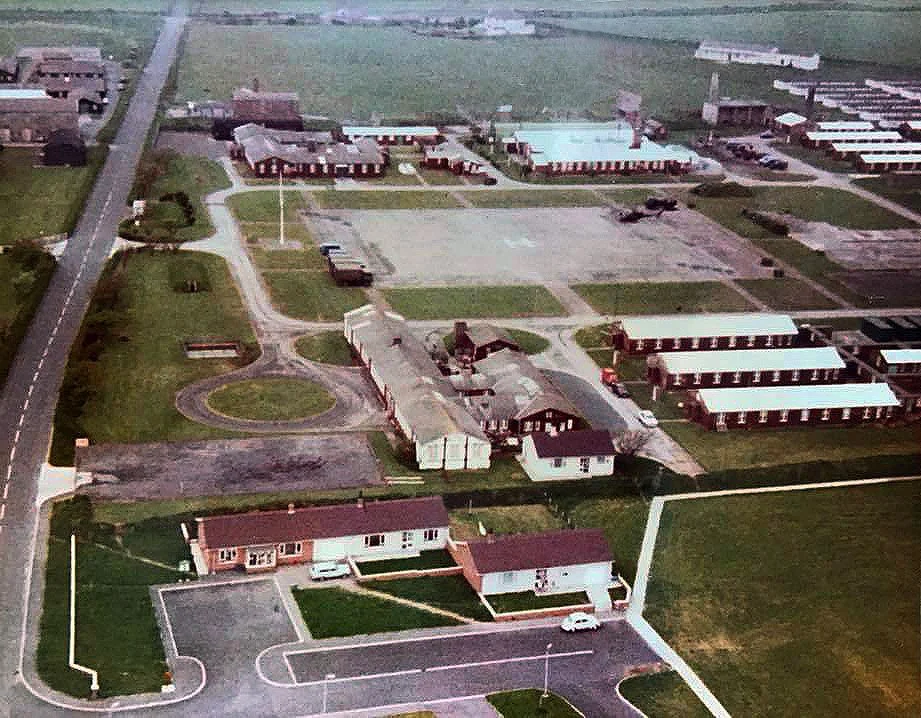

RAF Jurby
The trainee cadets had a nickname for it: 'The Camp on Blood Island.' Black humour, the way young men in uniform have always coped with hard places. RAF Jurby sat on the flat northern plain of the Isle of Man, beaten by Irish Sea wind, surrounded by sodden curragh and the unforgiving spine of Snaefell to the south. From 1939 to 1963 it taught bomb aimers, navigators, gunners and officer cadets the skills they would need in war. Some of them learned. Some of them died before they got the chance.
Why Here
Sir Alan Cobham had flown over the island in the early 1930s and picked out half a dozen suitable sites between Ballaugh and the Point of Ayre. The northern plain was flat, sparsely populated, and well placed for fighter protection of Belfast and Liverpool once France fell in 1940. Under the RAF Expansion Scheme the Air Ministry approached the Manx Government in 1937, bought 400 acres, and built fast. The station opened on 18 September 1939, a fortnight after war was declared. It had a single F-type hangar, two T2 types, four Bellman hangars and nineteen Blister hangars, all crouched in the layout that the British repeated at every Expansion Period airfield: technical area, station offices, officers' mess, sergeants' mess, airmen's quarters. Ten pillboxes ringed the perimeter, and seventeen brick-and-earth trench shelters could hold 800 personnel between them.
Learning to Fly, and to Die
The mountainous backbone of the island was notorious for mist, and trainee pilots were, by definition, inexperienced. In the three years to the end of 1942 there were 31 accidents involving Jurby aircraft and 76 dead. The first wartime fatality on Manx soil came on 1 January 1940, when a training flight from RAF Upper Heyford crashed into Snaefell in poor visibility, killing three of four crew. By mid-1941 fatal accidents averaged one a month. Boys from across the Commonwealth flew worn-out Hampdens, Handley Page Herefords with cooling problems, Blenheims and Fairey Battles - aircraft already obsolete on the front line, demoted to training where they could still kill. The worst single tragedy in Jurby's later years came on 6 September 1953, when an Avro Anson carrying the outgoing and incoming station commanders, Group Captains Worthington and Richmond, flew into the slopes of Clagh Ouyr above the Black Hut. All four men aboard died.
The Squadrons Pass Through
Between November 1940 and October 1941 five fighter squadrons rotated through Jurby. The first was 307 Polish Night Fighter Squadron, flying the slow, gun-turreted Boulton Paul Defiant under Squadron Leader Stanislaw Pietraszkiewicz. Then came 258 Squadron with Hurricanes, then 302 Polish Fighter Squadron, formed in 1940 from airmen who had escaped the German invasions of Poland and France and already battle-hardened over Duxford. In August 1941 the first Spitfires arrived with 457 Squadron, mostly Australian pilots with British ground crew. They flew convoy patrols over the Irish Sea, practised firing on drogues towed by Lysanders over the Ayres, and moved on to the new dedicated fighter station at RAF Andreas. Behind them the training went on: by 1944 the school had a new name, No. 5 Air Navigation and Bombing School, and a fleet of Avro Ansons with their gun turrets stripped out and a perspex panel set into the nose for the bomb aimer to lie behind.
After the War
More than 7,000 personnel passed through the station by 1945. King George VI and Queen Elizabeth visited on 6 July of that year, inspected the airmen of both Jurby and Andreas, and flew out aboard a King's Flight Dakota. In April 1950 the station was reborn as No. 1 Initial Training School - the first of its kind in the RAF, putting cadets through 24 weeks of preliminary training before flying school. The town of Ramsey gave Jurby its Freedom in April 1955. Eight years later, in January 1963, the closure was announced; by September the camp was empty. The Officer Cadet Training Unit moved to RAF Feltwell. Two hundred and thirty civilians lost their jobs.
What Remains
Drive down Ballamenagh Road today and you can still read the shape of the airfield in the land. The largest hangars survive on the south side, re-clad and let to lorry mechanics and light industry. The Guard House is now a cafe. The wooden officers' mess, built in 1938 to last ten years, became the Jurby Hotel, ran for half a century and was finally demolished in 2009 to make way for a health centre. One Bellman hangar houses the free-entry Jurby Transport Museum, full of buses and trams from the island's past. Another, for a time, held two Soviet spacecraft that an Isle of Man-registered company hoped to launch into orbit - they never flew. The annual Jurby Festival of Speed runs motorcycle laps around the perimeter track during the Classic TT fortnight. The Isle of Man Prison sits inside the old western taxiway. And Jurby has appeared in discussions about the island's long-term aviation future, listed as a contingency site in the Airport Masterplan should Ronaldsway ever need a replacement.
From the Air
RAF Jurby sits at 54.354N, 4.524W on the flat northern plain of the Isle of Man, about 400 ft above sea level. Visible landmarks: Point of Ayre lighthouse 6 nm NE, the long curve of Ramsey Bay 5 nm E, the broad mass of Snaefell rising to 2,036 ft 8 nm SE. Nearest operating airport is Ronaldsway (EGNS), 18 nm S. The disused runways are clearly visible from cruising altitude as a triangular pattern against farmland. Local weather can include rapid-onset Irish Sea fog.
Nearby Stories
- Kirkmaiden 3.2 km away
- Isle of Whithorn 4.1 km away
- Santon Railway Station 13 km away
- Solway Firth 16 km away
- St Bees Lighthouse 19 km away
- Portavogie 34 km away
- Walney Island 40 km away
- German submarine U-1024 55 km away