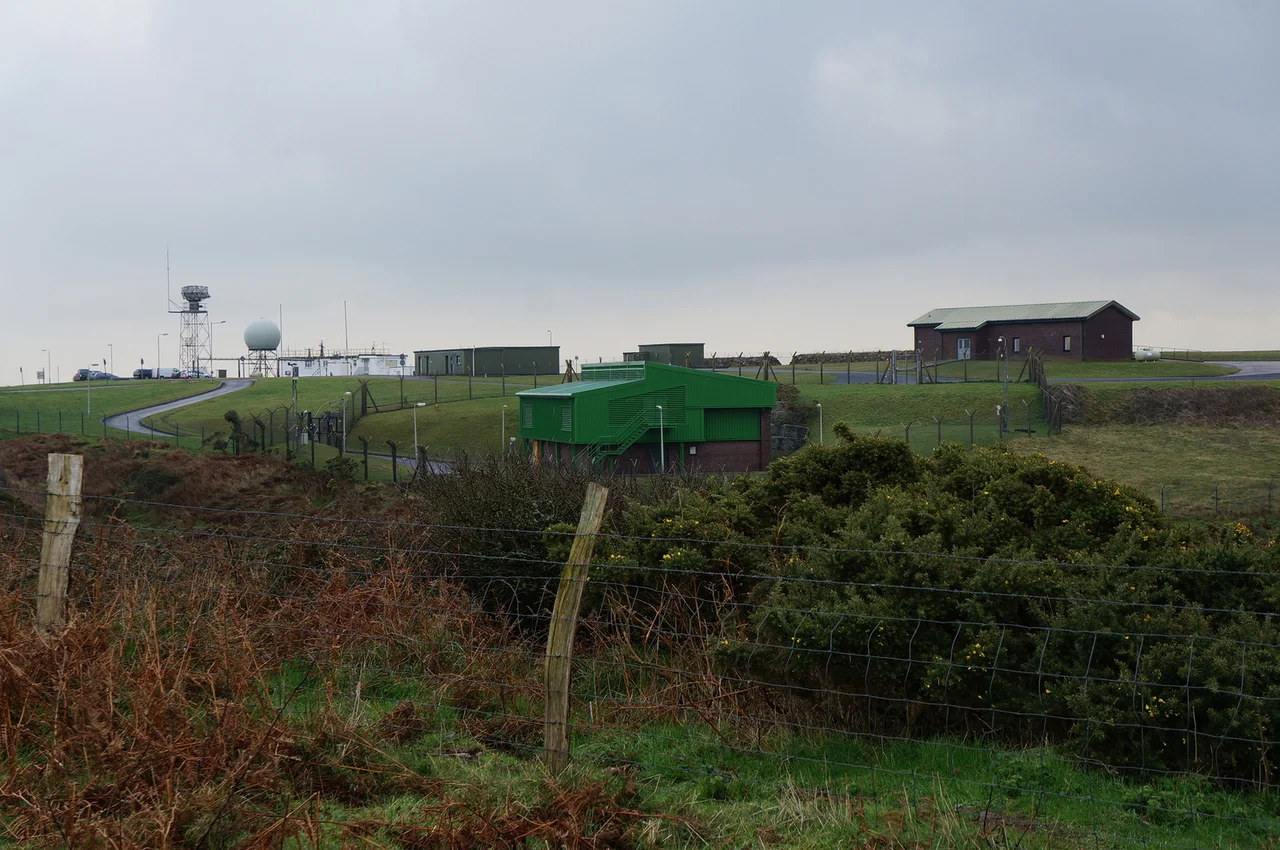

RAF Manorbier
On 6 June 1941, Winston Churchill stood on a Pembrokeshire cliff and watched a pilotless biplane rise from a ramp into the Welsh sky. The aircraft was a de Havilland Queen Bee - a radio-controlled Tiger Moth variant whose entire purpose was to be shot down. Behind Churchill stood his Secretary of State for War. Below him stretched the firing range that had been training British gunners since before the prime minister had ever heard of it. RAF Manorbier was, and is, a place built to make targets and then kill them.
The Earl's Field
The airfield began in 1933 as a curious hybrid. Algernon Capell, the 8th Earl of Essex, kept his private aircraft on the grass strip beside Manorbier village, and the RAF used the same field as a landing ground for aircraft visiting the flying-boat station at Pembroke Dock. By 1935 the Earl had left. By 1937, the field had become a target-drone base for the curiously named No. 1 Anti-Aircraft Co-operation Unit, whose 'Y' Flight flew Queen Bees out over the Bristol Channel so artillery gunners on shore could practice anti-aircraft fire. The Queen Bee was a remarkable piece of engineering for its decade: a wood-and-fabric biplane controlled by a man on the ground with a radio handset, retrieved from the sea by a small boat after it had survived - or failed to survive - the day's gunnery.
Pilotless and Patient
The Pilotless Aircraft Unit moved here from RAF St Athan in May 1942, settled in, and stayed. The work was unglamorous. Build a drone, launch a drone, fly the drone in a predictable pattern, hope the gunners hit it or hope they did not. Repeat. Through the war, the unit's drones flew thousands of sorties, calibrating guns whose targets would later be Heinkels and Junkers approaching real targets. No. 595 Squadron joined them in December 1943 with target-tug aircraft, towing canvas sleeves behind biplanes for the gunners to aim at. The squadron departed when its parent unit moved to RAF Fairwood Common, but the drone work continued. The RAF closed Manorbier as an active station on 1 September 1946. The army took the keys.
Starstreak
What followed has been even longer than the RAF years. In 1972 the anti-aircraft school at Larkhill in Wiltshire and the field at Manorbier were merged into Air Defence Range Manorbier - the sole UK range licensed to test the High Velocity Missile known as Starstreak. The numbers tell the story. Starstreak accelerates to Mach 3 within a single second of launch. Operators train for months in simulators before they are allowed to live fire one. The drones they shoot at - Banshees, manufactured by QinetiQ - are designed to survive missile engagements, with onboard radar to record whether the missile would have hit if armed. The installation itself covers only 102 acres. The danger area extends 220 square miles, reaching 13 miles out to sea and up to 50,000 feet vertically. Pilots flying along the South Wales coast learn early to check the NOTAMs for Manorbier.
Martlet on the Cliff
In March 2019, Thales Air Defence brought a different weapon here. The Lightweight Multirole Missile - Martlet - was being qualified for use from the AW159 Wildcat helicopter, and Manorbier ran the ground-launched trials. The Royal Marines Air Defence Troop of 30 Commando became the first sub-unit to use the system, firing laser-guided Martlets at Banshee drones over the bay. A separate trial sent six Martlets at a small boat target 4.5 km offshore, all with telemetry packages and no warheads, so that engineers could study the launcher dynamics without sinking anything. The Pembrokeshire coast - quiet, predictable, with usefully empty sea on three sides - made the data clean.
Living With the Range
Locals have lived with the noise since 1933. Most accept it; the range employs people and supports the village. In 2005 the Ministry of Defence proposed night firings - up to 100 missiles across 20 nights a year - and the response from Manorbier residents was less accommodating. Tourism, they argued, would suffer; the new night-vision tests could happen somewhere else. The proposal was scaled back. Today the range still fires by day, mostly, and walkers on the Wales Coast Path can hear the percussions roll across the cliffs when the gunners are working. Look out across the bay during a live fire window and you may see, briefly, the white trail of a Starstreak heading for a Banshee that does not yet know it is being hunted.
From the Air
Located at 51.6458 N, 4.7833 W on the south Pembrokeshire coast, immediately east of Manorbier village. Recommended observation altitude 3,000-4,000 feet, well outside the range complex. The active danger area (D-117) extends approximately 13 nm out to sea and vertically to FL500 when firing is in progress - ALWAYS check current NOTAMs before flying within 25 nm. Nearest airports: EGFE Haverfordwest (17 nm north) and EGFH Swansea (33 nm east). The range buildings sit on the headland just inland of Old Castle Head, with Manorbier Castle visible to the west.
Nearby Stories
- Gower Peninsula 0.2 km away
- St Davids Lifeboat Station 3.6 km away
- Dryslwyn Castle 8.1 km away
- Action of 17 November 1917 8.4 km away
- 102.5 Radio Pembrokeshire 9.6 km away
- Ilfracombe Lifeboat Station 15 km away
- Lighthouses on Lundy 19 km away
- Tehidy Country Park 121 km away