
RAF Metfield
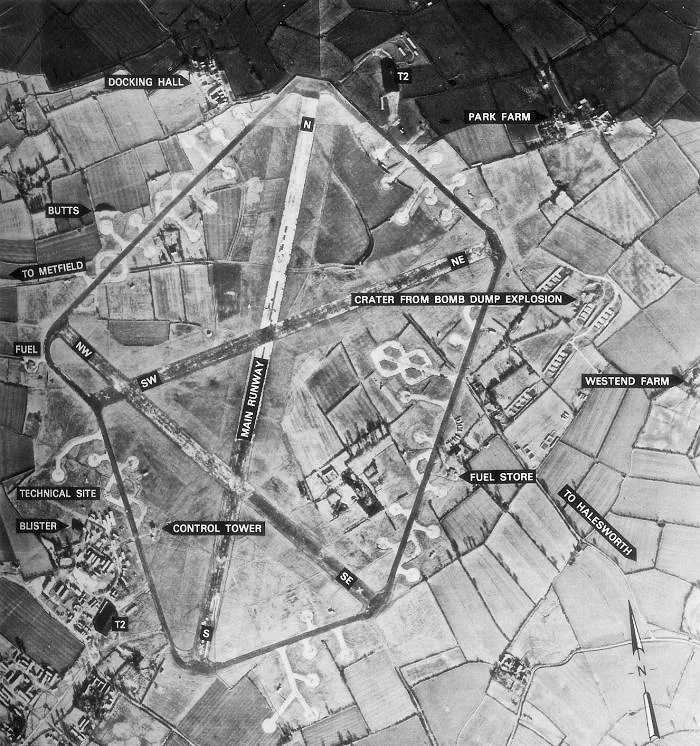
At 7:30 in the evening on 15 July 1944, soldiers from the 2218th Quartermaster Truck Company decided not to wait. The hoist operators at the Metfield bomb dump were on a meal break. The Quartermasters had bombs to deliver and a technique for unloading without the crane, one they had used successfully before. One bomb landed on another. They both went off. Twelve hundred tons of high-explosive and incendiary ordnance detonated in a chain reaction that shook the Suffolk countryside for miles. Six men were killed. An eyewitness 3.5 miles away was knocked flat. Five B-24 Liberators parked in nearby hardstands were damaged beyond repair; six more were severely damaged. Three of the Quartermaster soldiers, Privates Donald P. Adkins, Donald L. Hurley, and Steve W. Suchey, were so completely obliterated that they are memorialised at the Cambridge American Cemetery as missing in action.
Class A in the Suffolk Fields
Metfield was built in 1943 as a standard Class-A bomber base with three intersecting concrete runways, fifty dispersal points, and two T-2 hangars. Construction required closing the B1123 road between Halesworth and Harleston. The buildings to house its 2,900 personnel sprawled across former farmland to the southwest. The airfield was assigned to the United States Army Air Forces Eighth Air Force and given the designation USAAF Station 366. It was one of the most isolated Eighth Air Force fields in Suffolk, surrounded by countryside rather than other military activity.
Black and Yellow Checks
The first American occupants arrived on 3 August 1943: the 353rd Fighter Group, flying Republic P-47D Thunderbolts. They painted their aircraft with black, yellow, black, yellow spinners and a striking 48-inch black and yellow check band around each cowling, all the way back to the exhaust stubs. The 353rd was the fourth P-47 unit to join the Eighth Air Force, and from Metfield they flew counter-air sweeps over France and the Low Countries, escorted bombers to targets in western Europe, and dive-bombed German positions in France. On 12 April 1944 they moved on to RAF Raydon, and the field became a heavy bomber station.
Circle Z Liberators
The 491st Bombardment Group (Heavy) flew its Consolidated B-24 Liberators into Metfield in late May 1944, the last aircraft arriving on the 30th. Their tail code was a Circle Z. The squadrons, the 852nd, 853rd, 854th, and 855th, had been recruited unusually, with ground crews drawn from other stations across the 2nd Air Division. They began combat on 2 June, just in time to hammer airfields, bridges, and coastal defenses before and during the Normandy invasion. After D-Day they ranged across Germany, hitting Berlin, Hamburg, Kassel, Cologne, Gelsenkirchen, Bielefeld, Hannover, and Magdeburg. Once they bombed the headquarters of the German General Staff at Zossen. On 15 August 1944 the 491st was reassigned to RAF North Pickenham.
Clandestine Sweden
After the 491st left, a strange new tenant arrived. The 1409th Army Air Force Base Unit took over some of the B-24s, operating them alongside Douglas C-47 Skytrains and C-54 Skymasters under the command of the European Division of Air Transport. Their mission was classified: clandestine transport runs to neutral Sweden, flying out special materials and ferrying personnel. They also used RAF Leuchars in Scotland as an advanced base. On 4 March 1945, during the Luftwaffe's nighttime intruder mission Operation Gisela, a Junkers Ju 88G-6 strafed Metfield, killing one man in the control tower. The German night fighter had been trying to attack an inbound B-24 with its Schrage Musik upward-firing cannon and crashed just south of the airfield.
The Lake That Was a Crater
The 1944 explosion left a crater so large that an entire loop road had to be built to bypass it. For years afterward, the crater filled with water, becoming a lake that locals used as a dump for discarded equipment. When it was finally drained and cleaned, divers found everything from cookware to several unexploded bombs. Fragments of the 1944 ordnance still surface in the surrounding fields. The airfield itself was abandoned in May 1945 and sold off in 1964 and 1965. Today only a few brick buildings, some deteriorating Nissen huts, and concrete taxiway remnants suggest that 2,900 Americans once lived and fought from this quiet patch of Suffolk farmland.
From the Air
RAF Metfield sits at 52.367 degrees north, 1.396 degrees east, just southeast of Metfield village in Suffolk. Nearby aviation: Norwich Airport (EGSH) is roughly 18 nautical miles north; the Norfolk and Suffolk Aviation Museum at Flixton (next to former RAF Bungay) lies about 7 nautical miles to the east; RAF Honington (EGXH) is 15 nautical miles west. Recommended viewing altitude is 2,500 to 4,000 feet AGL to pick out the agricultural ghost of the triangular runway pattern and the section of preserved taxiway.
Nearby Stories
- RAF Hethel 4.1 km away
- West Stow Anglo-Saxon Village 4.9 km away
- Castle Hedingham 8.1 km away
- Shotley Gate 8.5 km away
- RAF Marham 14 km away
- Four Days' Battle 52 km away
- Southern Bight 79 km away
- SS Elbe 113 km away