.jpg)
RAF Usworth
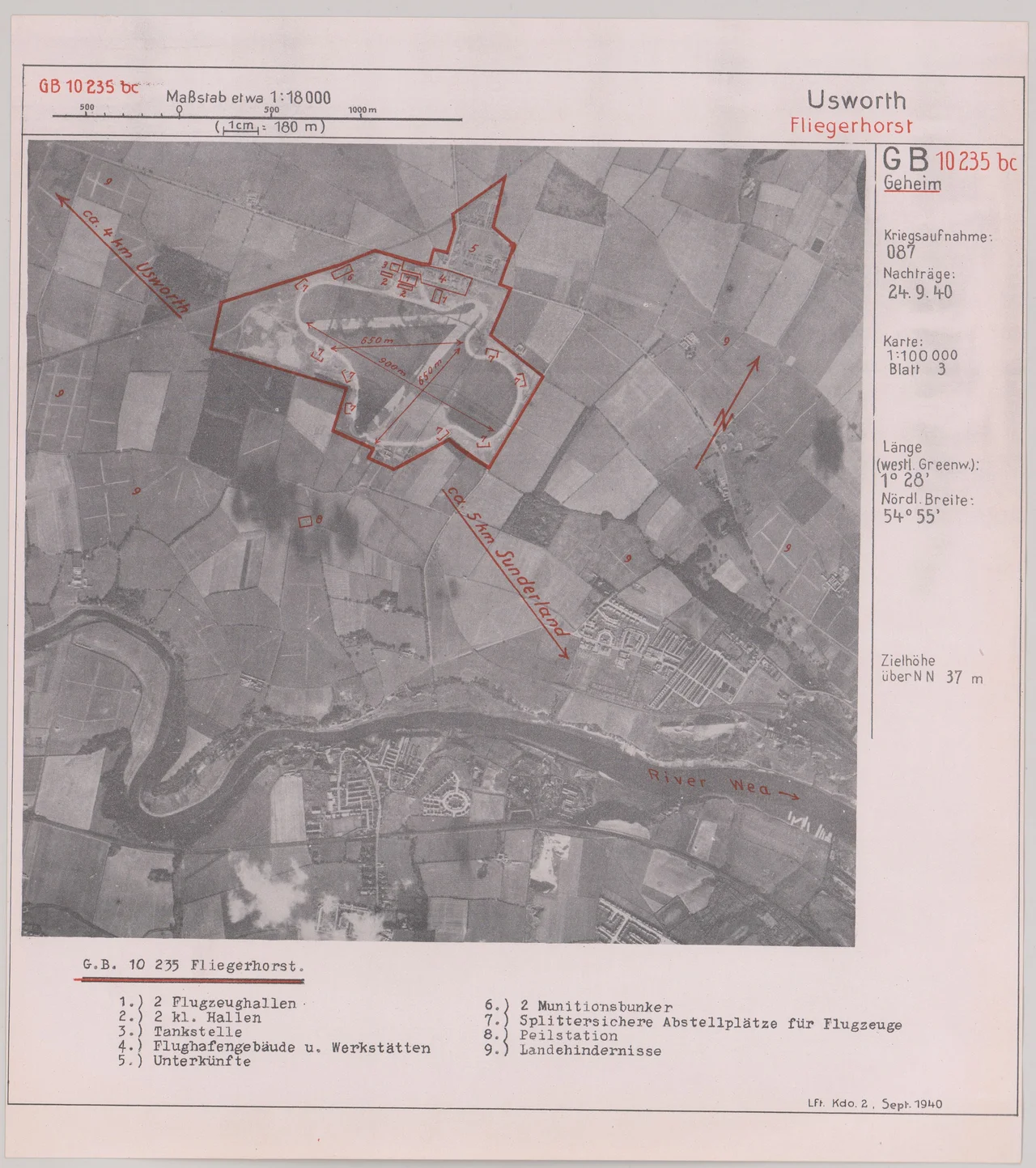
Stand on the perimeter of the Nissan plant in Sunderland and you are standing on a runway. Beneath the conveyor belts and pressed steel, beneath the visitor car park and the bonded warehouses, the concrete of RAF Usworth still runs roughly north-east to south-west. From this airfield, Hurricane pilots took off in August 1940 to climb at intercept formations of Heinkel bombers approaching the coast. The same ground that now produces Qashqais and Leafs once produced Wapiti formations, Spitfire dispersals, and the bone-cold dawn drills of part-time auxiliary airmen learning to fly between weekday jobs.
Born of Zeppelins
The airfield began in October 1916, not as a glamorous fighter base but as a defensive reflex. German Zeppelin airships had been drifting across the North Sea at night to drop bombs on Northern England, and the Royal Flying Corps scrambled to thread Home Defence flights along the coast. The flat ground north of the River Wear, between Washington and Sunderland, was requisitioned for B Flight of No. 36 Squadron. Locals knew it first as West Town Moor, then as Hylton, after the medieval castle nearby. On 27 November 1916, B.E.2c biplanes from the squadron's Seaton Carew detachment intercepted Zeppelin LZ34 over the Tees, sending it down in flames at the river mouth. The other airships turned for home. The new airfield had announced itself.
Weekend Warriors
After 1918, the field lapsed into the same quiet that swallowed most First World War aerodromes. For more than a decade, sheep grazed where biplanes had taxied. Then in March 1930, the gates reopened to house No. 607 (County of Durham) Squadron of the Auxiliary Air Force - a part-time outfit of local pilots and groundcrew who learned to fly on evenings and weekends. Their first aircraft, a single de Havilland Gipsy Moth and two Avro 504N trainers, arrived in October 1932. The shopkeepers, clerks, and engineers of County Durham took the wheel of biplanes between shifts. By June 1934, they could put nine Westland Wapiti bombers into formation past the Marquis of Londonderry, their Honorary Air Commodore. Empire Air Days drew crowds of thousands; for a few pence, you could sit in the cockpit of a Wapiti and feel the war the next decade was already preparing.
The 1940 Sky
When war came in September 1939, the airfield was a building site. Two concrete runways were being laid, dispersal pens dug, an underground Battle Headquarters tunneled near Cow Stand Farm. No. 607 Squadron, equipped now with Gladiators, decamped briefly to Acklington and then to France, where they would face the Luftwaffe over Merville and Croydon. They came home to Usworth in June 1940 with Hurricanes and the reputation of having destroyed more than seventy German aircraft. On 15 August 1940, in the middle of the Battle of Britain, a formation of Heinkel He 111 bombers escorted by Messerschmitt Bf 110s appeared off the North East coast. The Hurricanes of 607 Squadron met them over Whitley Bay and shot at least two Heinkels down. It was the day the Luftwaffe learned the Northeast was not the soft flank they had hoped for.
The Quiet Decade
After the war, the runways carried something gentler. From 1944, No. 31 Gliding School taught Air Training Corps cadets the rudiments of flight. In 1952, Airwork Ltd took over training duties, parking de Havilland Chipmunks in the east end of the great Lamella hangar at night and rolling them out at dawn. The Reserve Flying School closed in the late 1950s, and the airfield passed into civilian hands. Sunderland Corporation bought it on 3 July 1962 for twenty-seven thousand pounds, relaid the runways, and reopened it as Sunderland Airport. For another two decades, light aircraft buzzed in and out of County Durham.
Cars Where Hurricanes Stood
Sunderland Airport closed in 1984. Within two years, the bulldozers were back, this time clearing ground for the largest car plant in the United Kingdom. Nissan Motor Manufacturing UK opened on the old runway in 1986 and has produced millions of vehicles since. The North East Land, Sea and Air Museum sits just north of the factory, preserving aircraft and stories on a corner of the original airfield. The 2214 (Usworth) Air Cadet Squadron, formed here in 1941, still parades on Remembrance Day. The site that defended the coast from Zeppelins and Heinkels now exports cars to the world - a quiet rhyme of industry and air defence written into the same stretch of Wearside earth.
From the Air
RAF Usworth sat at 54.915 degrees N, 1.475 degrees W, just north of the River Wear between Washington and Sunderland. Newcastle International (EGNT) lies roughly 11 nautical miles to the north-west; the nearest GA strip today is Newcastle itself, as Sunderland Airport closed in 1984. The Nissan plant's bright roofs and the museum's preserved aircraft are visible at low cruising altitude, roughly 2,000-3,000 feet AGL. The North Sea is six nautical miles to the east. Look for the cluster of large factory buildings just inland from the coast.
Nearby Stories
- Cresswell Lifeboat Station 5.2 km away
- Auckland Castle 5.7 km away
- Battle of Otterburn 7.1 km away
- Saltburn Pier 11 km away
- Hadrian's Wall Path 11 km away
- Battle of Stainmore 18 km away
- Saltburn-by-the-Sea 39 km away
- Alexander L. Kielland (Platform) 296 km away