.jpg)
RAF West Kirby
There was no runway. There were no aircraft. For a base called RAF West Kirby - in the Royal Air Force, after all - this was a curiously grounded place. The camp sat at Larton, three miles inland from the actual town of West Kirby, with its entrance on Saughall Massie Road almost opposite Oldfield Lane. Wooden barrack huts lined neat rows on the heathland north of the Wirral Way. Twenty men slept in each hut. The drill square outside was where most of them met the RAF for the first time: eight weeks of marching, weapons handling, parades, fitness routines and shouting from sergeants of the RAF Regiment. Approximately 150,000 men passed through this gate between 1940 and 1957. For most of them, the discharge papers were their last contact with any uniform at all.
First Stop After Cardington
When the Second World War began, the RAF needed to train recruits faster than its peacetime depots could manage. New camps went up around the country. West Kirby opened in 1940 as one of them. New entrants went first to RAF Cardington in Bedfordshire, where they were issued uniforms, kit and the bewildering paperwork of military life. From Cardington they were posted out for basic training, and many travelled north to the Wirral. The camp ran an eight-week initial course - later trimmed to six - that started with the absolute fundamentals: how to march, how to salute, how to handle a Lee-Enfield rifle, how to dig in against air attack, how to recognise an enemy aircraft, how to do everything the RAF needed an aircraftman to do before he could be considered useful. The course did not teach flying. It taught the body and mind to take orders.
The National Service Years
After the war ended in 1945, military training did not. From 1949 to 1960 every able-bodied British man between 17 and 21 was conscripted under the National Service Act, and many of them ended up at West Kirby. The base had the dubious honour of being where they discovered what they had been called up to. Most arrived as raw civilians and left as Aircraftman second class - AC2 - the lowest enlisted rank in the air force. They would then be posted to trade-training camps elsewhere in the UK to learn whatever speciality the RAF had assigned them: engine fitting, wireless operating, store-keeping, cooking, parachute packing. Most spent their two-year service in administrative or technical roles. Some never came near an aircraft. The Cold War had made the air force into a vast bureaucracy with thousands of ground roles, and West Kirby fed conscripts into all of them.
Strict on Purpose
The RAF Regiment sergeants who ran the training had reputations to maintain. Basic training was meant to be sharp, and West Kirby's was sharper than at most operational stations. Men were inspected within an inch of their lives. Boot leather was polished until it reflected the sky. Buttons were aligned to military precision. Beds were stripped, remade with bedding-block corners, and inspected before breakfast. There were intensive physical regimes - cross-country running on the Wirral lanes, assault courses in the woods, weapons drill until the rifle felt like part of an arm. Educational classes covered RAF procedures, history, and the chain of command that recruits were now part of. Discipline was rigorous because it was supposed to be. The whole point of basic training was to take a civilian and turn him into someone who would do, without thinking, what an officer told him to do. Recruits arrived as individuals. Sergeants returned them as airmen.
Passing Out, December 1957
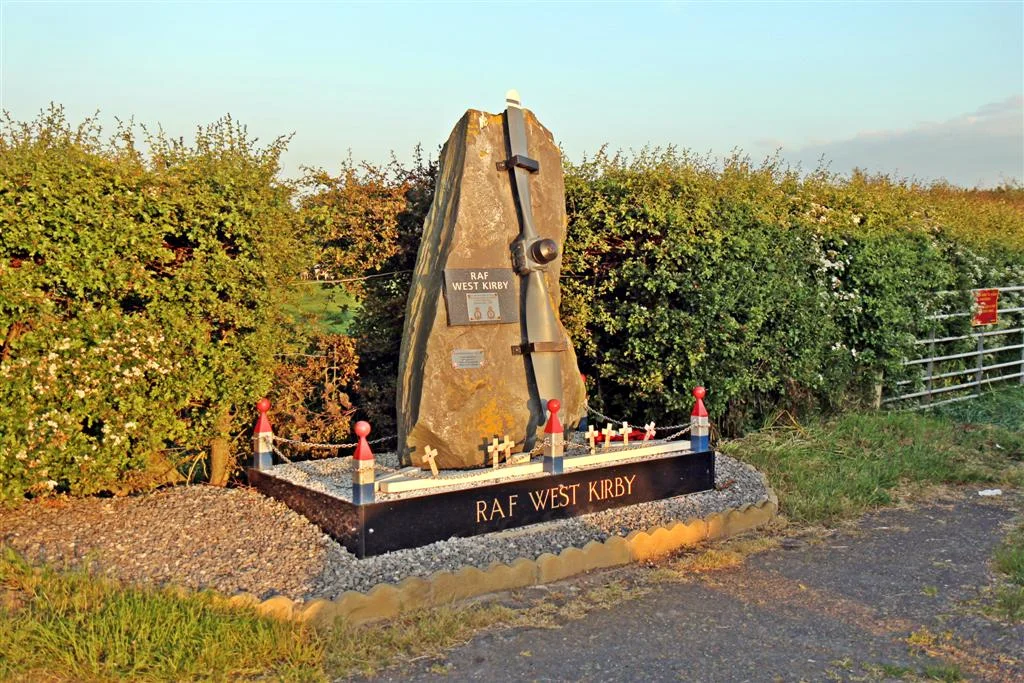
The last formal passing-out parade at RAF West Kirby took place on 20 December 1957. National Service was being wound down. The RAF's needs were changing. The camp lingered in residual use until 1960 and was then decommissioned. The wooden huts came down. The drill square was abandoned. The land returned to Wirral heathland. For decades there was almost nothing on the site - just clearings in the woods, paths that did not quite go anywhere, foundations under the soil. Then in the 1990s the RAF West Kirby Association raised funds to install a commemorative stone on Saughall Massie Road, where the gate had been, carrying the RAF motto Per Ardua Ad Astra - through adversity to the stars. The stone is small. The site it marks held 150,000 stories.
What the Recruits Remembered
The men who passed through West Kirby remembered different things. The cold. The noise. The smell of damp wool and floor polish. The particular Wirral wind that came off the Dee Estuary and seemed to find every gap in a greatcoat. They remembered the food and the boots and the bunk-room jokes. They remembered the moment in week three or four when the awkwardness gave way to coordination, when the rifle drill stopped being individual movements and became one continuous action. They remembered the men they shared a hut with - twenty per hut, packed in close - and lost touch with most of them afterwards. The RAF West Kirby Association still gathers some of them at reunions. The numbers shrink every year. The wood that grew back over the parade ground does not know what it covers. The commemorative stone does. So does the path that runs past it, still labelled with the RAF motto by the same association that wanted the camp remembered.
From the Air
RAF West Kirby was at Larton on the central Wirral at 53.38°N, 3.14°W - three miles inland from the town of West Kirby on the Dee Estuary. Best viewed at 1,500-3,000 ft. Liverpool John Lennon Airport (EGGP) is 11 nm east-southeast. The site is now woodland north of the Wirral Way path. Look for the open ground around Saughall Massie and the wooded area just north - the commemorative monument sits on Saughall Massie Road.
Nearby Stories
- RAF Wrexham 3.3 km away
- Birkdale Palace Hotel 3.7 km away
- Turton Tower 4.1 km away
- Tatton Park 5.6 km away
- Abergele Rail Disaster 9.6 km away
- Diglake Colliery Disaster 13 km away
- Ysbyty Ifan 16 km away
- Celtic Array 62 km away