
Raid on Mount's Bay
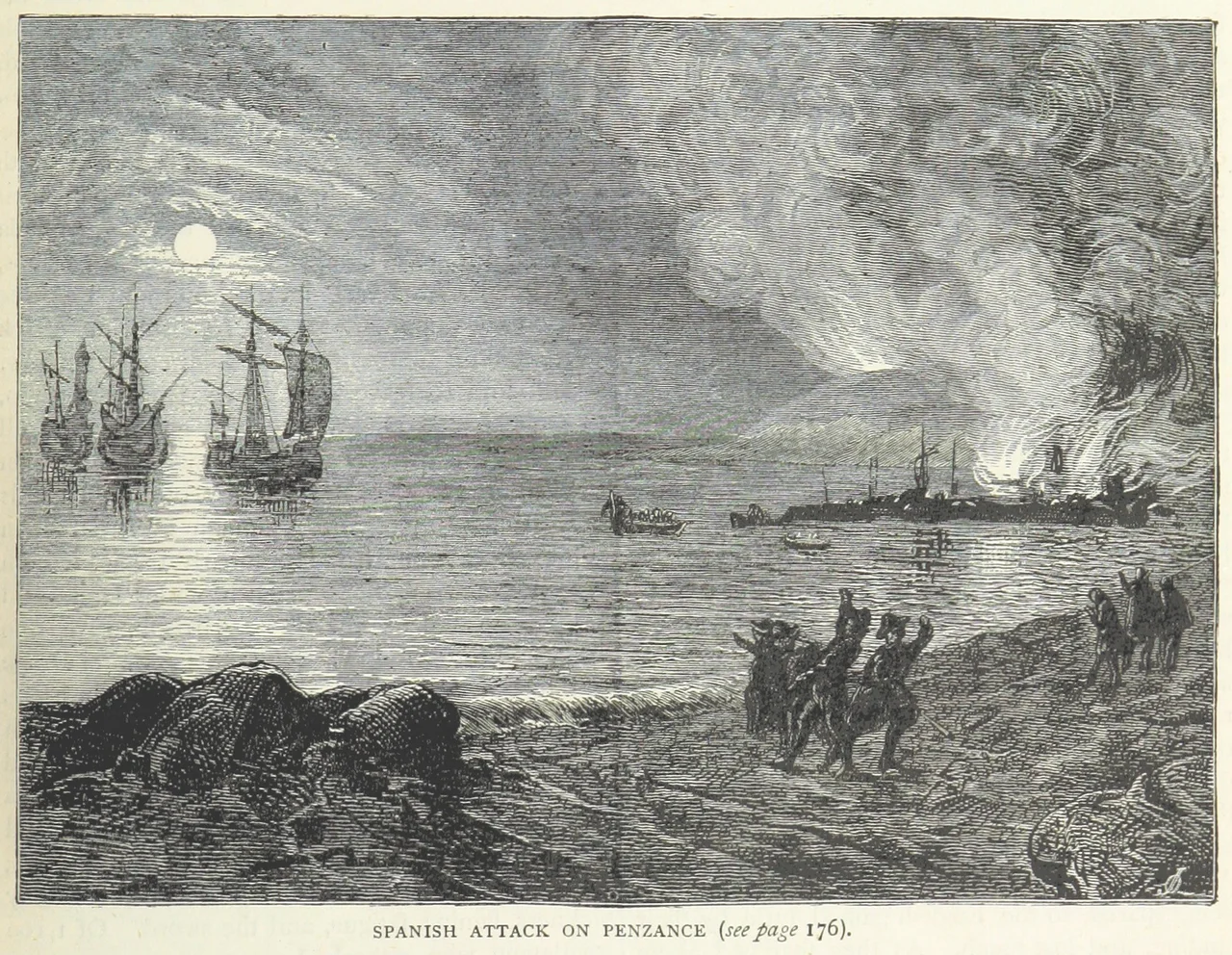
Jenkyn Keigwin died on his own doorstep. A cannonball from a Spanish galley anchored off Mousehole struck his stone house in the first hour of the raid, and when the smoke cleared his was the only building in the village still standing. Around him, on the morning of 2 August 1595, fishermen's cottages were burning along the harbour. Women and children fled inland over the cliffs toward Paul. Four galleys flying the cross of Burgundy rode at anchor in Mount's Bay, their oared decks crammed with three companies of Spanish arquebusiers under Carlos de Amésquita. For three days, the war Philip II had never finished with Elizabeth I came ashore in Cornwall.
A guide named Burley
The galleys had sailed from the Spanish base at Blavet in Brittany on 26 July, hunting for a place to bleed the English coast. After calling at Penmarch and sinking a French barque manned by an English crew, Amésquita turned north. He needed someone who knew where to land. He had brought one: Richard Burley, an English Catholic from Weymouth, who guided the squadron onto a rocky beach a few hundred yards west of Mousehole's harbour. The choice of Cornwall was deliberate. Since the Prayer Book Rebellion of 1549, when Cornish parishioners had risen against the imposition of English-language worship, Madrid had nursed a quiet hope that the Cornish might welcome a return to the old faith. Amésquita came partly to test that hope, partly to recoup the treasure England had seized off Pernambuco four months earlier, partly to spook Francis Drake before his planned expedition against Panama. The villagers of Mousehole knew none of this. They saw galleys, and they ran.
Paul, Newlyn, Penzance
The vanguard struck inland and reached the parish of Paul, half a mile up the slope, before any defence could form. The village was defenceless. The Spanish sacked and burned it, and put the church of St Pol de Leon to the torch. Amésquita, in a letter home, called the building a 'mosque', the language of a man steeped in the Reconquista applied to a Cornish parish church. Four residents of Paul were killed. Several more were taken prisoner. By the time Francis Godolphin, the local landowner and Sheriff of Cornwall, had scraped together about a hundred lightly armed men, the Spanish artillery scattered them; the Cornish fell back toward Marazion and the shelter of St Michael's Mount. Newlyn burned next. Then Penzance. The galleys swung their guns onto the town itself, and the bombardment destroyed roughly 400 houses and sank three merchant ships laden with wine. Godolphin tried again to rally his men. They ran again.
A mass on the Western Hill
On the third day, before re-embarking, Amésquita did something almost theatrical. He sent Brother Domingo Martínez ashore with a field altar and celebrated a Catholic mass in the open air on the Western Hill outside the smoking ruins of Penzance, the first Latin mass on English soil since Elizabeth's accession nearly forty years before. It was less a religious act than a flag planted in scorched ground, a message that the war was not over and that Spain could put priests on Cornish hills whenever it chose. Then Amésquita released his prisoners, herded his men back to the galleys, and on 4 August stood out to sea. Sir Nicholas Clifford arrived with a relieving force soon after, too late, and spent his fury on the villagers rather than the enemy, accusing the common folk of abandoning Godolphin. The next day, off Penmarch, Amésquita met a Dutch squadron of forty-six ships, sank two of them, and limped back to Port Louis on 10 August. He had lost twenty men. He had also, briefly, broken England's myth of an inviolable coastline.
What the villages remembered
Newlyn and Penzance rebuilt. Mousehole, the smallest and the first to burn, never fully recovered. For generations afterwards Cornish families on this coast carried the story without quite knowing what to do with it: a defeat with no battle, an invasion with no occupation, a war their inland countrymen seemed to forget. The Spanish never came back in force. The Armada year had been 1588; this was a coda nobody had asked for, a reminder that the long sea-war between Madrid and London still had teeth. Centuries later the novelist Winston Graham, better known for the Poldark books, built his historical novel The Grove of Eagles around the raid, sending his fictional protagonist running through the burning villages in search of a woman married to the Vicar of Paul. The fiction stays close to the record. The record itself stays close to the houses that were rebuilt: in Mousehole, the Keigwin Arms still stands on the harbour, named for the man who died in 1595 defending his door.
Flying the bay today
From the air the geography of the raid is laid out in a single sweep. Mousehole's tight stone harbour sits at the western horn of Mount's Bay, with Newlyn and Penzance climbing the curve to the north and east, and St Michael's Mount itself a granite punctuation mark four miles across the water. The whole arc that Amésquita sailed and burned can be flown in a few minutes.
From the Air
Mount's Bay opens south at 50.10 N, 5.53 W, between the Penwith peninsula and the Lizard. Best viewed at 1,500 to 2,500 feet to keep Mousehole, Newlyn, Penzance and St Michael's Mount together in one window. Land's End Airport (EGHC) lies five miles west; Newquay (EGHQ) is the alternate at twenty-five miles north. Coastal cliffs and frequent Atlantic squalls; watch for compressed visibility off the Lizard.
Nearby Stories
- Wadebridge 8.1 km away
- Caerhays Castle 8.1 km away
- Sevenstones Lightship 16 km away
- Battle off Lizard Point 20 km away
- MV Cita 22 km away
- Carnewas and Bedruthan Steps 30 km away
- 1979 Fastnet Race 71 km away
- HMS Affray 108 km away