
Railway Museum of Athens
Among the iron machines in this collection sits a railway carriage built for a king. The Athens and Piraeus Railway constructed a royal saloon as a gift to King George I, marking the twenty-fifth anniversary of his reign, and first showed it off at an Athens international exhibition in 1888. Nearby stands an open coach with a stranger pedigree still: it was a present from the Oriental Railways to Sultan Abdul Aziz of the Ottoman Empire. Two rolling thrones, one Greek and one Ottoman, parked under the same roof - the Railway Museum of Athens is full of these quiet collisions of history on wheels.
Founded by the Railways Themselves
The Hellenic Railways Organisation - the national rail company known as OSE - founded the museum in 1978, a way of keeping the machines that built the country's rail network from being scrapped and forgotten. For decades the collection lived at 4 Siokou Street in Athens. In 2019 it moved to the former MPR depot site in Lefka, in the port city of Piraeus. The transition has not been smooth: as of 2022 the museum was closed to the public, its locomotives waiting in storage. It is, for now, a museum in transit - which is perhaps fitting for a collection devoted to things built to move.
The Age of Steam
The heart of the collection is its steam locomotives, machines that carry their birth years like nameplates. The oldest is a Krauss tank engine of 1884, named Tiryns after the ancient citadel. Belgian-built Couillet engines from 1888 and 1890 sit alongside it, one bearing the name Messolongion. There is an 1899 locomotive from the famous Diakofto to Kalavryta rack railway, still coupled to its third-class passenger coach, and a 1903 engine that was later rebuilt into a snowplough to clear the mountain lines in winter. Each was hand-assembled in an era when a locomotive was the most complex machine most people would ever see, and when a rail line reaching a remote town changed that town forever.
The Trains That Worked
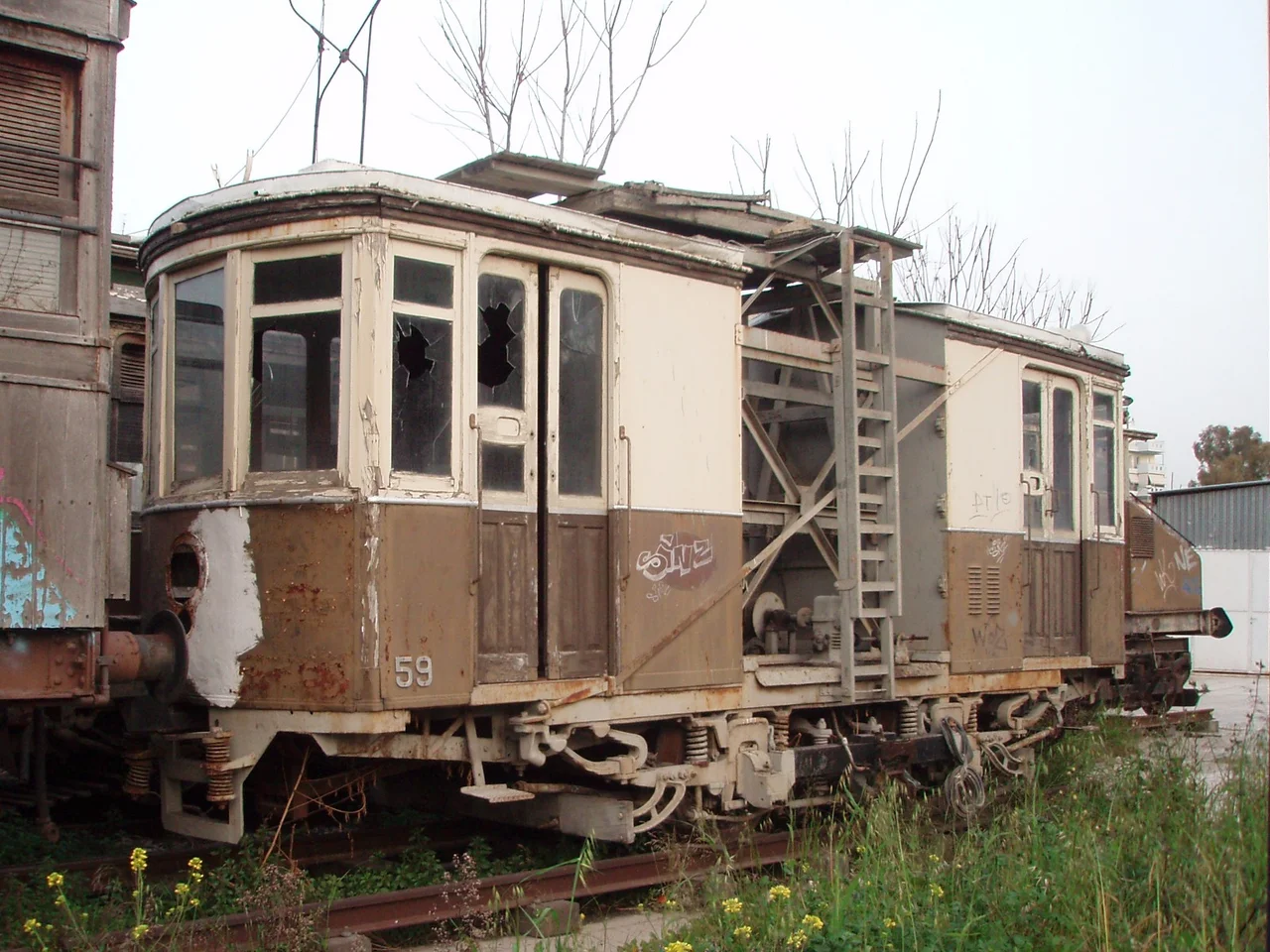
Not every machine here was glamorous. Three small industrial locomotives once hauled ore at the Eretria chrome mines, including engines built by the German firms Jung and Orenstein and Koppel, and a diesel from 1957 - the workhorses of Greek industry, blunt and purposeful. Tram vehicles survive too, among them a 1935 car from the old Piraeus Harbour Tram. In open-air storage, in poorer condition and awaiting restoration, sit a handful of electric cars and trams from the early Athens to Piraeus electric railway, the ancestor of today's metro Line 1. These are the ordinary trains, the ones that carried workers and freight rather than kings - and they tell the more honest half of the story.
Why a Country Builds a Railway
Greece is a hard country to connect. Mountains wall off valleys, the sea breaks the land into peninsulas and islands, and for centuries that geography kept communities apart. The locomotives in this collection were the answer to that isolation - the means by which a young nation, independent only since the 1830s, began to stitch itself into a single state. Different gauges, foreign builders, royal gifts and mining mules all reflect a railway assembled piece by piece, line by line, often by outside engineers and outside money. The machines now sit silent in a depot in Piraeus, but each one once meant the same thing to the town at the end of its line: the world had finally arrived.
From the Air
The museum's former Athens home stood near 38.010 degrees N, 23.721 degrees E in the northwestern part of the city; the collection has since moved to the Lefka depot site in Piraeus, southwest toward the coast. From the air, the dense Athens urban grid fills the Attica basin, with the port of Piraeus and its harbors marking the seaward edge. Best viewed at low altitude in clear weather. Nearest airport is Athens International (LGAV), roughly 30 km east-southeast.
Nearby Stories
- Great Sand Beach 5 km away
- Battle of Delium 7.7 km away
- Tower of Aliartos 9 km away
- HMHS Britannic 10 km away
- Saronic Gulf 15 km away
- Sousaki Volcano 17 km away
- Sanctuary of Apollo Maleatas 24 km away
- Skyros 66 km away