.JPG)
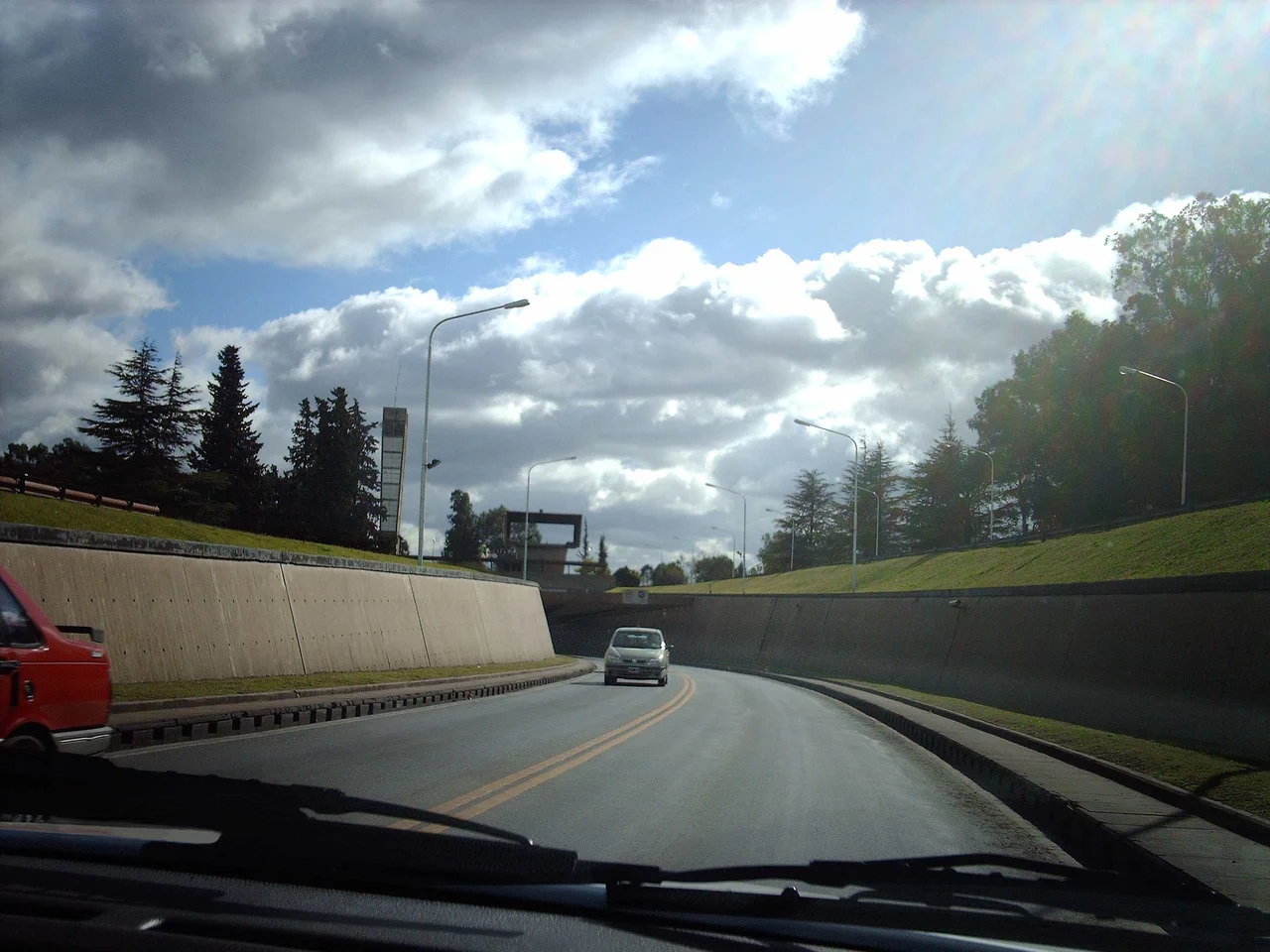
Raúl Uranga – Carlos Sylvestre Begnis Subfluvial Tunnel
Most river crossings reach for the sky. This one dives. Thirty-two meters beneath the surface of the Paraná, one of South America's great rivers, a two-lane highway runs through a chain of concrete tubes laid along the riverbed like the segments of a giant submerged worm. Drivers descend a ramp on the Santa Fe shore, vanish under nearly a kilometer of muddy water, and surface again in Entre Ríos, on the far bank near the city of Paraná. For most of the twentieth century, the only way across here was a ferry. Then engineers decided to go under the river instead of over it.
The River That Said No
The Paraná is not an obstacle to be taken lightly. Wide, fast, and heavy with silt, it had divided Santa Fe and Entre Ríos so completely that the two provinces functioned almost as separate worlds, linked only by boats. Engineers spent decades arguing over how to bridge it. A cable-stayed span was proposed and rejected. Idea after idea collapsed under the cost and the sheer scale of the water. The breakthrough came not from a single inventor but from two politicians willing to share the risk. In 1960 the governors of the two provinces, Raúl Uranga of Entre Ríos and Carlos Sylvestre Begnis of Santa Fe, signed a joint treaty authorizing construction. The first stone was laid in 1962. The decision to build a tunnel rather than a bridge would define the project: it would be sunk, not raised.
Tubes on the Riverbed
The method was audacious. Rather than dig through rock, the builders fabricated the tunnel in pieces on land, each tube a hollow concrete cylinder 65.45 meters long, weighing 4,500 tonnes, with walls half a meter thick. One by one, the sections were floated out, lowered into a trench dredged along the riverbed, and joined end to end underwater. A German-led consortium headed by the firm Hochtief carried out the work, beginning the first tubes in 1966. When the segments were finally sealed together, they formed 2,397 meters of roadway, with access ramps reaching 270 meters at each end. Inside, the driving lane is 7.5 meters wide, the ceiling 4.41 meters overhead. It was among the earliest immersed-tube road tunnels in South America, a technique then more familiar in Europe and North America than below the Paraná.
Opening Day, 1969
On 13 December 1969, after nine years of treaties, dredging, and sunken concrete, the tunnel opened to traffic. What had been a ferry crossing became a five-minute drive beneath the water. The effect on the region was immediate and lasting. Until the Rosario–Victoria Bridge opened decades later far to the south, this tunnel remained the only road link between Santa Fe and Entre Ríos, and one of the few connecting two of Argentina's most productive and populous regions. By 2004, traffic counts recorded more than 2.7 million vehicle crossings in a single year, the overwhelming majority of them cars and motorcycles, the rest heavy trucks hauling freight that once had to wait for a barge.
A Name That Changed
For most of its life the tunnel carried a different name. It was originally dedicated to Hernando Arias de Saavedra, known as Hernandarias, remembered as the first governor in South America who was descended from Europeans yet born in the Americas. In 2001 the name was changed to honor the two governors whose 1960 treaty had set the whole improbable enterprise in motion. The structure is still run jointly, overseen by an interprovincial board with members from both Santa Fe and Entre Ríos. It remains a rare thing: a piece of infrastructure that does not merely cross a border but is owned in common across one, a tunnel that belongs equally to both shores it connects.
From the Air
The Raúl Uranga – Carlos Sylvestre Begnis Subfluvial Tunnel lies at approximately 31.70°S, 60.50°W, running beneath the Paraná River between the city of Paraná (Entre Ríos) on the east bank and Santa Cándida Island, about 15 km from Santa Fe city, on the west. From the air the tunnel itself is invisible, but its ramps and toll plazas mark where National Route 168 dips toward the water; trace the highway and you will see it simply stop at the riverbank and resume on the far side. The braided channels and islands of the Paraná make an unmistakable navigation feature. Best viewed from 2,000–4,000 ft AGL in clear conditions. Nearest airports: Sauce Viejo / Santa Fe (SAAV) to the southwest and General Justo José de Urquiza / Paraná (SAAP) just to the east.
Nearby Stories
- Predelta National Park 18 km away
- Sa Pereira Rail Disaster 26 km away
- Esperanza, Santa Fe 27 km away
- Rafaela 37 km away
- San José Palace 158 km away
- El Palmar National Park 170 km away
- San Carlos Castle 201 km away
- The Pampas 343 km away