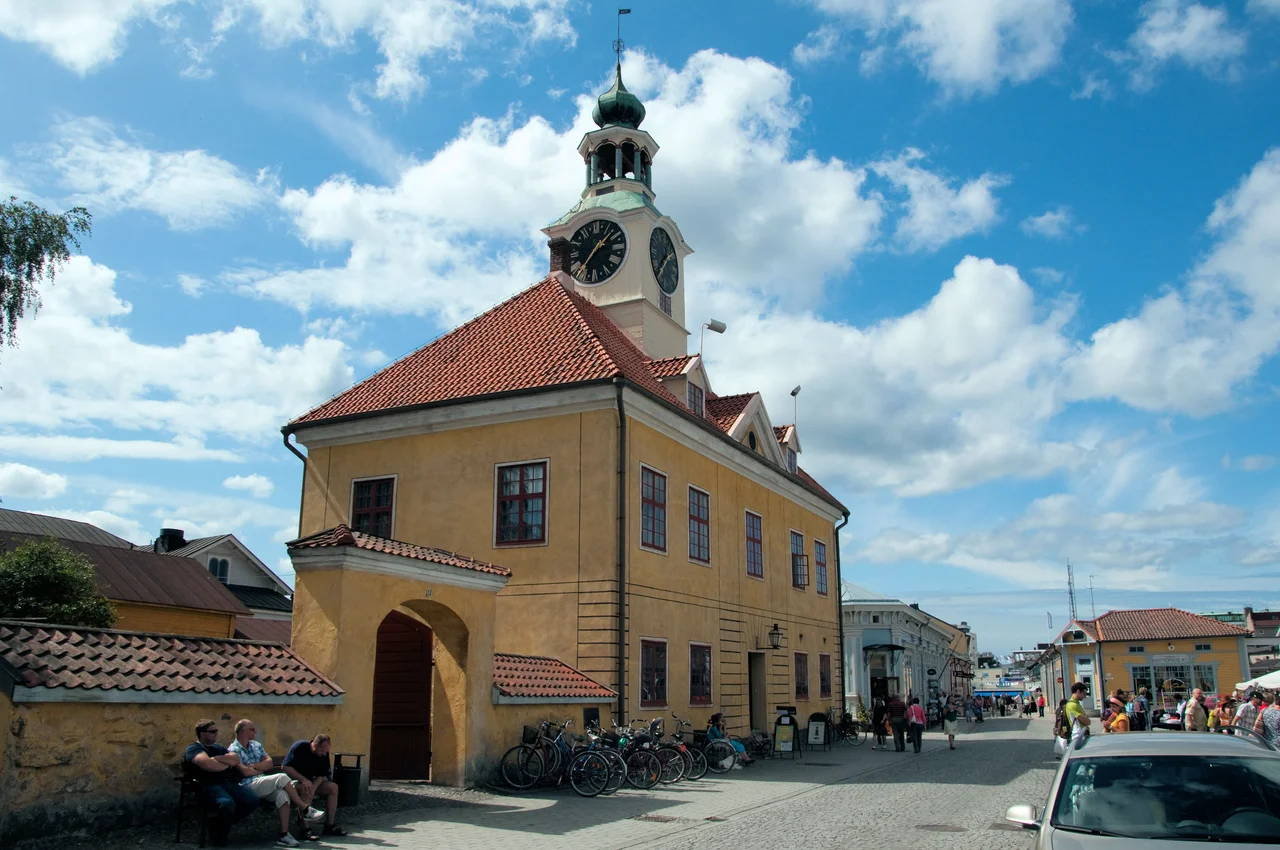

Rauma Old Town Hall
In autumn 2025, contractors working on the tower of Rauma's old town hall brought down a three-metre iron spike and found it rusted clean through. The spiira had been forged in the 1770s and had stood on the clock tower ever since, and old photographs show that something else once sat on it — a ball at the tip, which disappeared at a date nobody bothered to write down. A forge at Tuusulanjärvi made the replacement for 9,685 euros. The original was kept as a museum object, which was convenient, because the museum is downstairs.
Four Town Halls and a Habit of Burning
Nothing survives of Rauma's medieval town hall, though it may have stood beside the Church of the Holy Trinity. By the 1500s the town was meeting on the plot next door to the present building, and the researcher Aina Lähteenoja concluded that this hall went up in the town fire of 1640.
The replacement first appears in writing in 1647, when it was being planned; it was finished in the early 1650s and burned in its turn in the town fire of the early 1680s. Rauma then built in wood again, on the neighbouring plot, and that fourth town hall lasted almost ninety years before its condition became indefensible. In the 1770s the council finally gave up on timber. Work on a stone building began in 1775 and finished the following year. It got its yellow paint the summer after that, and a grey fieldstone wall was run along the street edges of the plot — rendered now, and tiled over, with a brick gate arch.
Designed in Turku, Roofed by a Parish Clerk
The design came from Christian Friedrich Schröder, the city architect of Turku, with the Turku master mason Johan Schytt running the actual construction. Rauma's own councillors had a hand in the preliminary sketches, which shows in how conventional the result is: late Baroque in its detailing, but two storeys with a clock tower, a shape that had been standard for European town halls since the Middle Ages.
The hard parts went to men who built churches. The steep roof was the work of Job Höckert, parish clerk of nearby Lappi. The tower was raised by the master builder Anders Wahlberg, and it is wooden and Renaissance in feeling — it looks, unmistakably, like the free-standing bell towers Wahlberg put up for country churches, which is exactly what it is, transplanted onto a civic building and given a clock.
Justice Above, Cells Below
The layout tells you what an eighteenth-century Finnish town hall actually was. Upstairs sat the town court and the magistracy: two session halls, one heated chamber and two unheated ones. Downstairs was rougher — a guard room, two lock-ups, and a shop with its own back rooms, so that a merchant could sell goods a wall away from whoever had been arrested the night before.
A fire insurance survey of 1855 records German roof tiles, oil paint on the walls and a striking clock in an iron-clad tower. The police quarters on the ground floor were enlarged with two more cells in 1895, sharing that floor with the city treasury office. There was no cellar at all until 1932, when one was excavated for a boiler room as part of a new heating system. A restoration in 1976 pulled the building back close to its original appearance.
The Lace Downstairs
Rauma Museum was founded in 1891 and moved into the town hall in 1902, taking only the upper floor at first because the police were still using the ground. When they left in the 1930s, the museum took the whole building. Today the upstairs rooms carry the city's history and the ground floor is given over to raumanpitsi — Rauma bobbin lace.
The lace deserves the room. Bobbin lace has been made in Rauma for centuries, and it was never a genteel hobby: it was paid work, and one of the few reliable ways a woman without property could earn money in a seafaring town, though men made it too. Lace is slow, exacting and hard on the eyes, and the pieces displayed downstairs represent thousands of hours of labour by people whose names mostly went unrecorded. Rauma has held an annual Lace Week since 1971, closing with Black Lace Night, and the craft is now the thing the town is known for after its ships. A museum shop called Kistupuad occupies part of the building.
Two Hundred and Fifty
A full restoration began in 2023 under the architect Minna Linnala. The exterior work was completed in November 2025 and the interiors were due to follow in March 2026 — the year the building turns 250.
That it survived to have an anniversary is not typical. Eighteenth-century town halls in Finland were replaced, rebuilt or burned as a matter of course, and only two are preserved in anything like their original form: this one and Porvoo's. Rauma outgrew the building long ago and put up a new town hall in 1910. It kept the old one anyway, on the edge of the market square, with a new spike on the tower and the courtrooms full of glass cases.
From the Air
Rauma Old Town Hall stands at 61.1279°N, 21.5112°E on the edge of the market square in Old Rauma, about 200 metres southwest of the Church of the Holy Cross. From the air the pair make the town's easiest fix: the church's white steeple and, close by, a yellow two-storey stone block with a dark wooden clock tower — the only two masonry buildings in a district that is otherwise almost entirely low wooden houses. Best appreciated from 1,500–2,500 feet, where the medieval street plan of narrow, slightly crooked lanes is still legible. The Rauma shipyard and port lie roughly 3 km southwest, and Kylmäpihlaja Lighthouse about 6 nm offshore to the west. Nearest controlled fields are Pori (EFPO) about 22 nm north-northeast, Turku (EFTU) about 43 nm southeast, and Eura (EFEU) about 20 nm east. Expect low overcast and short daylight from November to February; June and July give long, low light that suits the wooden town.
Nearby Stories
- Uusikaupunki Automobile Museum 9.5 km away
- Köyliönjärvi 11 km away
- Kurjenrahka National Park 17 km away
- Jusélius Mausoleum 17 km away
- St. Olaf's Church, Tyrvää 42 km away
- Archipelago Sea 58 km away
- Battle of Bomarsund 108 km away
- Härnösand Cathedral 218 km away