
Rauma: The Town That Calls Its Dialect a Language
Ask someone in Rauma what language they speak and you may not hear the word Finnish. *Rauman giäl* - the Rauma tongue - leans on g's and b's that standard Finnish hardly uses, clips the endings off words, and carries freight borrowed from Swedish, Dutch, German, English and Estonian, hauled home by men who spent more of the year at sea than ashore. When a 2007 poll asked residents whether the thing they spoke was a dialect or a language, most declined to choose: it was both. In a country as linguistically tidy as Finland, that refusal tells you a good deal about a working town of roughly 40,000 people on the Gulf of Bothnia.
Yarns from Rauma
Writing in anything but standard Finnish was once actively discouraged, which is part of what makes Frans Hjalmar Nortamo remarkable. Born in Rauma in 1860 and a physician by trade, he wrote his *Raumlaissi jaarituksi* - 'Yarns from Rauma' - in the speech he had grown up hearing. Those pieces are generally regarded as the first Finnish literary texts composed in a dialect that was not the mainstream, and the written form Nortamo improvised for them is still the one Rauma schoolchildren learn. He died in Pori in 1931.
The town he was writing about had already been around for four centuries. King Christopher of Sweden granted Rauma the right to trade in 1442, making it the third oldest town in Finland and one of only six whose roots reach into the Middle Ages, alongside Turku, Naantali, Porvoo, Ulvila and Vyborg.
Fifty-Seven Ships
By 1897 Rauma owned the largest sailing fleet in Finland: fifty-seven vessels, carrying Finnish timber and tar out to European ports and bringing back, among other cargo, the loanwords that still season the local speech. The distinction lasted exactly one year. Helsinki's fleet overtook Rauma's in 1898, and the town never won the title back. The last Rauma sailing ship, the barquentine *Uljas*, kept working until 1941.
That era is easiest to read at the Rauma Maritime Museum, which occupies the town's old maritime school, a building finished in 1900. Its interest is less in hulls and rigging than in the people who crewed them - what a Rauma sailor ate, earned, feared and came home to, in the decades when a boy from a small Bothnian port could reasonably expect to see Rotterdam and Cadiz before he saw Helsinki.
Made With Bobbins
Rauma's other export needed no ship at all. From the mid-17th century onward the town turned out bobbin lace fine enough to earn it a nickname, Lace Town, and the craft was never confined to women at parlour windows. Children worked bobbins. So did old men. So, notably, did sailors, who had long empty weeks at sea and fingers already trained on rope.
The tradition survives as a festival. Lace Week began in 1971 as a set of exhibitions where the best lacemakers could show their work, and it has since expanded into a nine-day, town-wide celebration; the 2026 edition, its fifty-sixth, ran from 18 to 26 July. Since 1990 the week has ended in the Night of Black Lace, when the market square stays open into the small hours and all of Old Rauma spills into its lanes.
Pulp, Steel and Water Vapour
Rauma is not a preserved town, and the twentieth century is the reason. Pulp and paper milling drove the post-war decades and gave the place a smell that residents recall without affection; modern equipment has largely dealt with that, and most of the white plume drifting off the mill area at the edge of town is water vapour rather than smoke. The shipyard, revived by Finland's war-reparation orders in the 1940s, is still cutting steel - Rauma Marine Constructions built the Vaasa-Umeå ferry *Aurora Botnia*, which entered service in 2021, along with corvettes for the Finnish Navy.
Then there is Olkiluoto. The third reactor at the power plant in neighbouring Eurajoki was under construction from 2005 to 2022, and the Franco-German consortium building it brought engineers and their families in from central Europe. The town's restaurants and cafés were happy to accommodate them.
What You Do With a Day Here
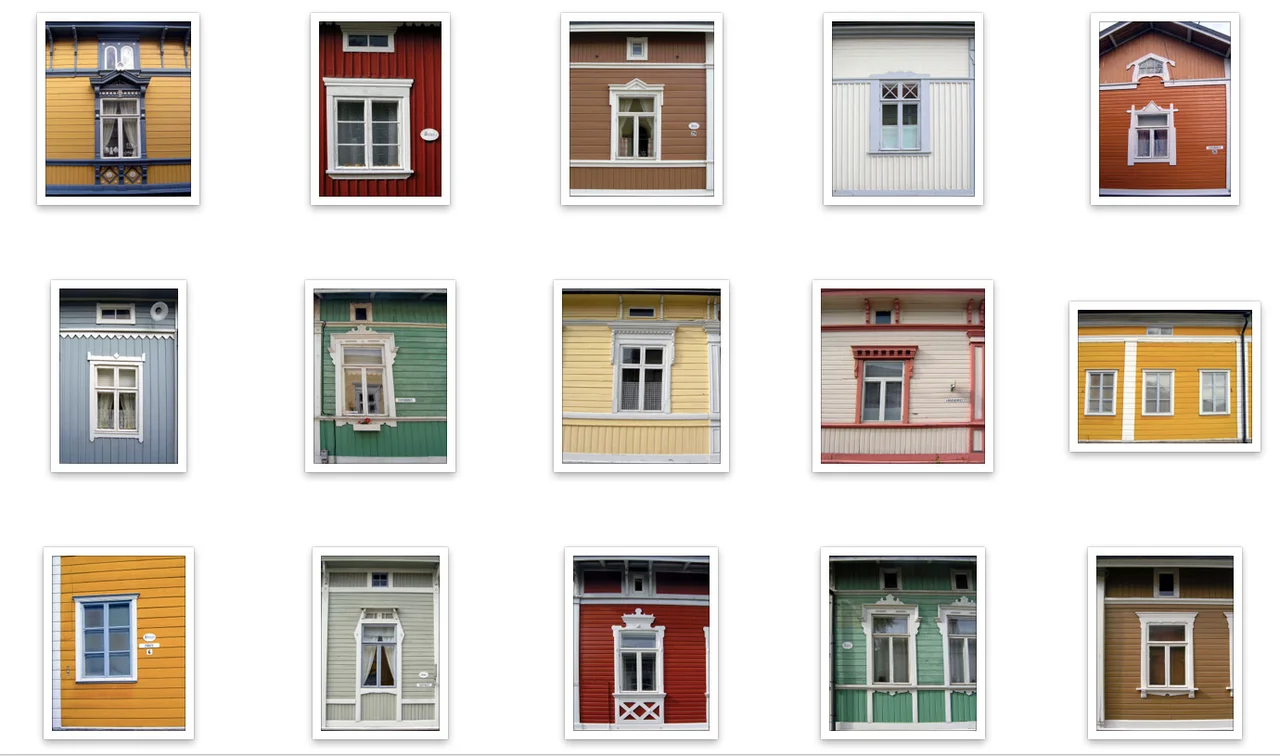
Walk, mostly. Rauma is small enough that nearly everything worth seeing sits inside the old town or a short stroll from it, and much of the pleasure lies in the courtyards behind the wooden facades, where cafés and galleries hide from the street. At the market you can buy fresh and smoked fish. On a menu you may find *lapskoussi*, mashed potato with salted meat, or *topseilvellinki*, a raisin soup usually eaten with pancakes - both survivors of a diet designed for long voyages. The local drink, *Puksprööt*, mixes juniper-rowan liqueur with white wine and arrives with a tar-infused rope, which is precisely as maritime as it sounds.
Beyond the harbour lie hundreds of islands and islets, edged by the Bothnian Sea National Park and reachable by boat in summer, sometimes on foot across the ice in winter. Rauma teenagers will tell you there is nothing to do here. They are not entirely wrong, and they are entirely missing the point.
From the Air
Rauma sits at 61.13°N, 21.50°E on Finland's west coast, on the Gulf of Bothnia. The town is easy to identify from the air: the paper mill and port complex mark the shoreline, the dense small-block grid of Old Rauma sits just inland of it, and a scatter of low granite islands and islets fans out to the west. There are no roads heading west from town - that direction is open water. Nearest airport is Pori (EFPO), about 49 km north by road; Turku (EFTU) is about 94 km south, and Helsinki-Vantaa (EFHK) is the main international gateway. Best viewed at 2,000-4,000 feet, where the old town's street pattern reads clearly against the newer grid around it. Coastal haze and low cloud are common in autumn and spring; the archipelago freezes over in most winters, flattening the coastline into a single white plane.
Nearby Stories
- Uusikaupunki Automobile Museum 9.5 km away
- Köyliönjärvi 11 km away
- Kurjenrahka National Park 17 km away
- Jusélius Mausoleum 17 km away
- St. Olaf's Church, Tyrvää 42 km away
- Archipelago Sea 58 km away
- Battle of Bomarsund 108 km away
- Härnösand Cathedral 218 km away