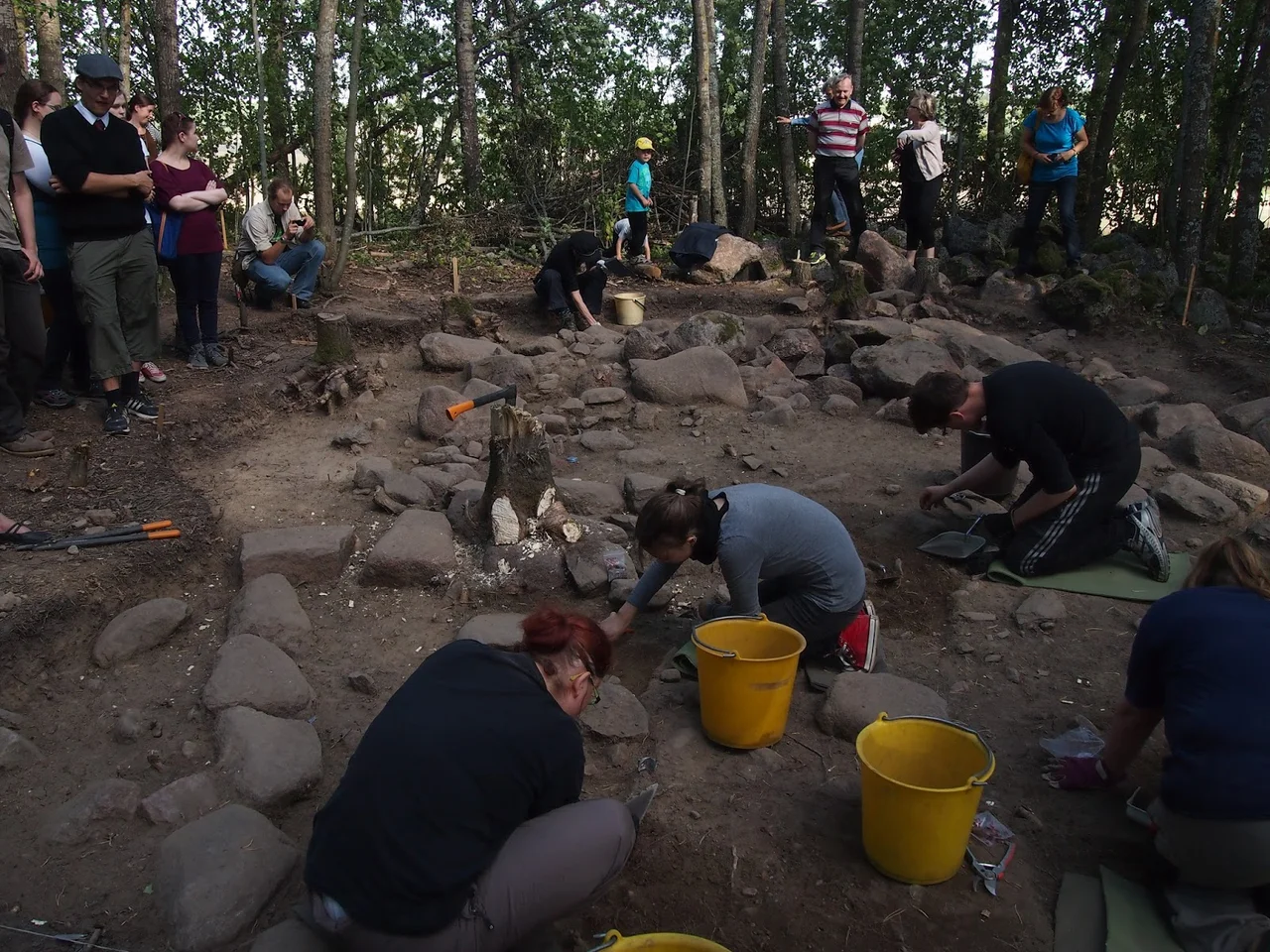

Ravattula Church
Archaeologists had hunted for it for more than 150 years. Finland has no shortage of burial grounds from the centuries when the Iron Age slid into the Middle Ages, but not one of them had ever yielded the trace of a church building — no sill stones, no post holes, nothing that could be called a wall. Then, in 2013, a University of Turku team working on a low rise above the Aura River in Kaarina lifted the turf and found a rectangle of stones laid out with obvious intent. The name of the hill had been sitting in plain sight the whole time. Ristimäki: Cross Hill.
A Rectangle of Stones
The building was small: roughly six metres by ten, two rooms with a narrow choir at one end. Its walls were horizontally laid logs, notched at the corners in the technique Finnish carpenters would keep using for the next eight hundred years, and the floor was covered with planks. None of that wood survives. What Juha Ruohonen's excavators uncovered was the stone footing the log sills had rested on, intact enough to read the outline of the walls straight off the ground. Radiocarbon dates place its completion around the 1170s, shortly after the middle of the twelfth century. That makes it — so far, and the qualifier matters — the oldest known church building site in the country.
Four Hundred Graves Behind a Fence
A fence once enclosed the churchyard, and inside it lie something on the order of four hundred graves, all aligned the same way as the church itself. Roughly sixty have been excavated across the 2010–2016 seasons. The dead were laid in coffins, dressed in good clothing, and sent off with their possessions: glass beads in strings of colour, brooches and buckles for fastening cloaks and belts. One grave held textiles preserved to a degree that almost never happens in Finnish soil. Read one way, these are Christian burials — coffins, shared orientation, ground set apart by a fence. Read another, they are Iron Age burials, because equipping the dead with goods is exactly what pre-Christian Finns did. Both readings are correct at once, which is the point.
Not a Conquest, a Century
Finland's conversion story, as usually told, arrives from outside and arrives fast: a Swedish crusade in the 1150s, a bishop named Henry, a martyrdom on lake ice. Historians have grown steadily less comfortable with that account — the crusade itself surfaces only in a version of King Eric's legend written around 1344, and Henry's existence is disputed by serious scholars. Ristimäki cuts across the whole debate by simply being older than the institutions. It predates the Catholic Church's parish organisation in Finland. It was probably a village church, or a private chapel for a nearby settlement, built by locals who wanted one. "Christianity certainly did not come as a result of the Crusades," Ruohonen has said of the site. "It was a long process over many generations."
Taken Down, Not Burned
The church stood for only a few decades. By the 1230s or 1240s it was gone — not destroyed but dismantled, its timber almost certainly carted off and reused, which is what you did with good logs. The timing is suggestive. In 1229 the bishop's seat moved to Koroinen, a few kilometres downstream on the same river; in 1300 it moved again, to the newly consecrated cathedral at Turku, four kilometres below Ristimäki. A small wooden church on a private hill had no place in that hierarchy. The congregation walked downstream to something larger, and the hill went back to being a hill.
Reading a Hill
There is nothing dramatic to see at Ristimäki today — a wooded rise, a river below, farmland around. The drama is in what the site settled. Ruohonen completed his doctoral thesis on the excavations in autumn 2024, and the finds were exhibited in Turku at Aboa Vetus & Ars Nova from late 2023 into spring 2024, a short walk from the cathedral that eventually replaced the little church upstream. Standing on Cross Hill, you are standing on the earliest physical evidence that Finns were building churches for themselves before anyone arrived to tell them to.
From the Air
Ristimäki sits at 60.4705°N, 22.3428°E, above the Aura River in Kaarina, roughly four kilometres upstream from Turku Cathedral. The site is a low wooded hill and is effectively invisible from the air; navigate instead by the Aura River, which threads southwest from here to Turku, and by the cathedral tower marking the river's lower reach. Turku Airport (EFTU) lies just outside the city to the northwest, making this a very short repositioning hop; Tampere-Pirkkala (EFTP) is about 120 kilometres away and Helsinki-Vantaa (EFHK) some 160 kilometres east. A slow pass at 1,500 to 2,500 feet AGL gives the best read of the river valley and the ribbon of settlement along it. Summer brings long daylight and generally good visibility; winter here means short days, a very low sun, and frequent low cloud drifting in off the Archipelago Sea.
Nearby Stories
- Vaskijärvi Strict Nature Reserve 4.8 km away
- Teijo, Salo 6.9 km away
- Sarka (museum) 7.5 km away
- Karuna Church 12 km away
- Halikko Church 21 km away
- Battle of Grönvikssund 22 km away
- Pyhämaa 27 km away
- Battle of Bomarsund 87 km away